When the temperature along Avenue P North climbs past +30°C in July, a broken air conditioner stops being an inconvenience and becomes an urgent problem. Hudson Bay Park’s post-war bungalows and mid-century single-detached homes were built before central air conditioning was standard, meaning most cooling systems here were retrofitted decades after construction. That history matters when something goes wrong: a system added to a 1950s bungalow in the 1990s is now pushing 30 years old, and Saskatoon’s brutal freeze-thaw cycle has been stressing its components every single year.
The two large parks that curve through Hudson Bay Park make summer afternoons feel genuinely pleasant, but inside those well-loved homes near Witney Avenue North and Richardson Road, a failing AC unit tells a different story. Warm air from the vents, ice forming on the coil, or a unit that simply won’t start are signals that something mechanical has broken down. This page is for Hudson Bay Park homeowners already dealing with that problem. If your AC has stopped cooling effectively or quit entirely, AC repair services from Pro Service Mechanical are available same-day, seven days a week.
Short Seasons, Long Neglect: Hudson Bay Park’s Aging Units
Homes built between 1940 and 1960 develop a recognizable pattern of cooling failures. Because most AC systems were retrofitted into these properties rather than designed in from the start, the ductwork, electrical connections, and refrigerant lines have all been working harder than they would in a purpose-built installation. The first thing most Hudson Bay Park homeowners notice is warm or room-temperature air blowing from registers that should be cold. This almost always points to one of three problems: low refrigerant, a failing compressor, or a dirty evaporator coil that has stopped transferring heat effectively.
Ice forming on the indoor coil or on the copper lines near the outdoor unit is a warning that demands immediate attention. Frozen coils feel counterintuitive when you’re hot, but they signal restricted airflow or a refrigerant charge problem, and running the system in that state risks compressor damage that turns a $300 repair into a $1,500 one. Unusual noises are equally important: a grinding sound points to a failing fan motor bearing, a hissing or bubbling noise often indicates a refrigerant leak, and a hard clicking or chattering at startup typically means a capacitor or contactor is failing.
Weak airflow from every register in the house, even when the unit appears to be running, usually means a blower motor is struggling or a clogged filter has choked the system. In Hudson Bay Park’s older homes with narrower duct runs, reduced airflow is also a sign of duct deterioration. Unusually high power bills during a warm stretch, even before a full breakdown, are worth noting. They mean the system is working overtime to maintain a setpoint it can no longer reach efficiently. If you’re seeing any of these signs, check out our guidance on the best time to service your equipment before problems escalate.
Hudson Bay Park homeowners should also watch for water pooling around the indoor air handler. A clogged condensate drain is a common summertime nuisance in retrofitted systems, but it can also indicate that a frozen coil has thawed and dumped a significant amount of meltwater into the unit. Left unaddressed, this causes secondary damage to cabinetry and flooring. Shut the system off and call for a diagnostic immediately rather than letting it run through repeated freeze-thaw cycles.
Component Failures Common in Hudson Bay Park’s Mid-Century Retrofitted Systems
With roughly 85% of Hudson Bay Park’s homes dating to before 1990, and the majority built between 1940 and 1980, the AC systems serving this neighbourhood fall into a high-risk age bracket. Average AC lifespan runs 10 to 15 years, but Saskatoon’s short cooling season means some units have been sitting idle for nine months at a time, which allows seals to dry out, lubricants to thicken, and corrosion to develop in ways that continuous-use climates never produce. Many systems in this neighbourhood are genuinely at or past their design lifespan, making component failures the norm rather than the exception.
Capacitor and contactor failures are the most frequent service call in older AC systems, and Hudson Bay Park is no exception. Capacitors are the small cylindrical components that give the compressor and fan motors their startup jolt. After years of thermal cycling between Saskatoon’s -40°C winters and +35°C summers, these components degrade and eventually fail, leaving the system humming but unable to start. Capacitor replacement typically costs $150 to $350, including parts and labour, and is often completed in a single visit. Contactors, the electrical switches that route power to the compressor, fail in similar fashion and carry comparable repair costs.
Refrigerant leaks rank as the second most common failure category. In systems installed before 2010, R-22 refrigerant was standard, and Hudson Bay Park’s older retrofitted systems are heavily represented in that cohort. R-22 was phased out in 2020, meaning it can no longer be manufactured, only recovered and reclaimed from existing supplies. That scarcity drives costs to $100 per pound or more, and a full recharge can run $350 to $800 or higher depending on how much refrigerant has escaped. For a system already 20-plus years old, paying those prices to recharge R-22 raises serious repair-versus-replace questions. Newer systems running R-410A face lower refrigerant costs for standard leaks, and the leak itself can often be repaired at a fraction of the total cost.
Fan motor failures, both the condenser fan motor on the outdoor unit and the blower motor on the air handler, are the third most common category. These motors operate under significant stress in Saskatoon’s climate: extended cold idle periods thicken the lubricant, and then the first hot day of summer demands full output immediately. Motor replacement runs approximately $350 to $800 depending on the unit. Evaporator coil problems, including pinhole leaks from formicary corrosion and physical fouling from years of accumulated dust, are more expensive to address, typically $600 to $1,200 for cleaning or repair, and potentially higher for coil replacement.
Compressor failures represent the most expensive single repair in any AC system. A compressor replacement on a mid-sized residential unit runs $800 to $1,500 or more in parts alone, plus labour. In Hudson Bay Park’s aging systems, compressor failure is often the result of a cascade: low refrigerant causes the compressor to overheat, or a frozen coil forces it to run under impossible conditions. When a compressor fails on a system that is already 15 or more years old and running R-22, replacement of the entire outdoor unit is usually the more economical outcome. A proper diagnostic will confirm which scenario you’re in before any money changes hands.
How Pro Service Mechanical Diagnoses Your AC Repair in Hudson Bay Park
Every AC repair call starts with a systematic diagnostic, not a guess. When a technician arrives at your Hudson Bay Park home, the first checks are electrical: verifying that the thermostat is calling correctly, that circuit breakers haven’t tripped, and that the disconnect at the outdoor unit is intact. From there, the technician moves to the capacitor and contactor, since these are statistically the most likely failure points in systems of this age. A failed capacitor often mimics a compressor failure, so ruling it out first saves homeowners from being incorrectly quoted for a far more expensive repair.
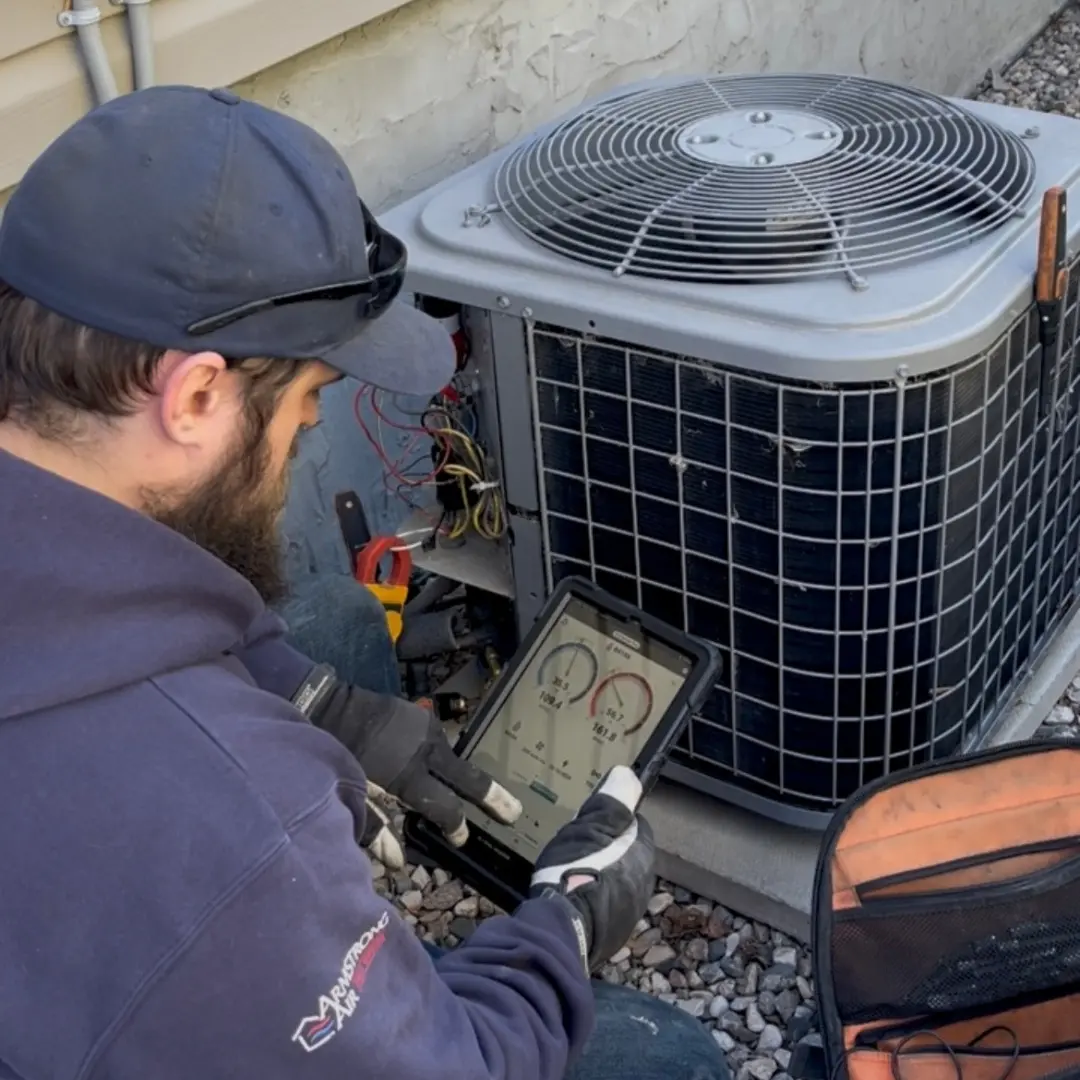
With electrical components cleared, the technician checks refrigerant pressure using calibrated gauges. This reveals whether the system is undercharged, overcharged, or has a leak, and whether the refrigerant type is R-22 or R-410A, which directly affects the repair cost conversation. Airflow is measured at the supply registers, and the evaporator coil is inspected for ice, fouling, or physical damage. The diagnostic fee at Pro Service Mechanical runs $75 to $200 depending on system complexity, and it is applied toward the repair cost if you proceed. You receive a written quote before any repair work begins. For a broader look at how air conditioning maintenance and repair fit together, our main resource page covers the full picture.
A Hudson Bay Park Repair Call: One Capacitor, One Hour, $3,200 Saved
In late July, Karen M. called from her home on Pendygrasse Road after her central AC stopped cooling overnight. The outdoor unit was humming loudly but the compressor wasn’t engaging, and the house had already climbed to 28°C inside by mid-morning. Her first instinct was that the compressor had died and she was facing a full replacement. A Pro Service Mechanical technician arrived within two hours, ran the diagnostic sequence, and found a failed run capacitor on the compressor circuit. The capacitor had swelled and lost its charge capacity, preventing the compressor from starting. The part was on the service vehicle, the swap took under an hour, and Karen’s system was cooling normally before noon. Total cost: $285. A compressor replacement on that same unit would have run roughly $1,100 to $1,400, and a full system replacement even more. The diagnostic caught the real problem first.
Why Hudson Bay Park Homeowners Trust Pro Service Mechanical for AC Repair
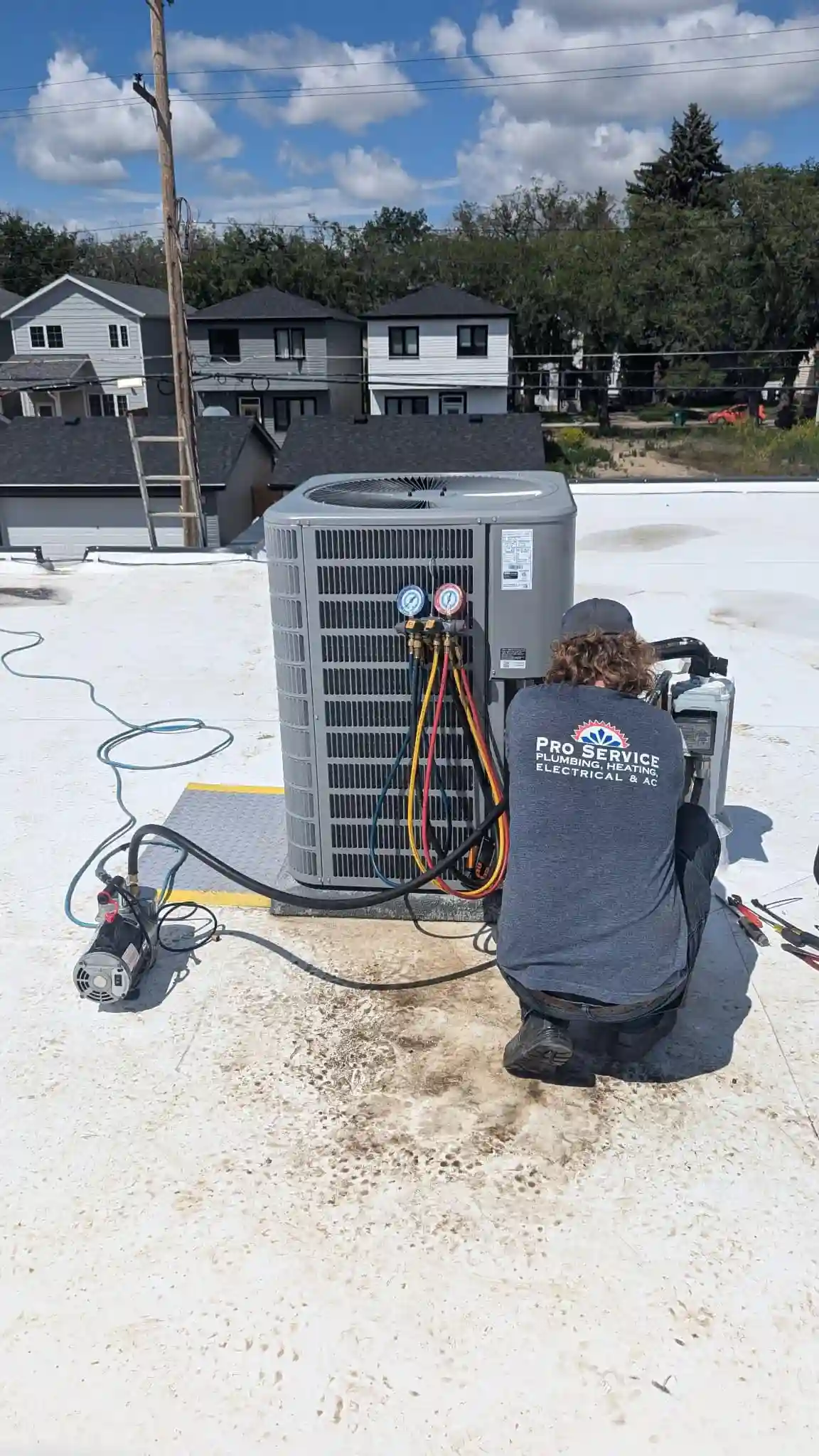
Refrigerant handling is a regulated activity in Canada, and not every technician who shows up with a set of gauges is legally certified to work with it. Pro Service Mechanical technicians hold TSASK gas fitter licences and carry refrigerant handling certification, which matters particularly for the R-22 work still required on Hudson Bay Park’s older systems. Attempting to recharge an R-22 system without proper recovery equipment is both illegal and wasteful; certified handling ensures that recovered refrigerant is reclaimed correctly and that the diagnosis accounts for the full cost picture, including whether R-22 pricing makes continued repairs worthwhile.
Same-day parts availability is a meaningful differentiator during a Saskatoon heat wave. The most common failure components for residential AC systems, including capacitors, contactors, fan motors, and common contactor kits, are stocked on service vehicles. That means a capacitor failure on Witney Avenue North doesn’t require a parts order and a second appointment; it gets fixed on the first visit. For less common components, Pro Service Mechanical’s supplier relationships allow next-day sourcing in most cases.
Transparent diagnostic fees are another reason homeowners in this neighbourhood return when problems arise. The $75 to $200 diagnostic cost is disclosed before the technician arrives, not after the work is done. If you proceed with the repair, that fee is applied to the total. If the repair cost exceeds what makes sense for your system’s age, you receive a clear explanation with no pressure. The goal of the diagnostic is to give you accurate information, not to sell the most expensive outcome.
Response times in normal summer conditions run one to two hours for Hudson Bay Park addresses. The neighbourhood’s location near Circle Drive and its proximity to central Saskatoon means routing is straightforward. During peak heat events, demand across the city increases and wait times can extend, which is why calling early in the day matters. Connecting directly at 306-230-2442 reaches a real person, not a recording, even during busy periods. Our full range of heating systems service is also available through the same line for shoulder-season issues.
The 50% Rule: AC Repair or Replace for Hudson Bay Park’s Aging Systems
The industry standard for repair-versus-replace decisions is the 50% rule: if the cost of a repair exceeds 50% of the cost of replacing the system, replacement is usually the better financial decision. A more precise version uses the formula of multiplying the system’s age in years by the estimated repair cost; if that number exceeds $5,000, replacement becomes the stronger recommendation. For a 20-year-old system facing an $800 compressor repair, the calculation (20 x $800 = $16,000) clearly points toward replacement. For a 10-year-old system needing a $200 capacitor, the calculation (10 x $200 = $2,000) points clearly toward repair.
Hudson Bay Park’s housing era produces a wide spread of outcomes. Homes where AC was retrofitted in the 1990s may have systems that are 25 to 30 years old, well past the point where major repairs make sense. Homes that had systems installed more recently, in the 2000s or 2010s, are in a different category entirely, and even significant single-component repairs like a fan motor or evaporator coil cleaning often pencil out in the homeowner’s favour.
R-22 refrigerant status is a separate overlay on this calculation. If a system requires R-22 and has a leak, the refrigerant cost alone can push a borderline repair into replacement territory. There is no way to convert an R-22 system to run R-410A without replacing the outdoor unit and often the indoor coil as well. Understanding this upfront prevents homeowners from spending $400 on a refrigerant recharge that buys one season before the same leak reappears. Our technicians explain this clearly during the diagnostic, before any refrigerant is purchased.
Even when replacement turns out to be the right answer, the diagnostic process comes first. A fair diagnosis tells you exactly what failed, what it would cost to repair, and what the system’s realistic remaining life looks like. That information lets you make a decision based on facts rather than a sales pitch. When replacement does make sense, our team will refer you to AC installation services and ensure the transition is handled properly. A Request for Service starts the process with no obligation.
Same-Day Cooling Repair When Hudson Bay Park’s Summer Heat Hits Hard
Saskatoon’s warmest stretches tend to arrive without much warning, and when the temperature jumps from 22°C to 33°C in 48 hours, AC failures that were simmering for weeks tend to surface all at once. Hudson Bay Park’s mid-century bungalows, with their original wood-frame construction and sometimes modest insulation, heat up quickly without air conditioning. Seniors residents in particular, including those near Oliver Place and St. Joseph’s Home, face real comfort and health risks when cooling fails during those stretches.
Pro Service Mechanical operates a 24/7 emergency AC repair line for exactly these situations. Calling 306-230-2442 during a heat event connects you to a real dispatcher who can schedule same-day service and provide guidance on what to do in the meantime, including whether to shut the system down to prevent compressor damage. Response times during normal summer periods run one to two hours for Hudson Bay Park addresses. During declared heat events when call volume spikes across the city, the first call of the day typically receives the shortest wait.
If you’re in a nearby neighbourhood dealing with a similar problem, Pro Service Mechanical serves the broader northwest Saskatoon area. Residents in Arbor Creek and Lakeridge can access the same same-day response. Whatever your address, reach the team at 306-230-2442 and describe your symptoms so the right parts are loaded before the technician heads your way.
Frequently Asked Questions About AC Repair in Hudson Bay Park
What does an AC repair typically cost for a mid-century home in Hudson Bay Park?
Repair costs depend entirely on which component has failed. Capacitor and contactor replacements, the most common repairs in systems of this age, typically run $150 to $350 all-in. Fan motor replacements fall in the $350 to $800 range. Refrigerant leak repairs vary significantly based on how much refrigerant has escaped and whether the system uses R-22 or R-410A. An R-22 recharge alone can cost $350 to $800 or more due to scarcity following the 2020 phaseout. Compressor repairs or replacements represent the highest end, running $800 to $1,500 or beyond. The diagnostic fee of $75 to $200 is applied toward the repair if you proceed, so you’re not paying twice for the diagnosis and the fix.
My AC system is from the late 1990s. Is it worth repairing, or should I just replace it?
A late-1990s system is approximately 25 to 30 years old, which is well beyond the typical 10-to-15-year design lifespan. Whether repair makes sense depends on what has failed and how much it will cost. The 50% rule provides a useful frame: if the repair cost exceeds 50% of replacement cost, or if multiplying the system’s age by the repair cost exceeds $5,000, replacement is usually the better financial choice. A 28-year-old system facing a $600 fan motor repair might still pencil out as a repair, but the same system facing an $800 compressor failure plus a refrigerant issue almost certainly does not. A proper diagnostic gives you the real numbers before you commit to either direction.
My older AC system uses R-22 refrigerant. What does that mean for my repair options?
R-22 was phased out in 2020 under federal regulations, and new production is no longer permitted. The only R-22 available today is recovered and reclaimed from existing systems, which has pushed the cost to roughly $100 per pound or more. If your system has a refrigerant leak and requires R-22, the recharge cost alone can run $350 to $800 depending on the charge size, before any leak repair work. There is no straightforward retrofit to convert an R-22 system to R-410A; it requires replacing the outdoor unit and often the indoor coil. For systems that are already 20-plus years old and running R-22, a refrigerant leak is often the trigger that makes replacement the more practical choice. Pro Service Mechanical technicians will identify your refrigerant type during the diagnostic and explain what repair costs look like before any refrigerant is purchased.
How quickly can Pro Service Mechanical respond to an AC emergency in Hudson Bay Park on a hot day?
During normal summer operating conditions, response times for Hudson Bay Park addresses run one to two hours from when you call. The neighbourhood’s location near Circle Drive makes routing efficient from central Saskatoon dispatch. During heat waves when multiple calls arrive simultaneously across the city, response times can extend, which is why calling early in the day significantly improves your position in the queue. The 24/7 emergency line at 306-230-2442 connects to a real dispatcher at any hour, and they can provide interim advice, including whether to shut the system down to prevent further damage while you wait. Having your thermostat model and a description of the symptoms ready when you call helps the technician load the most likely parts before arrival.
What is the most common AC failure in Hudson Bay Park’s post-war retrofitted homes?
Capacitor and contactor failures consistently top the list for systems of the age common in Hudson Bay Park. These electrical components degrade over time from repeated thermal cycling, and Saskatoon’s extreme temperature range between -40°C winters and +35°C summers accelerates that process significantly. A failed capacitor often presents as a unit that hums but won’t start, or one that trips the breaker repeatedly. The good news is that capacitor replacement is among the least expensive repairs, typically $150 to $350, and can usually be completed in a single visit with a part stocked on the service vehicle. Refrigerant leaks and fan motor failures follow closely behind in frequency, and all three failure types are diagnosable in a single service call.