
Expert electrical solutions designed to keep your business running.
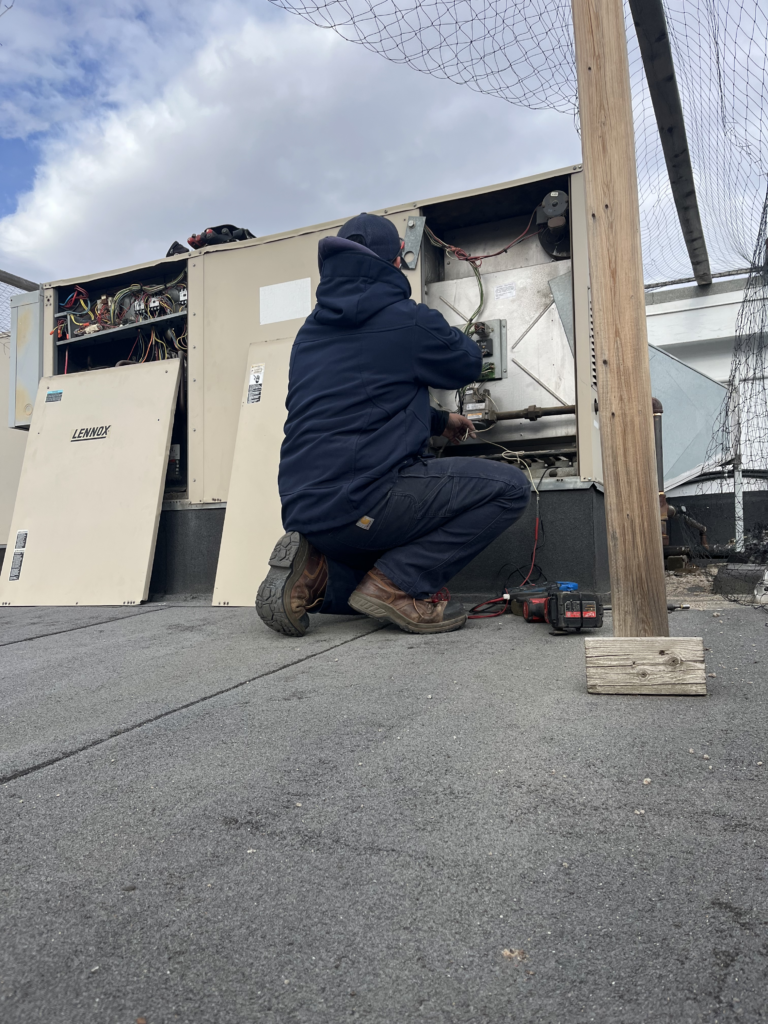
A well-functioning electrical system is critical for any business, ensuring smooth daily operations, safety, and energy efficiency. At Pro Service Mechanical, we specialize in providing top-quality commercial electrical services, from routine maintenance to complex installations. Our experienced electricians work with offices, retail spaces, restaurants, warehouses, and other commercial facilities to deliver safe and energy-efficient electrical solutions tailored to your needs.
Custom solutions for new builds and renovations.
Prevent downtime with expert troubleshooting and service.
Electrical issues in a commercial space can lead to costly downtime, safety hazards, and lost productivity. Our team at Pro Service Mechanical provides fast, reliable electrical services to ensure your business stays powered and protected. Whether you need new wiring, system upgrades, or emergency repairs, we have the expertise to get the job done right.
At Pro Service Mechanical, we understand that your business depends on a reliable electrical system. Our commercial electrical services are designed to minimize downtime, improve energy efficiency, and ensure safety across all operations. Whether you’re planning an expansion, upgrading existing systems, or need emergency electrical repairs, our skilled electricians are ready to assist. Contact us today to discuss your commercial electrical needs!
Our licensed professionals have years of experience in HVAC, plumbing, and electrical services, ensuring top-tier workmanship every time.
We’re here when you need us most. Our emergency response team is ready around the clock to handle urgent repairs and restore comfort fast.
We stand behind our work with industry-leading warranties and a commitment to customer satisfaction. Your comfort is our priority.
Pro Service Mechanical provides electrical services in Saskatoon across a wide range of commercial occupancies, including offices, retail strips, restaurants, dental and medical clinics, warehouses, multi-tenant plazas, agricultural operations, and light manufacturing facilities. Each building type carries its own load profile, code obligations, and scheduling constraints. A restaurant build-out demands dedicated circuits for commercial kitchen equipment, exhaust fans, and walk-in coolers sized to CEC Section 28 motor and appliance requirements. A dental or medical clinic requires isolated circuits for imaging equipment and procedure rooms. A warehouse with multiple tenants needs clear sub-metering, properly labelled distribution panels, and feeder capacity that can absorb new tenants without triggering an emergency service upgrade. Understanding those differences before the first circuit is pulled is what separates a contractor who protects your uptime from one who creates problems mid-tenancy.
Tenant improvements are among the most common requests we handle for Saskatoon property managers. When a new tenant moves into a retail bay or office suite, the existing electrical often needs to be reconfigured: new circuits for signage and point-of-sale systems, dedicated feeds for HVAC equipment, and lighting layouts that meet current Canadian Electrical Code requirements. Every alteration that adds load, modifies wiring, or changes the occupancy classification requires a TSASK electrical permit, and work must pass both rough-in and final inspection before it can be concealed or energised. Coordinating that permit sequence with your construction timeline is part of the service, not an afterthought.
Commercial lighting upgrades consistently deliver measurable returns for Saskatoon building owners. Converting T12 fluorescent or metal halide fixtures to LED in offices, parkades, and warehouses reduces energy consumption, cuts lamp replacement labour, and improves light quality for tenants. SaskPower has periodically offered commercial energy efficiency incentives for qualifying LED retrofit projects, which can offset a meaningful portion of project cost. Beyond the energy savings, updated lighting with occupancy sensors and daylight controls supports lease renewal conversations and helps position older buildings competitively against newer inventory on the east side of the city.
Commercial electrical panel upgrades become necessary when tenant loads grow beyond what the original distribution was designed to carry, or when gear reaches an age where parts are no longer available and thermal imaging starts showing hot spots. In Saskatoon's older west-side commercial stock, it is not uncommon to find split-bus panels or undersized feeder conductors that cannot safely support a modern tenant mix. Panel work at the commercial level involves a load calculation per CEC Section 8, coordination with SaskPower for any service-side changes, and a phased outage plan that minimises the window during which tenants are without power. For buildings served by Saskatoon Light and Power rather than SaskPower directly, the process follows SL&P's service request and inspection sequence, which includes a TSASK meter socket inspection before re-energisation.
Unplanned electrical outages are one of the fastest ways to turn a tenant complaint into a lease dispute. A documented preventative maintenance programme is the most reliable way to find deteriorating terminations, overloaded circuits, and failing emergency systems before they become closures. A typical annual programme for a Saskatoon multi-tenant plaza includes thermal imaging of main distribution gear, torque checks on lugs and bus connections, breaker exercise, emergency and exit light testing, and a written deficiency report you can share with your insurer or include in your building audit file. For properties where insurance renewal now requires evidence of electrical maintenance, that report is not optional.
Electrical repairs and maintenance on a scheduled basis also address the specific stresses that Saskatoon's prairie climate places on commercial electrical systems. Winter cold snaps that push SaskPower grid demand past 3,500 MW create voltage fluctuations that stress older switchgear. Summer thunderstorms generate switching surges and repeated recloser operations that are hard on POS systems, refrigeration controls, and building automation equipment. Vehicle collisions with poles along arterials like Circle Drive and Idylwyld produce instantaneous surge events on the downstream feeder. A whole-building surge protective device installed at the main service, combined with point-of-use protection for sensitive equipment, is a straightforward line of defence against those events and a reasonable expectation for any property carrying significant tenant electronics or medical equipment.
Commercial backup generators and emergency power systems are relevant for any Saskatoon facility where even a short outage has significant financial or safety consequences: restaurants with large refrigeration loads, medical clinics with imaging equipment, data-dependent operations, and care facilities with life-safety requirements. Installation involves a load analysis to identify critical circuits, selection of an appropriately sized generator, installation of a transfer switch that prevents backfeed onto SaskPower lines, and wiring of a separated emergency panel. TSASK inspection is required before the system can be commissioned, and the grounding of separately derived systems must comply with CEC Section 10. Automatic transfer switches that bring the generator online within seconds of a utility fault offer the highest level of uptime protection, and are worth the incremental cost for operations where even a brief interruption causes tenant disruption or product loss.
After-hours and weekend scheduling is not a premium add-on for Pro Service Mechanical; it is a standard part of commercial service delivery. Panel changeouts, feeder tie-ins, and outage-dependent work are regularly scheduled for late evenings and weekends so that tenants remain operational during business hours. Written outage windows, advance tenant notification, and temporary power where feasible are all part of how disruptive work gets completed without generating complaints. Under Saskatchewan OH&S regulations, lockout and tagout procedures are followed on every job involving de-energised equipment, and the site is secured against unauthorised access during after-hours work.
General contractors and developers working on Saskatoon commercial and multi-tenant projects benefit from an electrical partner who understands the full permit and inspection sequence. Commercial electrical construction requires coordination between the rough-in schedule, insulation and drywall trades, TSASK inspection availability, and SaskPower's service connection timeline. For new commercial services or upgrades, SaskPower's design and construction process typically runs four to eight weeks from application for straightforward urban projects, and longer if transformer or secondary conductor upgrades are required on their side. Submitting the service request early and keeping the application current as the design evolves prevents the utility timeline from becoming the critical path on your project schedule.
Network and computer cabling is frequently scoped alongside electrical rough-in on tenant improvement projects, particularly for office, medical, and retail fit-outs where data infrastructure and power need to be planned together. Running structured cabling and electrical conduit in the same mobilisation reduces ceiling disruption, avoids redundant access work, and gives the tenant a complete, documented low-voltage infrastructure from day one. For property managers, having a single contractor accountable for both the power and data pathways simplifies deficiency resolution and keeps the project close rate cleaner at handover.
Industrial electrician services extend the scope of what Pro Service Mechanical can deliver for Saskatoon facilities with three-phase distribution, motor controls, variable frequency drives, or higher-fault-level environments. Agricultural operations near Warman and Martensville, food processing facilities, and fabrication shops all require electricians who are comfortable working within arc-flash boundaries, following OH&S-compliant lockout procedures, and coordinating with SaskPower's industrial connection standards. Shutdown work is planned in advance with the facility manager so that maintenance windows are used efficiently and production downtime is kept to a minimum.
Property managers who want a documented service relationship for audit and lease renewal purposes can work with Pro Service Mechanical on a standing service agreement that covers scheduled maintenance visits, priority response for after-hours faults, and consistent invoicing structured to align with your CAM allocation. Detailed service reports, permit documentation, updated panel schedules, and as-built records are provided as a matter of course so that your building file is current whenever an insurer, lender, or prospective tenant's engineer asks for it. To discuss a maintenance programme or request a site assessment, contact our team at Request for Service or call (306) 230-2442.
Yes, after-hours and weekend scheduling is a standard part of commercial electrical work in Saskatoon, where panel changes, feeder tie-ins, and outage-dependent work are routinely done in the evening or overnight to protect tenant operations. Regular daytime labour runs approximately $110,$140 per hour for a journeyperson, while after-hours rates are typically $130,$170 per hour on weeknights and $150,$190 per hour on Sundays and statutory holidays, with materials and any lift or access equipment billed separately. Many Saskatoon property managers schedule disruptive work between 9:00 p.m. and 6:00 a.m. or on Sunday mornings to avoid impacting restaurants, clinics, and retail tenants. Saskatchewan OH&S regulations require proper lockout/tagout and controlled access regardless of time of day, and written outage notices to affected tenants are strongly recommended to protect your lease relationships. Our electrical services in Saskatoon include fully coordinated after-hours scheduling for commercial properties of all sizes.
For a commercial emergency in Saskatoon, a realistic on-site response window is one to four hours depending on time of day, weather, and road conditions, with after-hours emergency call-out fees typically ranging from $250 to $400 for the initial response, followed by $150 to $190 per hour for labour plus materials. If there is smoke, arcing, or a burning odour, call 9-1-1 first; once the area is declared safe, an electrician can investigate and repair. It is important to distinguish between a customer-side fault, which your electrician handles, and a SaskPower or Saskatoon Light and Power fault on the utility's infrastructure, such as a failed transformer, damaged service drop, or meter-side issue, which requires contacting SaskPower's outage and emergencies line directly. For complex faults such as a failed main breaker or damaged bus, expect costs of $1,500 to $5,000 or more depending on parts and labour time. You can reach us any time through our 24/7 emergency electrician in Saskatoon line.
In Saskatchewan, commercial electrical installations must comply with the Canadian Electrical Code (CEC) as adopted and enforced by TSASK, the province's electrical inspection authority, and any work that adds load, alters wiring, or changes occupancy typically requires a TSASK permit and inspection before it is legally defensible. Insurers and fire inspectors commonly look for clear working space in front of panels and disconnects, accurate and legible circuit directories, functioning emergency and exit lighting, GFCI protection where required by the CEC, and no evidence of permanent extension cords or overloaded circuits. A documented electrical inspection by a licensed commercial electrician, including a written deficiency list categorised by urgency, is the most effective way to demonstrate due diligence to your broker or risk manager. Items that represent an immediate life-safety risk under the CEC, such as exposed live conductors, failed emergency lighting, or severely overloaded circuits, must be corrected without delay to remain insurable. Our team can provide a formal assessment and the documentation you need; visit our electrical repairs and maintenance page to learn more.
In Saskatchewan, electrical permits for commercial work are pulled by the licensed electrical contractor performing the installation, and TSASK is the authority having jurisdiction for electrical inspections across Saskatoon and the rest of the province. A permit is required for any new installation, alteration, or replacement that involves adding circuits, changing load, installing or replacing panels, upgrading a service, or modifying feeder runs; simple like-for-like device replacements such as a single outlet or light fixture typically do not require a permit, but the work must still comply with the CEC. For tenant improvements, service upgrades, or change-of-use projects, a building permit from the City of Saskatoon Building Standards may also be required in addition to the TSASK electrical permit. Your contractor should confirm in writing whether permits are included in the scope and provide you with permit numbers and inspection sign-off documentation upon completion, which you will need for insurance records and future lease audits. We always include permit coordination as part of our commercial electrical construction process.
A commercial preventative maintenance program for a Saskatoon property typically includes an annual or biannual inspection of all panels and disconnects, thermal imaging to identify hot spots at terminations and bus connections, breaker exercise and torque checks on lugs, testing of all emergency lighting and exit sign battery packs, a review of circuit labelling, and a written deficiency report with items ranked by urgency. For a small single-tenant building or plaza bay with one or two panels, budget approximately $800 to $2,000 per annual visit; for a multi-tenant strip mall or office building with several panels, rooftop units, and common-area systems, expect $2,000 to $6,000 or more depending on site complexity. Saskatoon's climate, with its large temperature swings between -40°C winters and hot summers, accelerates the loosening of electrical terminations and drives moisture into outdoor equipment, making pre-winter and pre-summer checks particularly valuable. Many insurers now ask for evidence of regular electrical maintenance on commercial properties, especially those with older electrical infrastructure or high-occupancy uses such as restaurants and medical clinics. See our electrical repairs and maintenance services for program details.
Most commercial electrical work in Saskatoon can be invoiced with the level of detail your lease and property management structure requires, including separate work orders per suite, labour and materials tagged to individual tenant spaces, and a clear split between landlord-responsible common-area work and tenant-chargeable improvements. Standard commercial labour rates run approximately $110 to $140 per hour during regular hours and $150 to $190 per hour after-hours, with materials, permit fees, and any lift or access equipment itemised separately so you can allocate costs accurately. Detailed line-item descriptions on invoices, such as "Unit 104 - new 20A dedicated circuit for espresso equipment," make it straightforward to recover costs under the lease and reduce the likelihood of tenant disputes. For larger multi-tenant projects, we can structure progress billing tied to project milestones to help you manage cash flow and avoid budget surprises. A Request for Service is the best starting point to discuss a billing structure that fits your property management workflow.
Industry-standard warranty on commercial electrical work in Saskatoon is one year on labour and the manufacturer's warranty on materials, which typically ranges from one to five years on components such as breakers, panels, and LED drivers, and can be longer on certain LED fixtures. Larger tenant improvement projects or base-building upgrades are sometimes negotiated to a two-year labour warranty when specified in the contract. Warranty coverage generally applies to defects in workmanship and materials under normal operating conditions, and does not extend to damage caused by overloading circuits beyond their designed capacity, lack of routine maintenance, physical damage, or SaskPower-side events such as voltage surges or service interruptions, unless surge protection was included in the project scope. To keep warranty claims straightforward, ask your contractor to provide as-built panel schedules, updated circuit directories, and manufacturer documentation for any installed equipment at project close-out. This documentation also protects you during insurance renewals and when new tenants commission their own engineering reviews of the space.
Repeated nuisance tripping, warm or buzzing panels, discoloured breakers, or a panel that is more than 25 to 30 years old are all signals that warrant a professional assessment before the next busy season rather than waiting for a failure that could close your business for a day. In Saskatoon's commercial stock, older panelboards in strip malls and office buildings built in the 1980s and 1990s are increasingly reaching the end of their service life, and replacement parts for some obsolete brands are no longer available. A straightforward commercial panel replacement in the 100 to 225A range typically costs $3,000 to $7,000 including permits, labour, and updated labelling; if a main service upgrade is also required, costs can reach $15,000 to $50,000 or more depending on service size and SaskPower coordination requirements. TSASK requires a permit and inspection for panel replacements, and the work generally needs to be done during a planned outage coordinated in advance with your tenants. Our commercial electrical panel upgrades page covers what the assessment and replacement process looks like from start to finish.