
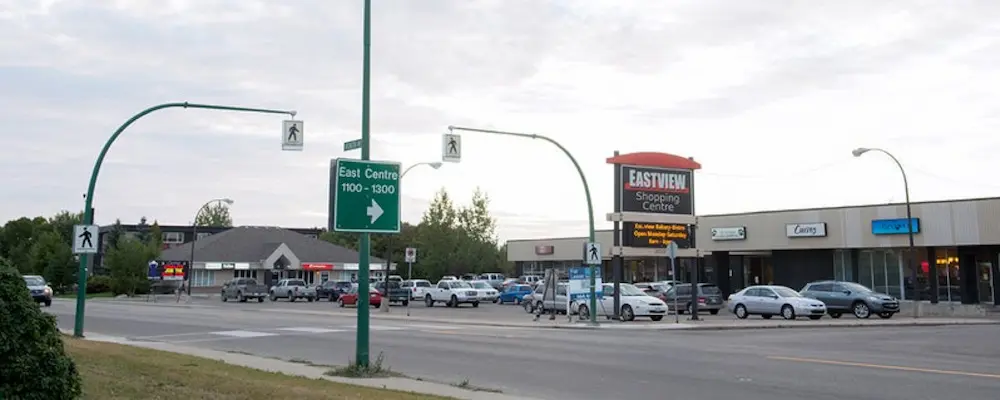
When the temperature climbs past 30°C on Arlington Avenue and your central air conditioner suddenly stops cooling, the afternoon becomes uncomfortable fast. Eastview is a south-central Saskatoon neighbourhood where most homes were built between 1991 and 2000, meaning the original AC systems installed during those construction years are now anywhere from 25 to 35 years old. Many are at or well past the point where components start failing under the stress of a Saskatchewan summer, and a breakdown on the hottest day of July is not a coincidence. It is exactly when aging capacitors, corroded contactors, and refrigerant leaks announce themselves.
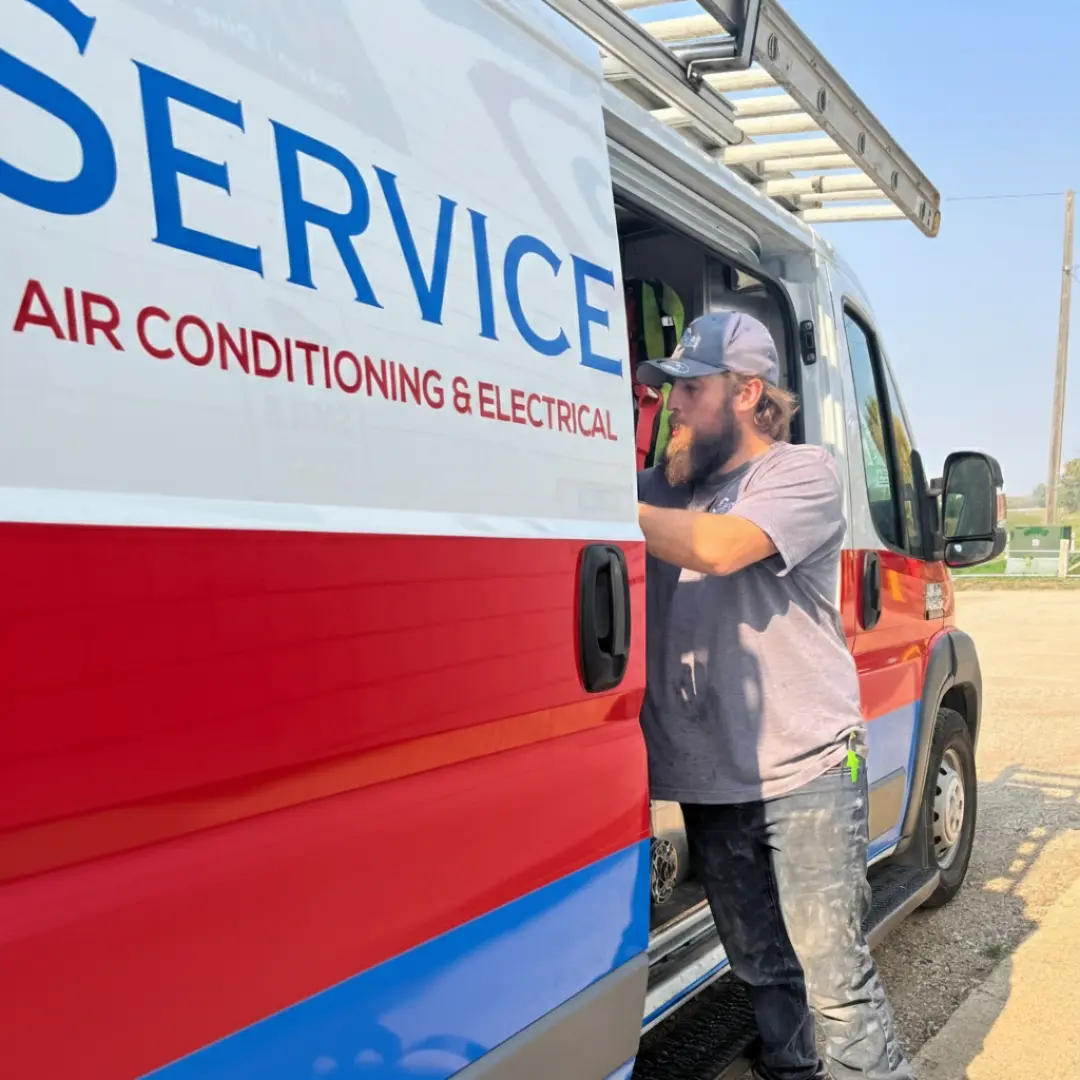
The neighbourhood sits just off Preston Avenue, surrounded by parks including Kistikan Park and James Anderson Park, and anchored by schools like John Dolan School on Arlington Avenue. On a sweltering afternoon when the kids are home from Pope John Paul II School and the house is full, a failed AC unit is not a minor inconvenience. It is an urgent problem that needs a trained technician today, not next week. Pro Service Mechanical responds to Eastview repair calls the same day, with the parts to fix the most common failures on the first visit.
Eastview’s Air Conditioners: How Much Time Is Left?
Homes built in Eastview during the 1990s were typically outfitted with 13 SEER central air conditioning systems, most of which have now been running through two to three decades of Saskatoon summers. The signs that a system is approaching a failure are often subtle at first, but they escalate quickly once July heat sets in. Warm air blowing from the vents when the thermostat is set to cool is the most obvious indicator, but it rarely appears without warning. Before full cooling loss, most homeowners notice the system running longer cycles without reaching the set temperature, or catching a faintly musty odour from the vents.
Weak airflow from the registers is another warning sign that is easy to dismiss. In Eastview homes where ductwork was sized for a 1990s build, restricted airflow often points to a clogged evaporator coil or a failing blower motor rather than a simple filter issue. Ice forming on the refrigerant lines or on the indoor coil is a related symptom. When airflow is blocked, the coil temperature drops below freezing, condensate freezes on the fins, and cooling stops entirely. Shutting the system off and letting it thaw is not a repair; it is a delay while the underlying cause worsens.
Strange noises from the outdoor condenser unit deserve immediate attention. A loud humming sound with no compressor activity typically points to a failed contactor, while a grinding or squealing noise from the fan motor indicates worn bearings from years of thermal cycling. Rattling can mean debris has entered the cabinet, which is common in Eastview given cottonwood season in late spring and the general prairie dust load that accumulates on condenser fins throughout the summer. Frequent tripped breakers on the AC circuit are also a red flag, particularly in older Eastview properties where the electrical panel may not have been updated alongside the mechanical equipment.
Higher-than-usual electricity bills without a corresponding change in usage habits are a quieter symptom. When a system struggles because of low refrigerant, a failing capacitor, or a dirty condenser coil, it draws more power to compensate. By the time the utility bill reflects the inefficiency, the component in question has usually been degrading for weeks. Contacting AC repair services at the first sign of any of these symptoms gives a technician the chance to fix a single inexpensive component before it causes cascading damage to the compressor.
Component Failures in Eastview’s 1990s-Era Cooling Systems
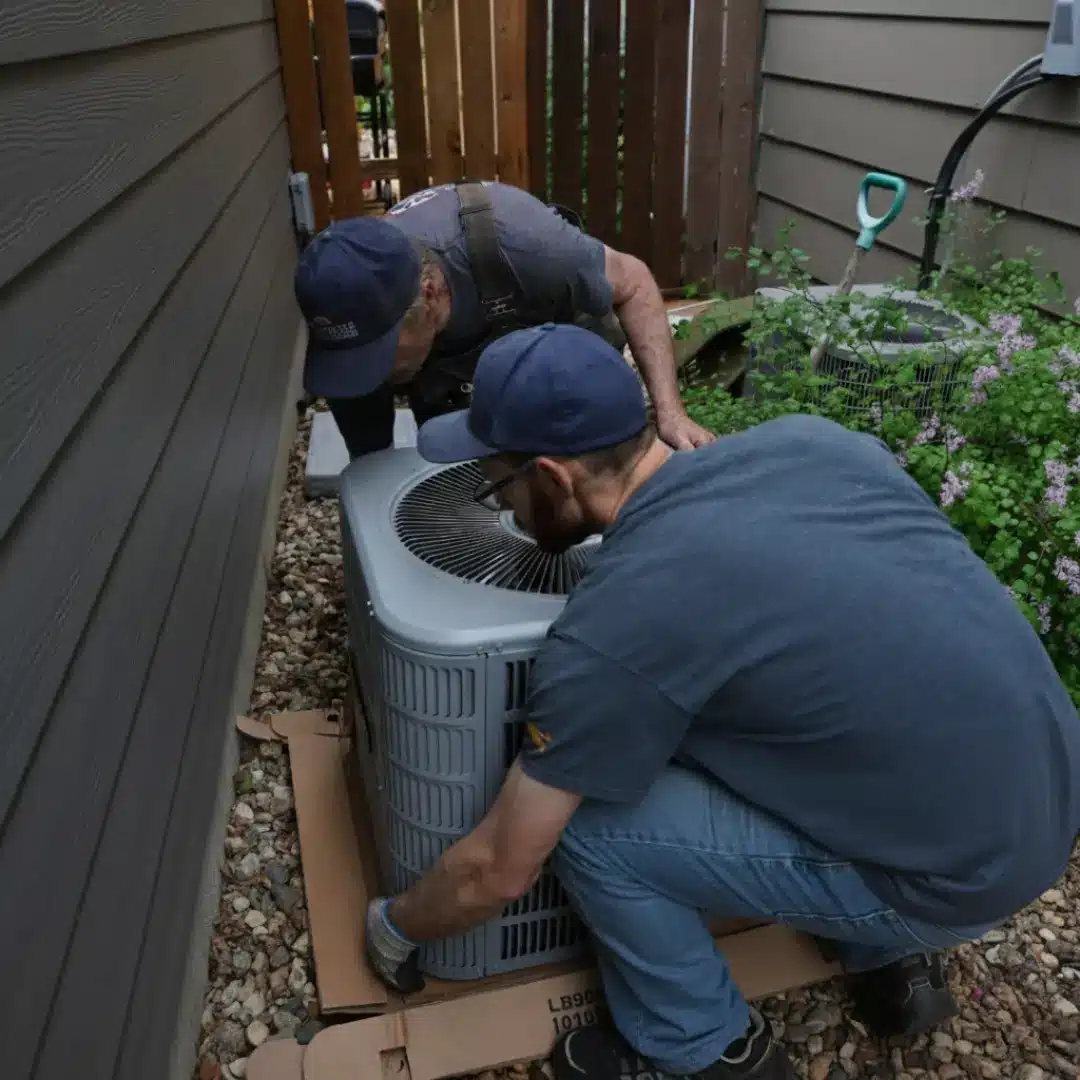
The most frequent failure in Eastview’s aging central air conditioners is the dual-run capacitor. This component, responsible for starting and running both the compressor and fan motor, degrades rapidly under the conditions Saskatoon produces. Daily temperature swings of 18°C or more during the summer, combined with thunderstorm voltage spikes and the deep cold of winter storage, cause the dielectric material inside the capacitor to bulge and eventually rupture. Replacement parts typically cost between $190 and $310 all-in, making this the most cost-effective repair a homeowner can authorize. It is also the failure that most commonly masquerades as a dead compressor, so getting an accurate diagnosis before authorizing expensive parts matters enormously.
Dirty condenser coils rank a close second. Eastview sits in a part of Saskatoon where cottonwood fluff in late May and June coats outdoor condenser fins like insulation, blocking the airflow the unit needs to reject heat. Combine that with the prairie dust load carried on dry July winds and many units are operating at severely reduced efficiency by midsummer. A choked condenser overheats the compressor, accelerating wear on the most expensive component in the system. Professional coil cleaning during a diagnostic visit often restores cooling performance without any parts replacement at all.
Refrigerant leaks are the third most common failure category. In systems installed during the 1990s, the brazed copper joints in the refrigerant circuit have experienced hundreds of thermal expansion and contraction cycles over decades of Saskatoon winters and summers. Hairline cracks develop at joints and at evaporator coil connections where acidic condensate concentrates. The result is a slow loss of charge that causes the system to underperform gradually before stopping entirely. For any Eastview system still operating on R-22, the refrigerant phased out of production in 2020, a leak diagnosis carries serious financial weight. Reclaimed R-22 now trades at five to ten times the cost of R-410A, and recharging a leaking R-22 system without repairing the leak first is throwing money into a failing machine. In most cases where an R-22 system has a confirmed refrigerant leak, the repair-vs-replace calculation tips decisively toward replacement.
Contactor burnout is a failure specific to Saskatoon’s thunderstorm season. The contactor is an electrical relay that closes the circuit to the compressor when the thermostat calls for cooling. Voltage spikes from prairie thunderstorms pit the contact surfaces over time, and eventually the relay hums without completing the circuit. The outdoor unit sounds like it wants to start but the compressor never engages. Contactor replacement is straightforward and falls in the $190 to $310 cost range alongside capacitor work.
Compressor failures and evaporator coil replacements sit at the expensive end of the repair spectrum. Compressors that have been subjected to years of low refrigerant operation, overheating from dirty coils, or repeated hard starts due to a failing capacitor will eventually seize or lose compression. Evaporator coil replacement becomes necessary when pinhole corrosion causes irreparable refrigerant loss. Both repairs are significant investments on 25 to 30-year-old equipment, and either one typically triggers the 50% rule discussion covered later on this page. For current guidance on whether your specific system warrants repair or retirement, Request for Service and our technicians will give you an honest assessment before recommending any parts.
How Pro Service Mechanical Diagnoses an Eastview AC Problem
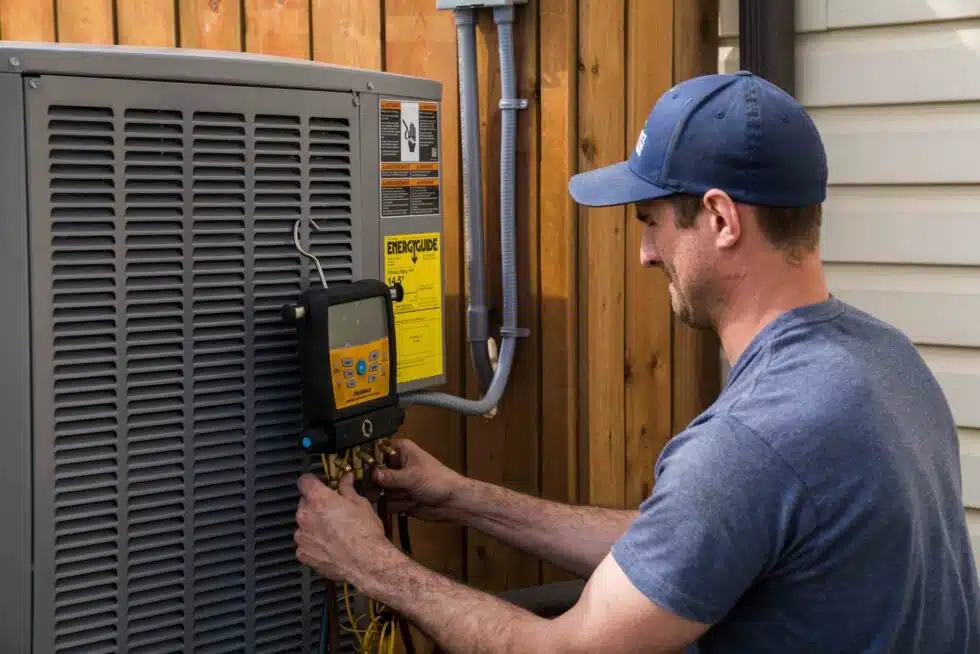
When a Pro Service Mechanical technician arrives at an Eastview home for a repair call, the diagnostic process follows a deliberate sequence designed to identify the root cause rather than just the presenting symptom. The technician starts at the thermostat and electrical panel, confirming power to the unit and ruling out a tripped breaker or blown fuse before touching the mechanical equipment. From there, the outdoor condenser is inspected for debris, coil condition, and capacitor status using a capacitance meter. Refrigerant pressure readings are taken with calibrated gauges to determine charge level and identify leak patterns. The contactor is tested under load, fan motor amperage is measured, and the evaporator coil and drain pan are inspected indoors for ice, corrosion, or standing water.
The diagnostic fee for an Eastview service call runs between $75 and $200 depending on system complexity, and that fee is communicated clearly before work begins. There are no surprise charges for opening the unit or running preliminary tests. Once the fault is identified, the technician presents the repair cost and timeline before any parts are ordered or installed. Pro Service Mechanical carries the most common replacement components, including capacitors, contactors, fan motors, and control boards, on the service vehicle, which means same-day repairs are the norm rather than the exception for these high-frequency failures.
From East Drive: A Same-Day Capacitor Repair in Eastview
Sandra K. called Pro Service Mechanical on a Thursday afternoon in late July after her central air conditioner stopped cooling entirely. She had noticed the outdoor unit humming loudly the night before but assumed it would sort itself out overnight. By the next morning, the house was already 27°C inside and climbing. A technician arrived within the hour and found a failed dual-run capacitor, a very common failure in 1990s-era systems during the height of summer heat. The capacitor had ruptured from dielectric breakdown after years of thermal cycling. The part was on the truck, the replacement took under 45 minutes, and the system was running properly before noon. Sandra’s compressor was intact, her refrigerant charge was normal, and the repair cost her a fraction of what a new system would have. “I thought the whole thing was done,” she said. “Turns out it was a part the size of a soup can.”
Why Eastview Homeowners Rely on Pro Service Mechanical for Cooling Repairs
Pro Service Mechanical holds TSASK gas fitter licensing and refrigerant handling certification, which are legal requirements for anyone working on AC systems in Saskatchewan. These are not optional credentials. A technician without refrigerant certification cannot legally recover, recycle, or recharge refrigerant under Canadian Environmental Protection regulations. When you call an uncertified contractor, you risk illegal venting of refrigerants, inaccurate charge levels, and voided equipment warranties. Every technician dispatched to Eastview carries current certification and works to the standards required by the Technical Safety Authority of Saskatchewan.
Transparent diagnostic pricing matters in a neighbourhood where most AC systems are approaching end-of-life age. Homeowners on Preston Avenue or Woodward Avenue deserve to know what a diagnosis costs before anyone opens the equipment, and they deserve an honest answer about whether a repair is worth authorising. Pro Service Mechanical’s diagnostic fees of $75 to $200 are quoted upfront, and the technician’s recommendation is based on the actual condition of the equipment, not on the margin available on a replacement sale. That kind of straightforward conversation is the foundation of every service call we run in this neighbourhood.
Parts availability is a meaningful differentiator during peak summer demand. When outdoor temperatures sit above 30°C for three consecutive days, every HVAC company in Saskatoon is busy. Pro Service Mechanical stocks the components that fail most often in 1990s-era systems, including dual-run capacitors, contactors, fan motors, and blower control boards, on the service vehicles serving Eastview. A repair call that turns into a parts-ordering delay in mid-July is a two-day wait in a hot house. Having the right inventory on the truck is not a small thing when that call comes in on a Friday afternoon.
For homeowners who want to stay ahead of summer failures, the best time to service your AC is late spring before the heat arrives and the repair queue fills up. A pre-season inspection catches capacitors that are measuring low, contactors that are pitted but still functional, and refrigerant charges that have slowly drifted down over winter. It is always cheaper to address these issues in May than in July. For everything beyond the AC itself, Pro Service Mechanical also handles heating systems and air conditioning maintenance across Eastview year-round.
Applying the 50% Rule to Eastview Air Conditioner Repair Decisions
The 50% rule is the most practical framework for deciding whether to repair or replace an aging AC system. The principle is straightforward: if the cost of a repair exceeds 50% of the current value of the equipment, replacement is the financially rational choice. A more actionable version uses the formula: system age multiplied by repair cost. If that number exceeds $5,000, replacement typically makes more sense than extending the life of a failing machine. For an Eastview system installed in 1997 that is now 27 years old, even a $200 repair produces a score of $5,400, which puts it right at the boundary of the decision point.
Context matters as much as the formula. A single capacitor failure on a system that has otherwise been well-maintained is a different situation than a compressor failure on a unit that also has a refrigerant leak, a corroded evaporator coil, and a contactor that was replaced two summers ago. Multiple failures in a single season are a reliable signal that a system has reached the end of its economic life. Saskatoon’s climate accelerates that timeline by 20 to 30% compared to milder markets; the extreme thermal cycling from -40°C winters to +35°C summers stresses every electrical and mechanical component in ways that coastal or temperate-climate systems never experience.
R-22 refrigerant is a deciding factor that overrides the 50% calculation in many Eastview cases. If a system manufactured before 2010 has a confirmed refrigerant leak and is operating on R-22, the cost of reclaimed refrigerant alone, five to ten times the price of R-410A, often makes repair uneconomic regardless of what the formula says. In that scenario, a technician’s honest recommendation is to move toward AC installation services rather than pour money into a system running on a phased-out refrigerant with a compromised circuit. The page linked here covers what that replacement process looks like.
Even when the numbers clearly favour replacement, the right sequence is still a diagnostic visit first. An accurate fault diagnosis tells you exactly what has failed and what it would cost to fix, giving you real numbers to apply to the 50% rule rather than estimates. Pro Service Mechanical does not assume a system needs replacement before running the diagnostic. If a repair makes sense, we say so and do it the same day. If replacement is the better path, we explain why with data in hand, not assumptions.
Same-Day AC Emergency Repair When Eastview Gets Hot
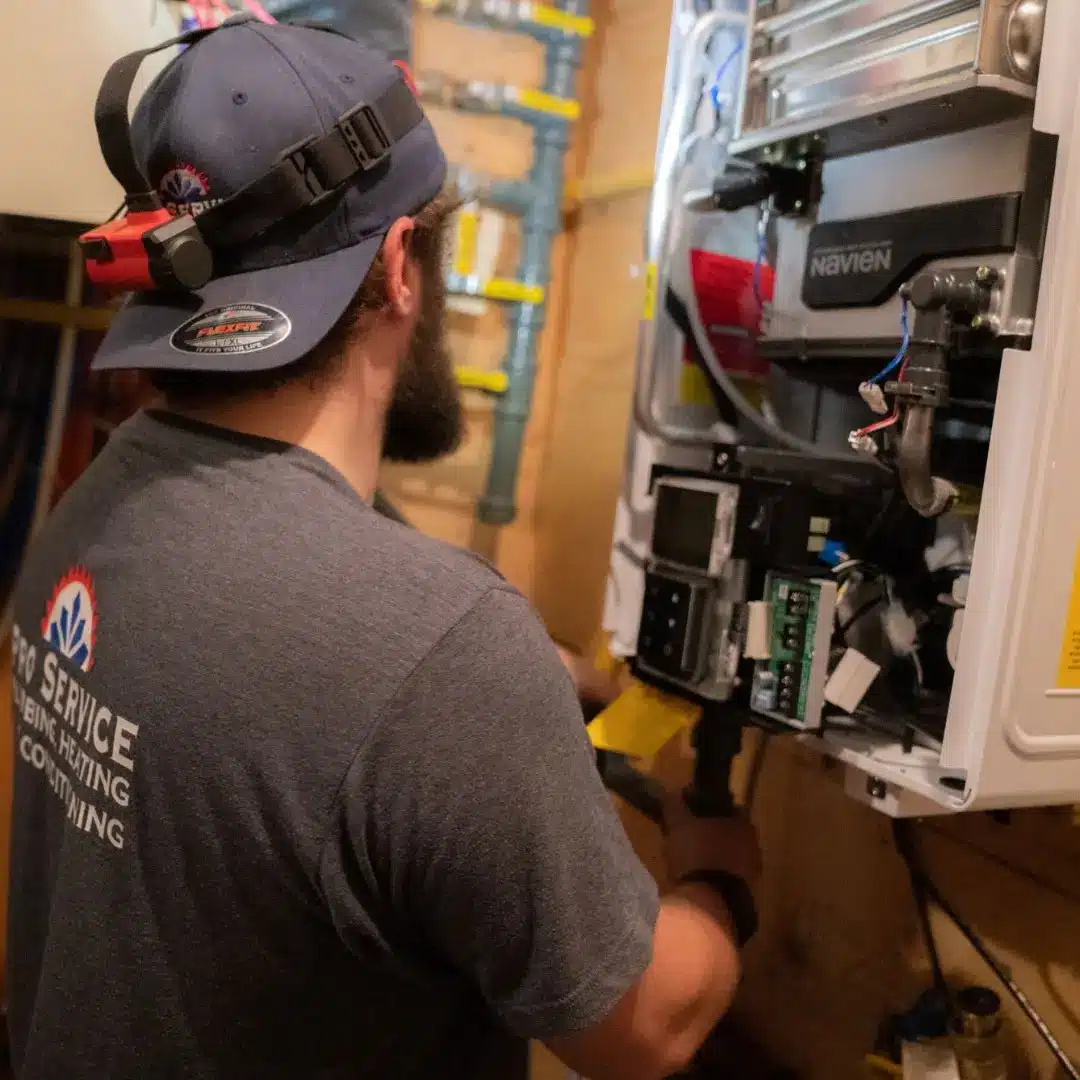
Saskatoon’s summer heat waves do not arrive gradually. A week of temperatures above 30°C can follow two weeks of mild weather, and the demand surge on HVAC companies when that happens is immediate. During peak heat conditions, Pro Service Mechanical prioritises emergency calls from homes with elderly residents, young children, and households without any alternative cooling. If your AC has stopped completely on a hot afternoon, calling 306-230-2442 connects you to a real person who can schedule same-day service. During normal summer conditions, response time in Eastview is typically one to two hours. During extended heat waves, that window may stretch, but emergency calls are triaged and dispatched ahead of routine maintenance appointments.
The emergency AC repair line at 306-230-2442 operates around the clock. A failed AC at 11:00 p.m. when the house is 30°C inside is an emergency, and it is treated as one. Technicians carry the most common repair parts for 1990s-era systems on every call, which means a capacitor or contactor failure found on an evening visit gets fixed that night rather than the following morning. The diagnostic fee structure applies equally to after-hours calls, and any additional emergency surcharge is communicated before dispatch, not after.
Eastview neighbours in nearby communities face the same summer repair pressures. If you have family or neighbours in Forest Grove, Lakeview, or Lakeridge, Pro Service Mechanical serves all of these areas with the same same-day response commitment. For planned service visits outside of an emergency, booking early in the season is the best way to secure a preferred time slot before the July rush fills the schedule.
Frequently Asked Questions About AC Repair in Eastview
How much does an AC repair typically cost in Eastview?
The cost depends entirely on which component has failed. Capacitor and contactor replacements, the two most common failures in 1990s-era Eastview systems, typically run between $190 and $310 all-in including parts and labour. Refrigerant leak repairs and recharges are more expensive, particularly if the system uses R-22, where reclaimed refrigerant costs five to ten times more than R-410A. Fan motor replacements fall in the mid-range, while compressor replacements on older systems can exceed $1,500 and often trigger the replacement discussion. The diagnostic fee of $75 to $200 is charged before any repair work begins, and the technician will give you a written quote before touching any parts.
Is it worth repairing an AC system that is 25 or 30 years old?
It depends on what has failed and what the repair will cost relative to the system’s remaining value. The 50% rule provides a practical guide: if the repair cost multiplied by the system’s age exceeds $5,000, replacement is generally the better financial decision. A single capacitor swap on an otherwise healthy 28-year-old system might still be worth doing. A compressor replacement on the same system, especially if refrigerant leaks or coil corrosion are also present, almost certainly is not. The key is getting an accurate diagnostic first so the repair-vs-replace calculation is based on real numbers rather than guesses. Pro Service Mechanical provides honest recommendations either way.
My Eastview home was built in the 1990s. Is my AC likely running on R-22?
If the AC system in your home was installed during the original 1990s construction and has never been replaced, there is a significant chance it is still operating on R-22, the refrigerant that was phased out of production in Canada in 2020. Systems manufactured before roughly 2010 were commonly charged with R-22. You can check the data plate on the outdoor condenser unit, which lists the refrigerant type. If it reads R-22 and you have a confirmed refrigerant leak, repair costs become very high very quickly because only reclaimed R-22 is legally available now, and it trades at a significant premium. In most cases, an R-22 system with an active leak is a strong candidate for full replacement rather than repair.
What is the most common AC failure in 1990s Eastview homes?
Dual-run capacitor failure is the most frequent repair call in this era of Saskatoon homes. The capacitor handles starting and running both the compressor and the outdoor fan motor, and its internal dielectric material degrades under the conditions Eastview systems face: extreme cold in winter storage, heat above 35°C in summer operation, and significant daily temperature swings that cause repeated thermal expansion and contraction. Dirty condenser coils blocked by cottonwood fluff and prairie dust run a close second, followed by refrigerant leaks from aging brazed joints and contactor burnout from thunderstorm voltage spikes. The good news is that capacitor and contactor replacements are among the most affordable repairs in the HVAC service catalogue.
How fast can Pro Service Mechanical respond to an AC emergency in Eastview?
Under normal summer conditions, response time in Eastview is typically one to two hours from the time of the call. During extended heat waves when demand across Saskatoon peaks simultaneously, that window may be longer, but emergency calls from homes with vulnerable residents are prioritised. Calling 306-230-2442 connects you to a live dispatcher who can give you an accurate estimated arrival time based on current call volume. The after-hours emergency line operates around the clock, and technicians dispatched on evening or weekend calls carry the same inventory of common repair parts as daytime service vehicles, so a capacitor or contactor failure found at 9:00 p.m. can be repaired the same night.