
When the temperature climbs past +30°C along Diefenbaker Drive and your air conditioner stops cooling, the problem does not wait for a convenient time. In Confederation Park, summer heat arrives fast and lingers, turning single-family homes built in the 1970s and 1980s into sweltering boxes within hours of a system failure. Families dealing with a broken unit in July do not need a sales pitch, they need a technician at the door, fast. Pro Service Mechanical provides same-day AC repair services across Confederation Park, with a dispatch line staffed by real people who understand what a failed compressor or a frozen evaporator coil means on a 33°C afternoon.
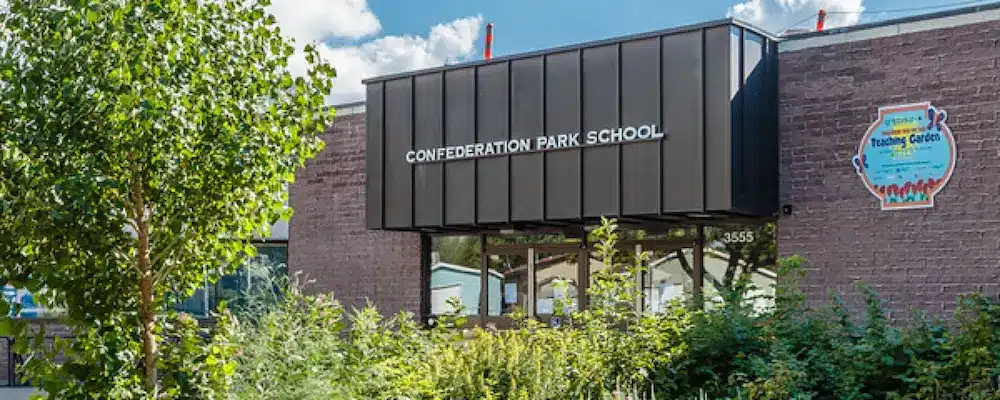
Confederation Park is a tight-knit, family-oriented neighbourhood on Saskatoon’s west side, with streets named after Canadian prime ministers and premiers, Pearson Place, Laurier Drive, Blakeney Crescent. The parks are well used, the rink at Bishop Roborecki School fills up in winter, and the paddling pool sees heavy traffic every July. When the AC fails on Cartier Crescent or Whelan Crescent, it is not just discomfort, it is a health concern for young children and elderly residents. Understanding how Confederation Park’s 1970s and 1980s construction affects cooling system wear is the first step to getting repairs done right and at a fair price.
Confederation Park’s 1985–2005 Installs Are Overdue
The symptoms of a failing air conditioner often appear gradually before they become a crisis. In Confederation Park’s predominantly 1970s and 1980s-built homes, the most common early warning is warm or lukewarm air blowing from supply vents even when the thermostat is set low. This is frequently the first sign of low refrigerant caused by a slow leak, a problem that worsens with every passing summer in aging copper coil systems. Do not ignore it, and do not assume adjusting the thermostat will resolve it.
Weak or uneven airflow points to a different category of failure. Blower motors in units installed in the late 1980s or 1990s are now well past their average service life, and restricted airflow forces every other component to work harder. Rooms near the far ends of duct runs, common in the ranch-style and two-storey layouts typical of this neighbourhood, often receive noticeably less cooling than rooms near the air handler. If some rooms feel comfortable and others feel stifling, the problem may be a struggling blower rather than a refrigerant issue.
Ice forming on the evaporator coil is a sign that demands immediate action. Shut the system off, switch the fan to “on” to help thaw the coil, and call for service. In Confederation Park homes, frozen coils typically result from either a refrigerant shortage or a clogged air filter blocking airflow, both of which put severe strain on the compressor. Left running, a frozen coil can destroy a compressor worth $1,500 or more in a matter of hours.
Strange sounds deserve attention too. A buzzing or humming noise when the unit tries to start usually points to a capacitor beginning to fail. A hissing sound near the indoor or outdoor unit suggests a refrigerant leak. Rattling or banging from the condenser typically means a loose or failing fan motor assembly. None of these sounds resolve on their own, and all of them escalate if ignored through a Saskatoon heat wave. The best time to service your system is before these symptoms appear, but when they do appear, acting quickly limits the repair scope and cost.
Component Failures That Plague Confederation Park’s Cooling Systems
Confederation Park’s residential construction history creates a specific repair profile. The majority of homes were built between 1970 and 1985, which means AC systems installed at the time of construction or shortly after are now 20 to 40 years old, well beyond their rated 15 to 20-year service life. Saskatoon’s climate accelerates this aging. The cycle of -40°C winters and +35°C summers causes repeated contraction and expansion of refrigerant lines, coils, and wiring insulation, shortening component life by an estimated 20 to 30 percent compared to systems in milder Canadian markets.
Refrigerant leaks are the single most common repair issue in this housing cohort. Dry summer heat accelerates coil corrosion, and older copper line sets develop pinhole leaks that bleed the system slowly over months. The critical complication for pre-2000 Confederation Park systems is refrigerant type: units installed before roughly 2000 almost certainly use R-22 (Freon), which was fully phased out in Canada in 2020. No new R-22 can be manufactured or imported; only reclaimed stock remains available, and prices reflect that scarcity, typically $100 to $200 per pound, with a full recharge often exceeding $1,000. If your pre-2000 system has a refrigerant leak, the repair conversation must include an honest assessment of whether topping up an R-22 system makes economic sense, or whether replacement is the more rational path. Systems retrofitted in the late 1990s or early 2000s may use R-410A, which is significantly cheaper to service when leaks occur.
Capacitors are the most frequently replaced component across all system ages. They are inexpensive, typical replacement costs run $150 to $300 including labour, and they fail without warning, usually on the hottest day of the year when the system is working hardest. A failed start or run capacitor leaves the compressor or fan motor unable to start, resulting in a system that hums, buzzes, or trips the breaker without producing cold air. Cold Saskatchewan winters degrade capacitor internals through repeated freeze-thaw cycles, making capacitor failures more common here than in warmer provinces. The good news is that a capacitor swap is a same-day repair with parts carried on most service vehicles.
Contactor failures follow a similar pattern, frequent, inexpensive to fix, and climate-accelerated. The contactor is the electrical switch that engages the compressor and condenser fan. Pitted or burned contacts cause intermittent operation, hard starts, and eventually complete failure. Replacement typically costs $150 to $250. Fan motor failures are somewhat more expensive, ranging from $300 to $600 depending on the motor type, and they are common in Confederation Park’s older condenser units where the motor has logged thousands of hours in Saskatoon’s summer heat without recent maintenance.
Compressor failure is the most expensive repair scenario, with replacement costs starting at $1,500 and often reaching $2,500 when labour and refrigerant costs are included. The compressor is the heart of the system, and it is usually the last component to fail, but it fails catastrophically when ignored refrigerant leaks or frozen coils go unaddressed long enough. For systems in the 1970s and 1980s Confederation Park cohort, a compressor failure almost always triggers a repair-versus-replace conversation, because the cost of the compressor alone often approaches or exceeds 50 percent of what a replacement system would cost. Evaporator coil replacements fall in the $800 to $1,500 range and are frequently required when R-22 systems develop coil leaks that cannot be cost-effectively sealed.
How Pro Service Mechanical Diagnoses a Broken AC in Confederation Park
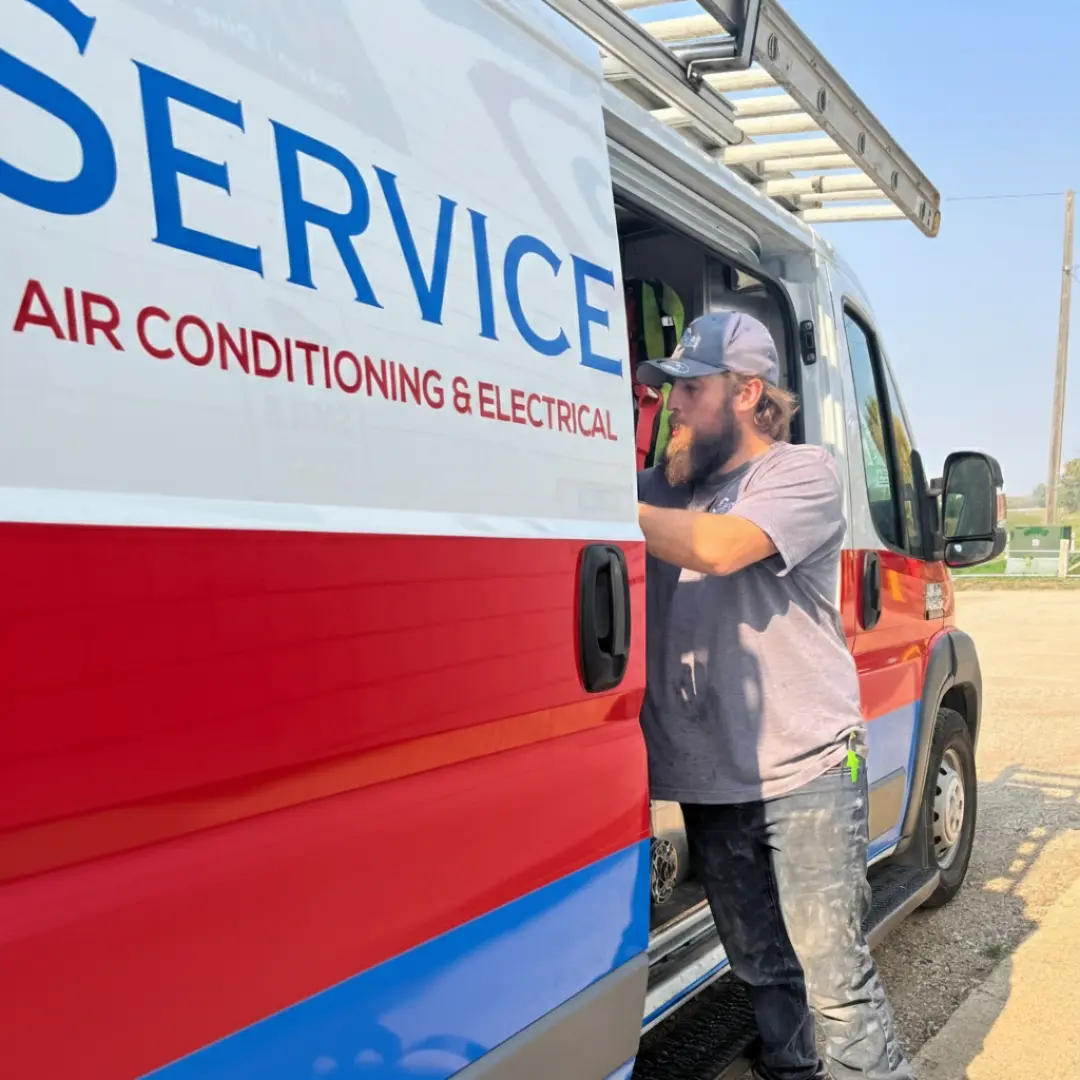
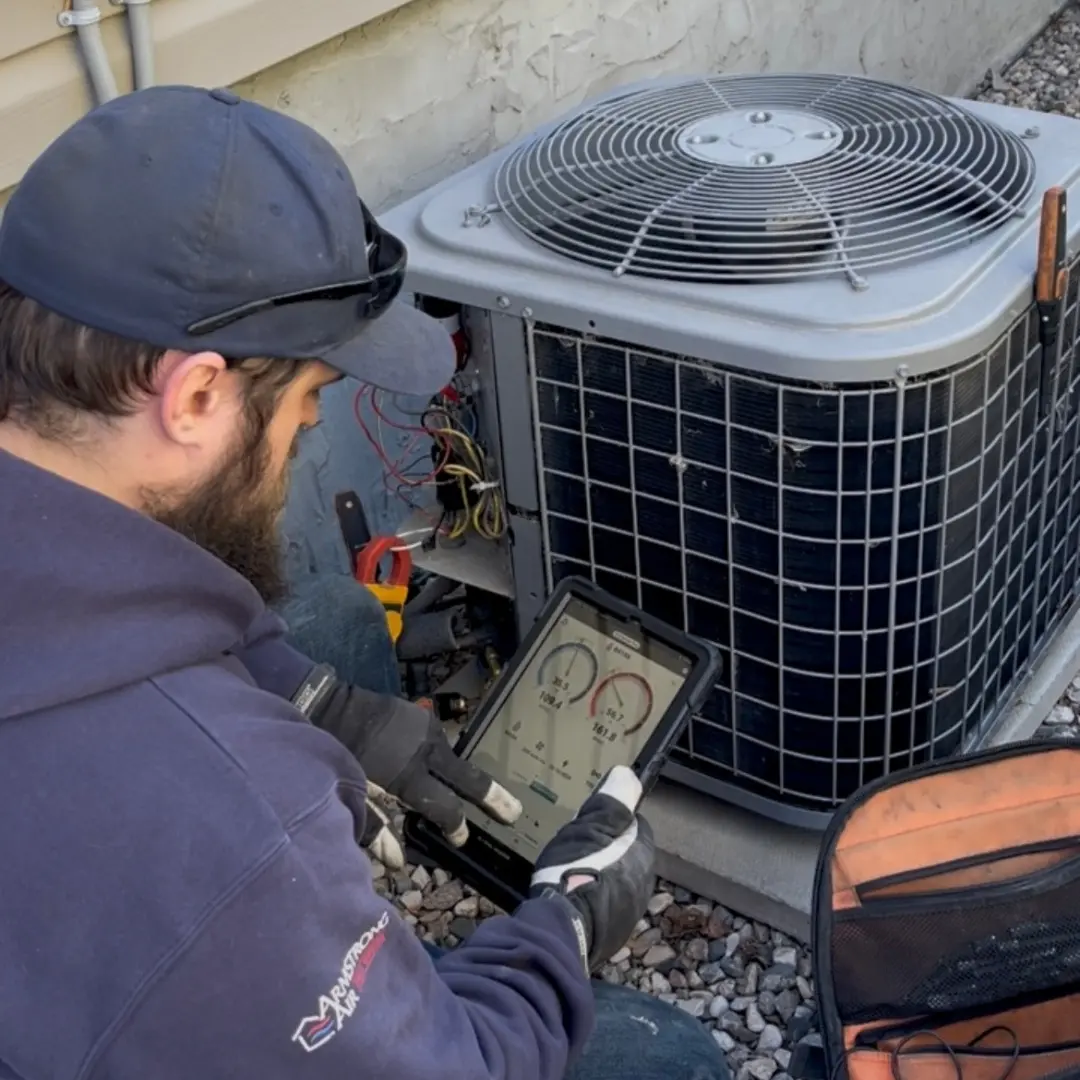
A thorough diagnostic is the foundation of every repair call. When a Pro Service Mechanical technician arrives at a Confederation Park home, the process follows a consistent sequence designed to identify the root cause rather than just the symptom. The technician begins at the thermostat and electrical panel, verifying settings, checking for tripped breakers, and confirming the system receives the correct voltage before touching any components. From there, the outdoor condenser unit is inspected: capacitor readings are taken with a multimeter, contactor condition is assessed, refrigerant pressures are measured with manifold gauges, and condenser coil condition is checked for dirt loading or physical damage. The indoor air handler is inspected next, evaporator coil condition, drain pan and condensate line status, blower motor amperage draw, and filter condition. The diagnostic fee is transparent, ranging from $75 to $200 depending on system complexity, and it is applied toward the repair cost when the work proceeds. No hidden charges, no surprise add-ons. The technician explains every finding before any repair begins, so homeowners understand exactly what failed and why.
For Confederation Park’s older systems, the diagnostic often reveals multi-component fatigue: a unit showing a failed capacitor may also have elevated compressor amperage draw and a slow refrigerant leak. Identifying the full picture during the first visit is what prevents a second service call two weeks later when the next component fails. That comprehensive approach is what separates a proper diagnostic from a quick-fix patch job, and it informs a realistic conversation about whether the repair is worth completing or whether the system has reached the end of its serviceable life.
A Repair Call on Pearson Place: When a Capacitor Saved the Day
Sandra K. on Pearson Place called Pro Service Mechanical on a Thursday afternoon in late July after her AC stopped producing cold air entirely. The condenser was running, she could hear the fan, but the house was climbing past 27°C by mid-afternoon. The technician arrived within two hours, ran the diagnostic sequence, and found a failed run capacitor on the compressor circuit. The compressor itself tested within normal operating parameters, refrigerant pressures were correct, and the evaporator coil was clean. The capacitor was replaced on the spot for $210 including labour. Cold air was restored within 30 minutes of the technician’s arrival. “I was convinced the whole unit was shot,” Sandra said. “It’s a 1997 unit and I figured it was done. Turns out it just needed a $40 part. The tech explained everything clearly and didn’t try to sell me anything I didn’t need.”
This outcome is more common than most homeowners expect. Industry data suggests that capacitor and contactor failures together account for a significant share of all no-cool service calls on systems of this vintage. The repair cost of under $250 preserved a system with several remaining years of useful life, saving thousands compared to premature replacement. Honest diagnostics matter, and they are the reason Pro Service Mechanical technicians check every component before recommending any course of action.
Why Confederation Park Homeowners Trust Pro Service Mechanical for AC Repair
Licensing and certification are the baseline. Every Pro Service Mechanical technician holds TSASK gas fitter licensing and is certified for refrigerant handling under federal regulations, which matters especially in Confederation Park, where many systems still contain R-22. Handling, recovering, and disposing of refrigerants legally requires certified technicians and proper equipment. When you hire an unlicensed contractor to top up an R-22 system by venting refrigerant to the atmosphere, you are exposed to both environmental liability and the risk of a botched repair that damages the compressor. That risk does not exist with Pro Service Mechanical.
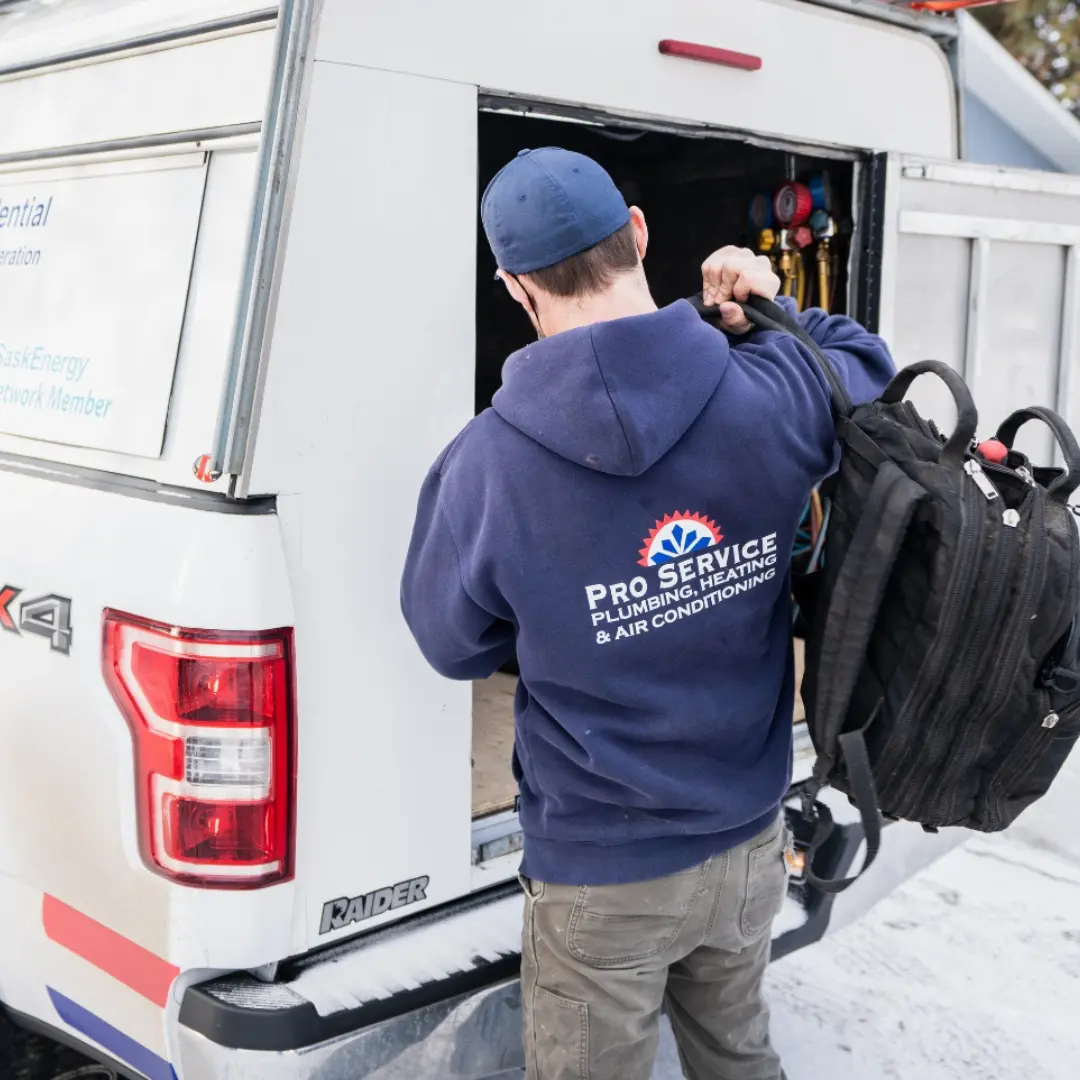
Parts availability is a practical differentiator. Service vehicles are stocked with the capacitors, contactors, fan motors, and control boards that cover the most common failures in 1980s and 1990s-era systems common throughout Confederation Park. When the diagnostic points to one of these components, the repair happens on the same visit, not three days later when a part gets ordered in. For compressor replacements and evaporator coil swaps, parts are sourced and installed within one to two business days in most cases.
Transparent pricing is not a marketing claim, it is a process. The diagnostic fee is quoted before the technician arrives. Repair estimates are presented after the diagnostic is complete, with itemized parts and labour, before any work begins. Confederation Park homeowners on fixed or moderate incomes do not need surprises on a repair invoice. The diagnostic fee range of $75 to $200 reflects real variation in system complexity, not arbitrary pricing, and it is credited toward the repair when the work proceeds on the same visit.
Response times reflect genuine local commitment. In normal summer conditions, Pro Service Mechanical targets a one to two-hour response across Confederation Park and the surrounding west side. During extended heat waves when call volume spikes, response windows lengthen, but the emergency AC repair line remains staffed around the clock, and priority dispatch is available for households with vulnerable residents including young children, elderly family members, or individuals with medical conditions. Reaching a real person when you call makes a real difference at 9 p.m. when the house is 30°C inside.
The 50% Rule: Repair or Replace Your Confederation Park Cooling System
The 50% rule is a practical framework: if a repair costs more than 50 percent of the replacement value of the system, replacement is generally the better financial decision. A more specific version accounts for age: multiply the system’s age in years by the estimated repair cost. If that number exceeds $5,000, replacement typically makes more economic sense than repair. For a 25-year-old system facing a $250 compressor repair, the calculation is clear: repair it. For a 22-year-old system facing a $1,800 compressor replacement, the math points firmly toward a new system.
Confederation Park’s housing era makes this calculation particularly relevant. Homes built in the 1970s that received their first central AC system in the late 1980s or early 1990s may be running equipment that is now 30 to 35 years old. Those systems have already exceeded their rated lifespan by 10 to 15 years. When they fail, the question is rarely whether they will need further repairs after a fix, it is how many more repairs they will need before the next summer ends. A realistic remaining lifespan estimate of zero to five years for systems in this cohort means that spending $1,200 on refrigerant work for an R-22 unit that will likely fail again next July is rarely money well spent.
R-22 refrigerant status is a key variable in this calculation for Confederation Park homes. If your system requires R-22 and has a refrigerant leak, the repair cost alone, reclaimed R-22 at $100 to $200 per pound, can push a single service call past $1,000 without touching the underlying leak source. Combining that cost with the age multiplier almost always makes replacement the logical choice. Systems converted to R-410A in the early 2000s face a more balanced calculation, particularly when the unit is under 20 years old and the failure is limited to a single component.
Even when replacement makes sense, a proper diagnostic comes first. Pro Service Mechanical never recommends replacement without completing a full diagnostic to confirm that the identified failure is not repairable at a reasonable cost relative to system age and remaining value. Homeowners deserve that honest assessment. If a repair makes sense, the technician will say so. If it does not, the technician will explain exactly why, with the diagnostic data to back it up. For guidance on AC installation services when replacement becomes the right path, that conversation happens separately and only after repair options have been honestly evaluated. For broader context on your air conditioning system’s health, or to understand how your heating systems interact with your cooling equipment’s wear patterns, Pro Service Mechanical handles both sides of the equation.
Same-Day AC Repair When Confederation Park Homes Can’t Wait
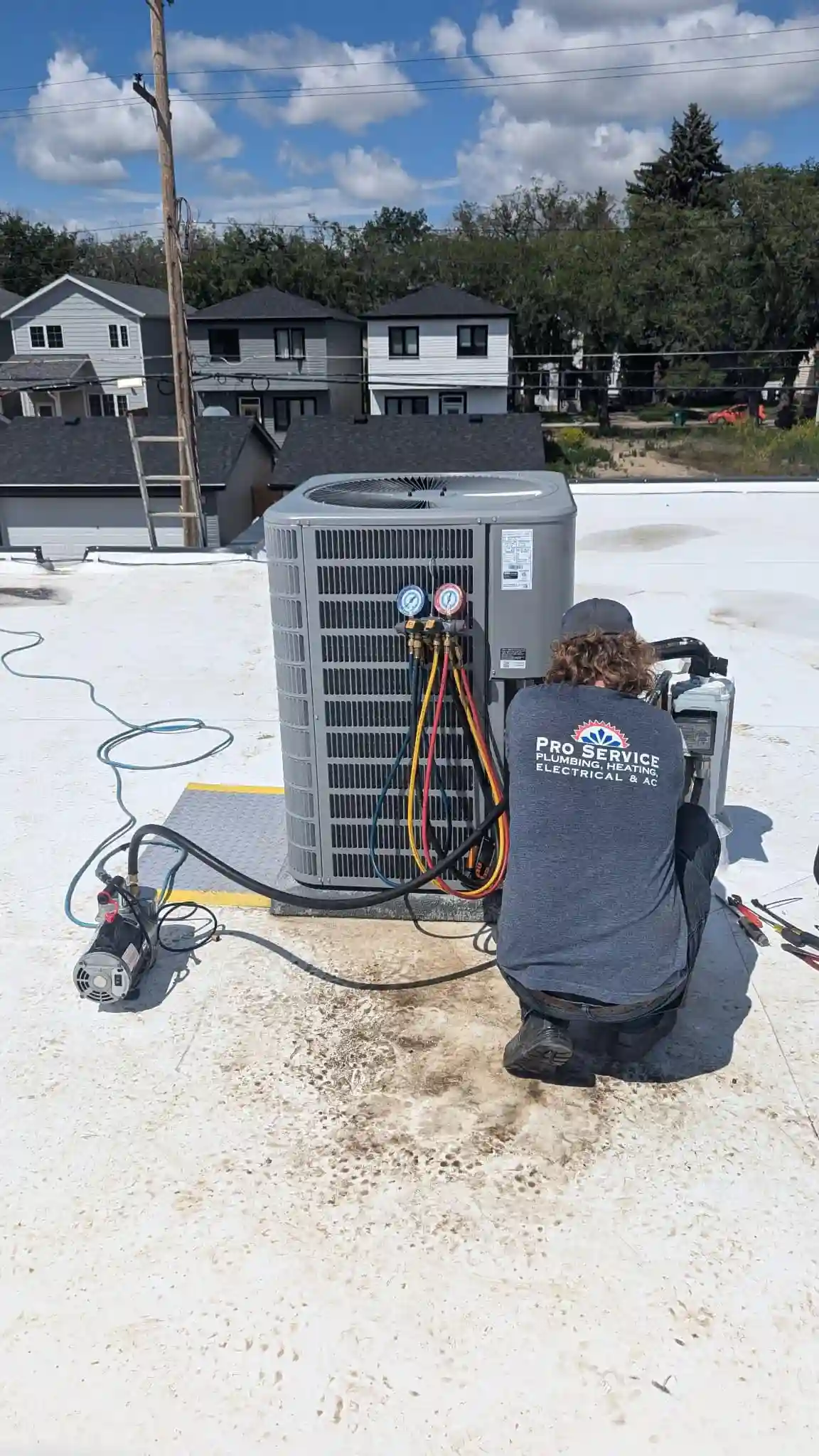
Saskatoon’s summer heat does not distribute itself evenly across the calendar. There are weeks in July and August when daytime highs stay above 30°C for five or six consecutive days, and those are precisely the days when AC failure calls flood every HVAC company in the city. Pro Service Mechanical maintains capacity specifically to handle demand spikes, stocked vehicles, additional technicians dispatched during heat events, and a 24-hour emergency line at 306-230-2442 that connects to a real dispatcher, not a voicemail box. When your system quits at 7 p.m. on a Friday in a heat wave, that call gets answered.
Response times during normal summer conditions average one to two hours for Confederation Park addresses. During sustained heat waves, that window can extend to three to four hours as call volume peaks, but emergency priority is available for households where the heat poses a genuine health risk. Technicians come prepared for the most common failure scenarios in this neighbourhood’s older systems, which means most repairs are completed on the same visit without a parts delay. Calling early in the day, even before the situation becomes critical, is always advisable during hot stretches. If you notice the system struggling in the morning, call Pro Service Mechanical at 306-230-2442 before it stops cooling entirely.
Confederation Park sits in close proximity to several other established west side neighbourhoods that face similar repair patterns in their 1970s and 1980s-era homes. Pro Service Mechanical serves the entire area, including Pacific Heights and Massey Place, with the same same-day response commitment. If you are a Confederation Park homeowner ready to book a diagnostic or request emergency service, the Request for Service form is available online, or you can call directly. Pro Service Mechanical is the west side’s trusted choice for honest, licensed, same-day AC repair, no upsell, no runaround, just the repair your system actually needs.
Frequently Asked Questions About AC Repair in Confederation Park
How much does an AC repair typically cost for a 1980s-era system in Confederation Park?
Repair costs vary significantly depending on which component has failed. A capacitor or contactor replacement, the most common failures in systems of this age, typically runs $150 to $300 including labour, and parts are usually on the service vehicle for a same-day fix. Fan motor replacements fall in the $300 to $600 range. Refrigerant leak repairs depend heavily on refrigerant type: R-22 recharges can exceed $1,000 due to scarcity, while R-410A top-ups are considerably more affordable. Compressor replacements represent the high end at $1,500 to $2,500. The $75 to $200 diagnostic fee is charged upfront and applied toward the repair cost when work proceeds on the same visit, so there are no surprise charges. Pro Service Mechanical quotes all repair costs before starting any work.
Is it worth repairing a 30-year-old AC system, or should I just replace it?
The answer depends on what has failed and what the repair costs relative to the system’s remaining value. The 50% rule provides a useful benchmark: if the repair exceeds 50 percent of replacement cost, replacement generally makes more economic sense. A more precise calculation multiplies the system’s age by the repair cost, if that figure exceeds $5,000, replacement is usually the better choice. For a 30-year-old system, even a moderately priced repair of $600 produces a calculation (30 x $600 = $18,000) that exceeds the threshold. That said, a $200 capacitor swap on a system that is otherwise healthy and running on R-410A can still buy several more seasons of reliable cooling. A proper diagnostic from Pro Service Mechanical will give you the information needed to make that call honestly, without pressure in either direction.
My Confederation Park home was built in the late 1970s. Is my AC system still using R-22 refrigerant?
If the air conditioning system in your home was installed before approximately 2000 and has never been replaced, there is a high probability it uses R-22 (commonly called Freon). R-22 was fully phased out in Canada in 2020, meaning no new R-22 can be manufactured or imported. Only reclaimed stock remains available, and it is expensive, $100 to $200 per pound, making a full recharge often cost more than $1,000. If your R-22 system has a refrigerant leak, the economics of recharging it rarely justify the cost relative to the system’s remaining lifespan and the ongoing scarcity of the refrigerant. Some Confederation Park homes had systems retrofitted in the late 1990s or early 2000s using R-410A, which is cheaper to service. The refrigerant type is printed on the data plate of your outdoor condenser unit, a Pro Service Mechanical technician will confirm this during the diagnostic visit and walk you through what it means for your repair options.
How quickly can Pro Service Mechanical respond to an AC emergency in Confederation Park during a heat wave?
In normal summer conditions, Pro Service Mechanical targets a one to two-hour response for Confederation Park service calls. During heat waves when demand is high across the city, response windows may extend to three to four hours, though the emergency line at 306-230-2442 is staffed 24 hours a day, seven days a week by a real dispatcher, not an automated system. Priority dispatch is available for households with young children, elderly residents, or individuals with medical conditions where heat poses a genuine health risk. The best strategy during a heat wave is to call as early in the day as possible, even if the system is still limping along, catching a failing unit in the morning means a same-day repair before the house becomes dangerously hot. The emergency AC repair line exists precisely for those moments when waiting until the next business day is not an option.
What is the most common AC failure in Confederation Park homes built in the 1970s and 1980s?
Refrigerant leaks are the most common underlying issue in this housing era cohort, driven by aging copper coil systems and Saskatoon’s extreme climate cycling between -40°C winters and +35°C summers. However, the most common presenting symptom, the failure that causes a sudden no-cool call, is a failed capacitor or contactor. These electrical components degrade from years of thermal stress and cold-weather cycling, and they often fail abruptly on the hottest days when the system is working hardest. The reassuring aspect of capacitor and contactor failures is that they are inexpensive and fast to fix, typically resolved in a single same-day visit. Compressor failure, while less frequent, represents the most serious outcome, usually the end result of ignored refrigerant leaks or repeated frozen-coil events that were not addressed promptly. Early intervention on the smaller failures is the most reliable way to avoid the larger ones. Pro Service Mechanical’s AC repair services are designed to catch those component issues before they cascade.
“`