
When the temperature climbs past +30°C along Dalhousie Crescent or Anderson Crescent and your central air conditioner stops cooling, every hour matters. College Park summers are short but intense, the same prairie climate that drives heating costs through the floor in January pushes air conditioners to their absolute limits come July and August. For homeowners on Carleton Drive or near Dr. Gerhard Herzberg Park, a system that quits mid-afternoon is not an inconvenience; it is an emergency that demands a same-day response from a qualified technician.
College Park’s streets carry names that honour universities, and the neighbourhood carries the character of a mature, established community built primarily between 1961 and 1980. That construction era is significant for AC repair: the systems cooling these homes are, in many cases, 20 to 40 years old, operating well past the 12- to 15-year lifespan a Saskatoon climate typically allows. Pro Service Mechanical has worked through these repair patterns across dozens of College Park homes and understands exactly what breaks, why it breaks, and what it actually costs to fix it. This page is for homeowners whose air conditioner is already failing, not for those shopping for something new.
College Park’s R-22 Era Systems Have Already Outlived Their 12-Year Average
The most obvious sign is warm air blowing from supply registers when the thermostat is calling for cooling. In College Park homes with systems installed in the 1990s or 2000s, warm air almost always points to one of two causes: low refrigerant from a slow coil leak, or a failed capacitor that prevents the compressor from starting. Neither is visible from the outside, which is why homeowners sometimes delay the call, the system appears to be “running” because the fan is moving air, just not cooling it.
Weak airflow from registers, especially in basements converted for additional bedrooms, is another common complaint in College Park’s split-level and bi-level homes. This symptom typically means a plugged evaporator coil, a failing indoor blower motor, or a filter so loaded with prairie dust that the system is starving for air. Saskatoon’s dry summer air loads AC coils and filters roughly twice as fast as more humid markets, something homeowners who moved here from Ontario or BC consistently underestimate.
Ice forming on the refrigerant lines near the indoor coil is a diagnostic red flag that should trigger an immediate shutdown. Running an iced system forces the compressor to work against restricted airflow, which is the leading cause of compressor failure in College Park’s older equipment. If you see frost on copper lines coming out of your furnace cabinet in summer, turn the system to “fan only” to melt the ice, then call for service before restarting. Catching a low-refrigerant condition early can be the difference between a $500 coil repair and a $2,500 compressor replacement.
Unusual sounds deserve attention in proportion to their severity. A brief clicking on startup is normal. Sustained buzzing or humming with no compressor engagement typically means a failed run capacitor. A grinding or squealing sound from the outdoor unit points to a worn condenser fan motor bearing. A banging or clanking from the outdoor cabinet during operation is a compressor in serious distress. In homes on Acadia Crescent or Balfour Court where original 1990s equipment may still be in service, these sounds are a signal to call for diagnostics before the system fails completely during a heat event.
Component Failures That Define AC Repair in College Park’s 1961,1980 Builds
Understanding the failure hierarchy for this housing era helps homeowners calibrate expectations before a technician arrives. Research from Saskatoon’s climate zone places capacitor failures at the top of the list, accounting for roughly 20 to 25 percent of all AC service calls. A run capacitor is a relatively inexpensive component, typically $150 to $400 to replace including labour, but when it fails the compressor cannot start and the system delivers nothing but warm air. College Park homes with 15- to 25-year-old condensing units are squarely in the age range where capacitors fail most frequently, because repeated thermal cycling between Saskatoon’s -40°C winters and +35°C summers fatigues the component far faster than in milder climates.
Refrigerant leaks are the second most common failure mode in this cohort, estimated at 15 to 20 percent of service calls. In College Park’s older systems, leaks develop at evaporator coil joints and condenser coil connections, both of which are susceptible to corrosion accelerated by dry prairie air. A slow leak produces gradually declining cooling performance over one or two seasons before the system stops cooling entirely. Repair costs for refrigerant leaks range from $500 to over $2,000 depending on whether the coil can be repaired or requires replacement.
The refrigerant type in a College Park system is a critical factor in repair cost and strategy. Homes built between 1961 and 1980 that have never had their AC replaced are almost certainly operating on R-22, a refrigerant phased out in Canada in 2020. Best estimates place 40 to 60 percent of active systems in this housing cohort still using R-22. Because new R-22 production has ended, technicians must source recycled stock at $100 to $200 per pound, compared to $20 to $50 per pound for R-410A used in post-2010 systems. A refrigerant leak in an R-22 system does not just cost more to repair, it can also trigger a repair-versus-replace conversation because the long-term cost of maintaining a leaking R-22 system can quickly exceed the system’s remaining value.
Contactors fail at roughly 10 percent of calls in this equipment age range, with repair costs of $200 to $500. A pitted contactor causes the condensing unit to stop responding to thermostat signals, which looks identical to a total system failure from the homeowner’s perspective. Fan motor failures also account for approximately 10 percent of calls, running $300 to $800 to replace. College Park’s dusty, dry summers accelerate motor bearing wear because fine particulate loads accumulate faster than in humid environments where airborne particles are heavier and settle more quickly. Evaporator coil failures round out the component list at 5 to 10 percent of calls, costing $1,000 to $2,500, while compressor failures, the costliest outcome, account for roughly 10 percent of calls with replacement costs of $1,500 to $3,000.
For a neighbourhood where 70 percent of active systems are estimated to be past the 15-year mark, the pattern is clear: the question is rarely whether a component will fail, but which one fails first and what condition the rest of the system is in when it does. That is exactly the information a proper diagnostic is designed to surface. If you want to understand the full scope of AC repair services available in Saskatoon, our service hub outlines everything we cover.
How Pro Service Mechanical Diagnoses Your AC Repair Call
When a technician arrives at a College Park home, the diagnostic sequence follows a defined order designed to find the most probable cause first and avoid replacing components that don’t need replacing. The process begins with a thermostat and electrical panel check to rule out control-side issues, then moves to the outdoor disconnects and contactor to confirm the condensing unit is receiving power signals. Refrigerant pressures are measured at both the high and low side to identify whether a leak or low charge is present. The capacitor is tested with a meter before any compressor diagnosis begins, because a failed capacitor mimics compressor failure. Fan motor amp draw is measured against nameplate ratings, and evaporator coil condition is inspected for ice, corrosion, or debris restriction.
Pro Service Mechanical charges a transparent diagnostic fee in the $75 to $200 range, which is disclosed before work begins. That fee covers the full assessment and is credited against any repair completed the same day. Most College Park diagnostics are completed within 45 to 60 minutes. Homeowners receive a clear explanation of what was found, what it will cost to repair, and an honest assessment of remaining system lifespan before any authorization is requested. For context on the best time to service your system to avoid emergency calls, our maintenance guide is worth bookmarking for next spring.
A College Park AC Repair That Avoided a Costly Replacement
David K., a homeowner on Dalhousie Crescent, called Pro Service Mechanical on a Thursday afternoon in late July after his central air conditioner stopped producing cold air overnight. The outdoor unit was running, the indoor fan was circulating air, and the thermostat was set correctly, all the signs of a refrigerant or capacitor issue. The technician measured a failed run capacitor within the first ten minutes of the diagnostic: the compressor was attempting to start but could not overcome the initial torque without the capacitor’s charge. The component was replaced on the spot using stock carried on the service truck, and the system was back to full cooling within the hour. Total repair cost was under $350. A compressor misdiagnosis, or a call to a technician who recommended replacement without testing the capacitor first, could have cost David over $3,000. That kind of repair outcome is exactly why a methodical diagnostic matters.
What College Park Homeowners Should Know Before Calling for AC Repair
Pro Service Mechanical holds TSASK gas fitter licensing and certified refrigerant handling credentials, which are legal requirements for working on refrigerant circuits in Saskatchewan. This is not a formality. Improper refrigerant handling on an R-22 system can result in venting regulated substances, which carries significant fines, and can also damage components if the system is recharged with the wrong refrigerant blend. Every technician dispatched to a College Park home is qualified to handle both R-22 legacy systems and current R-410A equipment.
Same-day parts availability is a practical differentiator in this neighbourhood. College Park’s equipment age profile means technicians frequently encounter older condenser fan motors, specific contactor models, and run capacitor values that are not stocked by every service provider. Pro Service Mechanical maintains a broad on-truck inventory specifically because College Park and the surrounding mature neighbourhoods generate a disproportionate share of calls involving older, less common components.
Diagnostic transparency matters when a homeowner is deciding whether to repair or replace a 20-year-old system. The diagnostic fee is quoted before work begins, credited to the repair if the homeowner proceeds, and refunded in no scenario includes a surprise “assessment charge” layered on top of parts and labour. College Park homeowners dealing with rental units and student tenants on Acadia Place or Balfour Court appreciate that service calls can be coordinated without the owner needing to be on-site, provided access arrangements are confirmed in advance.
Response times under normal summer conditions run one to two hours for College Park addresses. For broader context on our air conditioning service scope, including maintenance and seasonal checkups, the main AC service page covers the full range. Our heating systems page is the right resource if your furnace or boiler is also due for attention before the next heating season.
Applying the 50% Rule to College Park Air Conditioners
The 50% rule is the industry standard for repair-versus-replace decisions: if the cost of a repair exceeds 50 percent of the replacement value of the system, replacement is typically the better financial choice. In practice, this is often expressed as a simplified formula: multiply the system’s age in years by the repair cost, and if the result exceeds $5,000, replacement is almost always the right call. A 20-year-old College Park system facing a $300 capacitor replacement scores 6,000 on that formula, but the repair is so inexpensive relative to the system’s remaining value that it remains worthwhile. The same 20-year-old system facing a $1,800 compressor replacement scores 36,000 and makes a strong case for replacement.
For College Park’s 1961 to 1980 homes, the relevant age window for this decision is approximately 15 to 25 years on most active systems, assuming original installs from the 1990s and early 2000s. At that age, a single-component failure on an R-22 system, particularly a refrigerant leak that requires sourcing recycled refrigerant at $100 to $200 per pound, can cross the 50% threshold quickly. A compressor failure on an R-22 system is almost always a replacement trigger: the component cost alone ($1,500 to $3,000) combined with the ongoing expense of maintaining an R-22 refrigerant circuit makes repair economically unsound in most cases.
Systems under 12 years old, or systems that have been previously retrofitted with R-410A equipment, have a different calculus. A single capacitor or contactor failure on a 10-year-old system with no refrigerant issues is a clear repair scenario. Two or more simultaneous failures, or any compressor or coil failure on a system showing overall wear, reopens the replacement question regardless of age. The AC installation services page is the right resource if diagnostics confirm that replacement is the better path, but that conversation comes after, not instead of, an honest repair assessment.
Pro Service Mechanical will never push a replacement recommendation without a completed diagnostic. The data from the assessment determines the recommendation. If a College Park system has a failed contactor and a compressor still measuring within specification, the contactor gets replaced. If a system has a failed compressor, a leaking evaporator coil, and is operating on R-22 refrigerant after 22 years of Saskatoon winters, that is a different conversation and homeowners deserve to hear it plainly, with numbers attached.
Same-Day Emergency AC Repair Service Across College Park
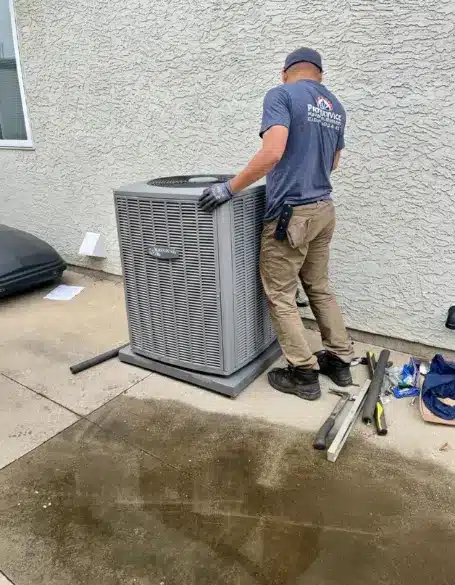
Saskatoon’s AC emergency window is narrow and intense. The city averages only a few weeks per summer where temperatures consistently exceed +28°C, but demand for emergency AC service spikes sharply during those periods. During a multi-day heat event, response times across the city can stretch to three to four hours even for urgent calls. Outside of peak heat events, Pro Service Mechanical’s average response time for College Park addresses is one to two hours. The 24/7 emergency line, 306-230-2442, connects to a real dispatcher, not a voicemail or automated queue. For emergency AC repair calls during a heat event, confirming your address, access details, and symptoms when you call helps the dispatcher prioritize correctly and equip the technician before departure.
The same-day service commitment means that capacitor swaps, contactor replacements, and many fan motor repairs are completed in a single visit. Refrigerant leak repairs and coil replacements may require a follow-up if a non-stock component is needed, but the diagnostic and any immediately correctable faults are addressed on the first call. College Park homeowners dealing with R-22 systems should mention their system age when calling, because sourcing recycled R-22 for a same-day recharge sometimes requires a supplier pickup that affects scheduling.
College Park sits close to a cluster of mature Saskatoon neighbourhoods with similar repair profiles. If you are looking for repair services in adjacent areas, Pro Service Mechanical also covers Grosvenor Park, Greystone Heights, and Haultain, all of which share College Park’s 1960s to 1980s construction patterns and similar refrigerant-era challenges. To book a repair call or request a diagnostic visit, use the Request for Service form or call 306-230-2442 directly.
Frequently Asked Questions About AC Repair in College Park
How much does AC repair typically cost for a 1970s or 1980s home in College Park?
Repair costs depend entirely on the failed component. A capacitor replacement runs $150 to $400 including labour, and it is the most common single repair in College Park’s equipment age range. A contactor runs $200 to $500. Fan motor replacements fall in the $300 to $800 range. Refrigerant leak repairs can cost $500 to over $2,000 depending on whether the coil needs replacement, and whether the system uses R-22 refrigerant, which must be sourced from recycled stock at $100 to $200 per pound. Compressor replacements range from $1,500 to $3,000 and often make more sense to replace the system outright. The diagnostic fee of $75 to $200 is credited toward the repair if you proceed on the same visit.
Is it worth repairing an R-22 air conditioner in College Park, or should I just replace it?
It depends on the nature of the fault. If an R-22 system fails due to a contactor or capacitor with no refrigerant leak, a repair at $150 to $500 is almost always worthwhile, even knowing R-22 is phased out. If the system has a refrigerant leak, the calculation changes: sourcing recycled R-22 is expensive, and if the leak is in a corroded evaporator coil, the repair cost can approach $2,000 or more. Combined with the age of most R-22 systems in College Park, that repair cost will frequently exceed the 50% rule threshold and push toward replacement. A failed compressor on an R-22 system is almost always a replacement trigger. An honest diagnostic is the only way to know which situation you are in.
My College Park AC is freezing up with ice on the lines. Is that a serious problem?
Ice on refrigerant lines or the evaporator coil is a warning sign that needs prompt attention, not a wait-and-see situation. The two most common causes are low refrigerant from a slow leak, and restricted airflow from a heavily loaded filter or a dirty coil. When the system runs in this condition, the compressor is working against abnormal pressures, which shortens its lifespan significantly. The immediate action is to switch the system to “fan only” mode to melt the ice, then check or replace the air filter. If the ice returns after the coil thaws and the filter is clean, call for a refrigerant diagnostic. Catching a low-refrigerant condition before the compressor fails is the difference between a $500 to $1,000 repair and a $3,000 one in College Park’s older systems.
How quickly can Pro Service Mechanical respond to an AC emergency in College Park?
Under normal summer conditions, response times for College Park addresses run one to two hours. During multi-day heat events when Saskatoon temperatures are consistently above +30°C, demand across the city increases significantly and response windows can extend to three to four hours even for urgent calls. The emergency line, 306-230-2442, is answered by a live dispatcher 24 hours a day, seven days a week. Having your address, system age, and a description of the symptoms ready when you call helps the dispatcher prioritize the call and equip the technician correctly before leaving for your neighbourhood. Most capacitor, contactor, and fan motor repairs are completed same-day with parts carried on the truck.
What is the most common AC failure in College Park homes built in the 1960s to 1980s?
Capacitor failure is the single most common cause of AC service calls in College Park’s equipment age range, estimated at 20 to 25 percent of all calls in this cohort. The capacitor provides the starting boost and running support for both the compressor and condenser fan motor, and it degrades faster under Saskatoon’s thermal cycling conditions than in milder climates. The symptom is usually an outdoor unit that hums or buzzes without the compressor engaging, sometimes accompanied by the indoor fan running normally. Refrigerant leaks are the second most common failure at 15 to 20 percent of calls, particularly in systems where original coils have been exposed to two or three decades of dry prairie air. Both issues are diagnosable within the first hour of a service call.