

When the temperature climbs past +30°C on Saskatchewan Crescent and your air conditioner stops cooling, every hour inside a Nutana heritage home becomes more uncomfortable than the last. Nutana is Saskatoon’s oldest neighbourhood, settled in 1883, and its beautiful tree-lined streets and character houses along 11th Street East hold some of the city’s most historically significant properties. Those same century-old homes also carry some of the most heavily aged mechanical systems in the city, and when a 25-year-old central AC unit quits during a summer heat wave, you need a repair crew, not a sales pitch.
Whether your system is frozen up, blowing warm air, or simply humming without doing anything useful, Pro Service Mechanical responds to AC breakdowns across Nutana the same day. This page covers what actually fails in homes of this era, what it costs to fix, and how to decide whether a repair makes financial sense for your system’s age. If you have already confirmed a full system replacement is needed, our AC installation services page covers that separately. For now, let us focus on getting your existing system running.
73% of Nutana’s AC SEER Condensers Are Showing Their Age
The warning signs that an AC system is about to fail are remarkably consistent across Nutana’s pre-1946 and early-postwar properties. The most obvious signal is warm air coming from vents that used to deliver cool relief. If you are standing in a living room on Main Street on a 30-degree afternoon and the supply registers feel no different from the ambient air temperature, your system has lost its ability to transfer heat, which points to either a low refrigerant charge, a failed compressor, or a frozen evaporator coil blocking airflow entirely.
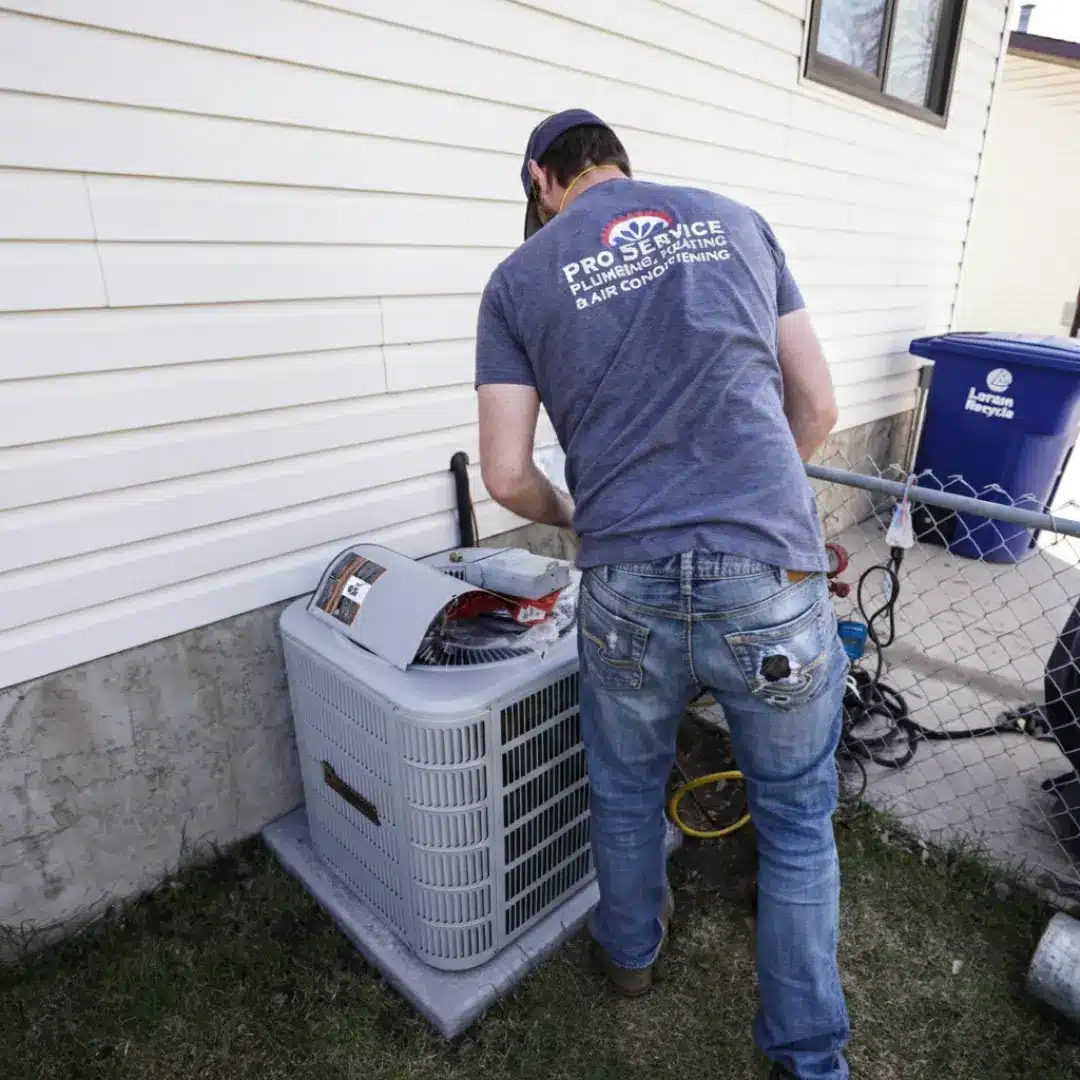
Weak or uneven airflow is another symptom common in Nutana’s older homes. The original ductwork in pre-1946 construction was not designed for modern central AC loads. Decades of thermal cycling cause duct joints to separate and insulation to degrade, meaning the air your system does manage to cool often escapes before it reaches living spaces. If some rooms cool adequately while others stay stuffy, the duct system itself may be the culprit rather than the AC unit.
Ice forming on the refrigerant lines or the indoor coil during warm weather is one of the more alarming signs homeowners report. It feels counterintuitive to see frost when it is 28°C outside, but a frozen coil almost always means either restricted airflow from a clogged filter or duct obstruction, or a refrigerant charge that has dropped low enough that the remaining charge expands too aggressively. In either case, running the system harder will not fix it. Shut the unit off, switch the fan to “ON” mode to thaw the coil, and call for a diagnostic.
Unexplained spikes in your electricity bill during summer months, combined with a system that runs almost continuously but never quite reaches the thermostat setpoint, indicate a system working far outside its design efficiency. In Nutana’s densely built older properties, this pattern often points to dirty condenser coils clogged with cottonwood fluff or cottonwood dust, which are notorious in Saskatoon from late May through June. A system straining through 30 to 40 percent reduced airflow across the condenser will spike your power bill and shorten compressor life simultaneously.
Component-by-Component Air Conditioner Failures in Nutana’s Pre-1980 Properties
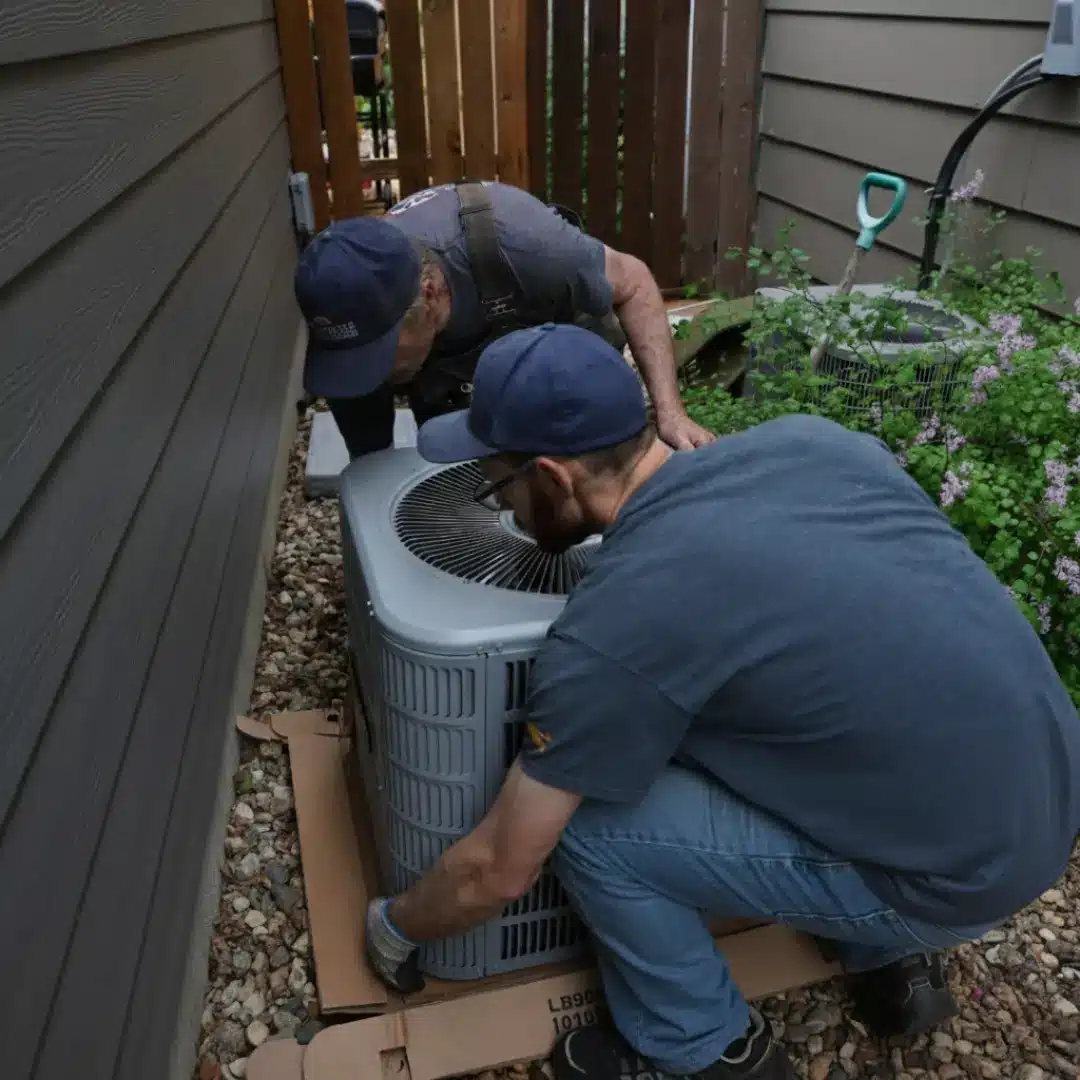
Nutana’s housing breakdown tells the repair story clearly. Approximately 47 percent of the neighbourhood’s homes predate 1960, another 26 percent were built between 1961 and 1980, and 11 percent date to 1981 to 1990. That means roughly 84 percent of residential properties in this neighbourhood have HVAC systems operating in conditions that stress older components far more aggressively than most technicians encounter in newer suburban builds. Here is what fails most frequently, in order of likelihood.
Capacitors are the single most common repair call in this housing cohort. The dual-run capacitor starts both the compressor and the condenser fan motor on each cooling cycle. Saskatchewan’s dramatic temperature swings, think 30-degree afternoons dropping to 12-degree nights within hours, cause the capacitor’s dielectric material to degrade through hundreds of thermal expansion and contraction cycles. A bulging, ruptured, or electrically weak capacitor produces the classic symptom of a humming outdoor unit that will not start. Capacitor replacement costs between $200 and $400 including labour, making it one of the most cost-effective repairs you can authorize.
Refrigerant leaks are the second most common issue and the most consequential in this neighbourhood’s housing era. In pre-2000 AC systems, the refrigerant used is almost certainly R-22, a compound phased out federally in Canada as of 2020. For any Nutana home built before 2000 that has never had its AC system replaced or retrofitted, R-22 refrigerant is no longer manufactured domestically and existing stocks command $100 to $200 per pound versus approximately $50 per pound for the current standard R-410A. A meaningful leak in an R-22 system can cost more than $1,000 to recharge alone, and a recharge without sealing the source leak is money that will evaporate within a season. Post-2010 retrofits or systems installed in the 1981 to 1990 cohort may use R-410A, which is still serviceable and affordable, but the majority of Nutana’s original systems fall into R-22 territory.
Dirty condenser coils and flattened fins deserve their own entry because Nutana’s location and seasonal cottonwood output make this a recurring repair pattern. Cottonwood fluff from the neighbourhood’s mature trees blankets outdoor condenser units every May and June, reducing airflow by 30 to 40 percent if the coil is not cleaned before the cooling season. Hail events, which are a regular Saskatchewan summer reality, flatten condenser fins and reduce coil efficiency further. Coil cleaning runs $150 to $300 and is one of the most impactful single-service repairs for an ageing system. Left unaddressed, restricted condenser airflow overheats the compressor and shortens its life significantly.
Fan motors and contactors are next in failure frequency. The contactor is the electrical switch that engages the compressor and fan circuits. In systems that have accumulated 15 or more years of operation, the contactor’s contact points pit and burn, causing intermittent starting failures or, in some cases, a unit that runs continuously because the contacts have fused. Fan motor bearings wear from seasonal overwork and from exposure to Nutana’s freeze-thaw cycles during the long shoulder seasons. Motor replacement runs $300 to $600 depending on the unit.
Compressors are the most expensive single component failure, typically ranging from $1,200 to $2,500 in parts and labour depending on system tonnage. In Nutana’s oldest cohort, compressors that have survived this long have often done so at the cost of being pushed hard through preventable issues, dirty coils, failed capacitors that forced hard starts, low refrigerant that caused overheating. By the time a compressor fails outright, the system usually has multiple other wear indicators that make the repair-versus-replace question very relevant. Evaporator coil replacements, including labour and refrigerant recovery and recharge, typically run $1,500 or more and trigger the same decision-point conversation.
How Pro Service Mechanical Diagnoses an AC Problem in Nutana
When a technician from Pro Service Mechanical arrives at a Nutana property, the diagnostic process follows a deliberate sequence designed to identify the true root cause rather than simply replacing the most recently failed part. The first check is always electrical: voltage at the disconnect, capacitor microfarad reading against the nameplate rating, contactor condition, and breaker continuity. Roughly 70 percent of no-cool calls resolve to an electrical component failure at this stage, and identifying a bad capacitor or contactor within the first few minutes prevents unnecessary deeper disassembly. The diagnostic fee for a service visit runs between $75 and $200, and that fee is applied toward the repair cost if you proceed with the same visit.
If the electrical checks are satisfactory, the technician moves to refrigerant pressures. System operating pressures are compared against the manufacturer’s charge specifications for the current outdoor temperature, and a pressure-temperature deviation immediately flags either a leak or a metering device problem. From there, airflow across both the evaporator and condenser coils is assessed, condensate drain function is confirmed, and the compressor’s amp draw is checked against rated limits. The full sequence typically takes 45 to 60 minutes and produces a written summary of what failed, what else shows wear, and the cost to address each finding. You decide what to authorize. For a deeper look at preventive timing, our article on the best time to service your air conditioner is worth reading before each cooling season.
An AC Repair Call on Saskatchewan Crescent
Last July, Paul M. called Pro Service Mechanical from his home on Saskatchewan Crescent after his central AC had been blowing warm air for two days. He had already replaced the filter and checked the breaker, neither of which changed anything. The technician arrived the same morning, ran the electrical diagnostic, and found a failed dual-run capacitor reading well below its rated microfarad value. The outdoor unit had been trying to start on every cycle but the capacitor lacked the stored charge to spin the compressor and fan motor up to operating speed. The part was on the service truck.
The repair took under an hour including the diagnostic, and the total invoice was $340. Paul’s system is a 14-year-old central AC unit that otherwise tested in good working order with clean coils and proper refrigerant pressure. A compressor replacement on the same unit would have been over $1,800. The capacitor swap restored full cooling and, as Paul put it, saved him from a very expensive decision he did not need to make yet. That is exactly the kind of outcome our AC repair services are built to deliver.
Why Nutana Homeowners Trust Pro Service Mechanical for Cooling Repairs
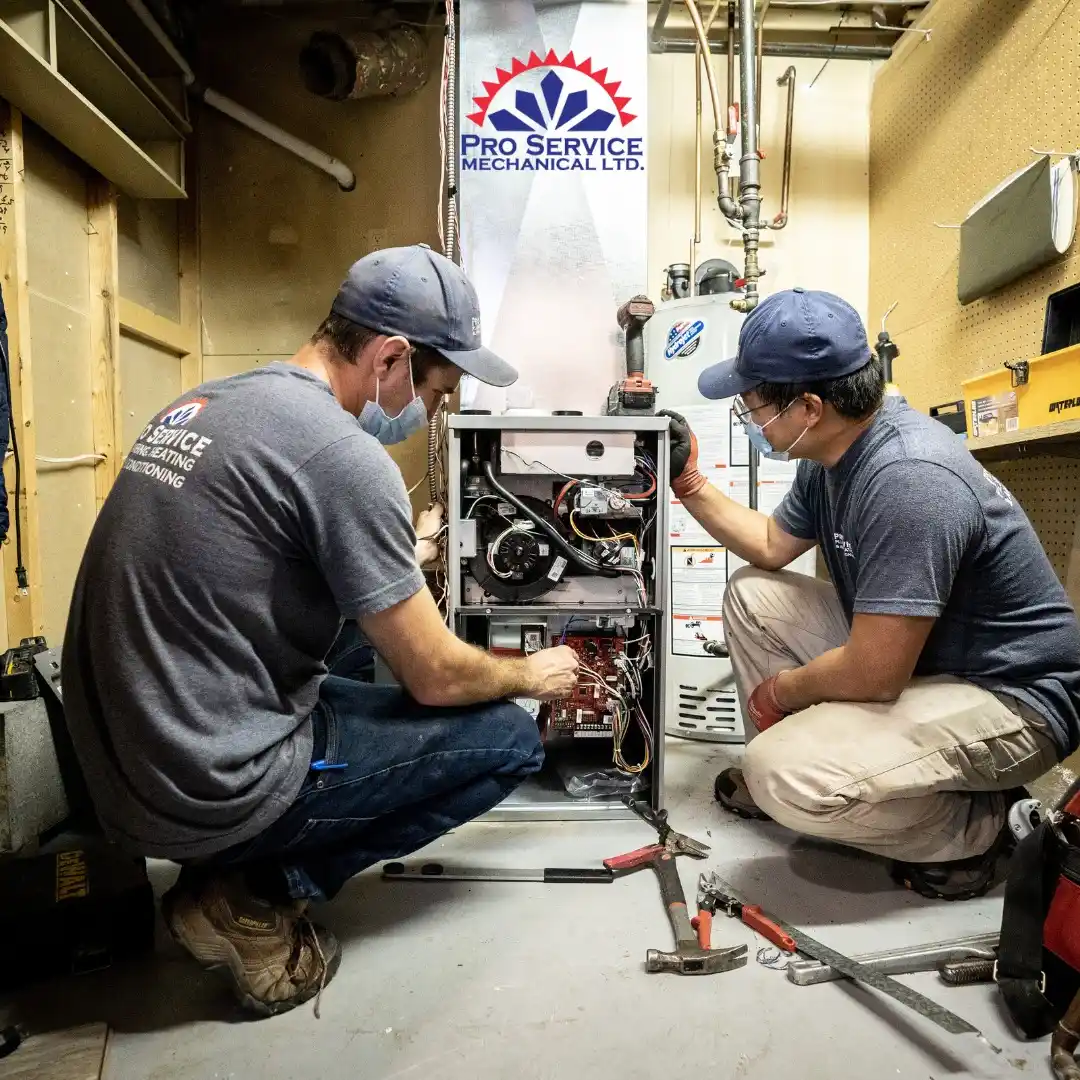
Repairing an AC system in an older Nutana property requires more than showing up with a set of gauges. The technicians at Pro Service Mechanical hold TSASK gas fitter licences and current refrigerant handling certification for both R-22 legacy systems and modern R-410A equipment. That certification matters because R-22 refrigerant cannot legally be purchased, handled, or vented without proper credentials, and a surprising number of Nutana’s pre-2000 systems are still operating on R-22 charges that have never been formally assessed.
Transparent pricing is a consistent reason Nutana homeowners return. The diagnostic fee of $75 to $200 is disclosed before the visit, not after the technician has opened the unit. If you authorize a repair on the same call, the diagnostic fee applies toward the total. There are no surprise charges for components that were on the truck already, and the written estimate you receive before any work begins is the price you pay.
Parts availability drives same-day repair success. Pro Service Mechanical stocks the most commonly failed components for this housing era on every service vehicle: dual-run capacitors in the most common microfarad ratings, contactors, fan motor capacitors, and condenser fan motors in the tonnage ranges typical for Nutana’s retrofitted central systems. For the majority of calls, parts are on the truck and the repair is complete in a single visit, not after a parts order that leaves you without cooling for three days.
Response time during normal operating conditions averages one to two hours from your call to a technician on site. During Saskatoon’s peak summer heat waves, that window may extend, but emergency AC repair calls are prioritized ahead of routine maintenance visits. If you are on a fixed income, elderly, or have medical conditions that make heat exposure dangerous, mention that when you call. We triage accordingly.
The 50% Rule: When AC Repair Stops Making Sense for Nutana Systems
Not every repair call ends with a repair recommendation. The industry-standard benchmark for repair-versus-replace decisions is the 50% rule: if the cost of a repair exceeds 50 percent of the value of a new system, replacement is generally the better financial decision. A more granular version uses the formula: system age multiplied by the repair cost. If that product exceeds $5,000, the economics of replacement typically win. For a 20-year-old system facing a $1,500 compressor replacement, the product is $30,000, well past the threshold.
Nutana’s housing era context makes this calculation important to understand clearly. A property built before 1960 that still has its original or lightly retrofitted AC system from the 1980s or 1990s is likely operating equipment with a remaining useful lifespan of one to five years at best. A capacitor replacement on that system at $300 to $400 is still a sound investment because it is inexpensive and restores full function. A compressor or evaporator coil replacement on the same system, costing $1,500 or more, warrants a harder look at what the remaining years of that system are actually worth.
The R-22 refrigerant question amplifies this for the pre-2000 cohort. If a diagnostic confirms an R-22 system has a meaningful leak, the cost of recharge at $100 to $200 per pound adds up quickly, and recharging without finding and sealing the leak source simply delays the same expense by one season. In that specific scenario, the repair cost calculation almost always tips toward replacement rather than continued investment in a refrigerant that is no longer manufactured.
Even when the numbers clearly favour replacement, a fair diagnostic comes first. No one at Pro Service Mechanical will recommend replacing a system after a capacitor failure. If a component repair will give your system several more serviceable years at a cost well below the replacement threshold, that is exactly what we will tell you. You can explore what a full replacement involves on our AC installation services page, but we will never push that conversation before the diagnostic justifies it. Our air conditioning overview page also covers the full range of services if you want context on where repair fits in the larger picture.
Same-Day AC Repair Response When Nutana Temperatures Spike
Saskatoon’s summer heat events do not give advance notice. A morning that starts at 18°C can reach 33°C by early afternoon, and by the time a homeowner on 11th Street East notices the AC is not keeping up, half the workday is already gone. Pro Service Mechanical operates a 24/7 emergency line specifically because heat-related AC failures do not follow business hours. Call 306-230-2442 and a real person answers, not a voicemail queue. Same-day emergency response is available across Nutana, and for urgent medical situations, priority dispatch applies.
During a standard summer week, one to two-hour response times are realistic for most Nutana addresses. During a multi-day heat wave when demand across the city spikes, response windows extend, but emergency calls involving elderly residents, infants, or medical equipment remain prioritized. The closer your call comes to the start of the heat event rather than day three of it, the more likely a same-day resolution is available. If you notice your system struggling on the first hot day of the season, that is the time to call, not after it has fully given out.
Nutana sits close to several other established Saskatoon neighbourhoods where Pro Service Mechanical provides the same repair coverage. If you are researching cooling options in the surrounding area, information is also available for nearby Buena Vista and Varsity View. For all heating systems service needs in the same home, the same team handles that work under one call. To book a diagnostic or request same-day service, use our online Request for Service form or call 306-230-2442 directly.
Frequently Asked Questions About AC Repair in Nutana
How much does an AC repair typically cost in a pre-1960 Nutana home?
Repair costs vary by component and refrigerant type, which is where Nutana’s older homes differ significantly from newer builds. A capacitor replacement, the most common repair call in this housing era, runs $200 to $400 including labour. Contactor and fan motor replacements fall in the $300 to $600 range. Refrigerant recharge on an R-410A system costs $300 to $600 depending on how much charge has been lost, while an R-22 recharge can run $800 to $1,500 or more due to the scarcity of post-phaseout refrigerant stocks. Compressor replacements and evaporator coil replacements start at $1,500 and can exceed $2,500. The diagnostic fee of $75 to $200 is disclosed upfront and applied toward your repair if the work is done on the same visit.
Is it worth repairing an AC system that is over 20 years old in Nutana?
It depends entirely on what has failed and how much the repair costs relative to replacement. A $300 capacitor swap on a 22-year-old system that is otherwise in good working order is almost always worth doing, as that single part failure does not indicate the rest of the system is about to collapse. However, a compressor failure on a 20-year-old R-22 system creates a very different calculation: the compressor costs $1,500 or more, the refrigerant charge at R-22 prices adds several hundred dollars more, and the system’s remaining useful lifespan is likely one to five years at best. Using the age-times-cost formula, a 20-year-old system with a $1,500 repair produces a product of $30,000, well past the $5,000 threshold where replacement becomes more economical. Your technician will walk through the calculation honestly after the diagnostic.
What is the R-22 situation for Nutana’s older systems, and what does it mean for repair?
R-22 is the refrigerant used in virtually all central AC systems manufactured before roughly 2010, which covers the majority of equipment in Nutana’s pre-1960 and 1961 to 1980 housing cohorts. Canada completed its R-22 phaseout in 2020, meaning the refrigerant is no longer manufactured domestically, and technicians must hold specific certification to handle remaining stocks. The practical impact is cost: R-22 now runs $100 to $200 per pound versus approximately $50 per pound for the current R-410A standard. A system with a meaningful leak that needs multiple pounds of R-22 to recharge can see refrigerant costs alone exceed $1,000. Equally important, a recharge without locating and repairing the leak source is a temporary fix; the refrigerant will simply escape again. If your system is on R-22 and has confirmed a refrigerant leak, that is a strong signal to weigh repair cost against replacement seriously.
How quickly can Pro Service Mechanical respond to an AC emergency in Nutana during a heat wave?
Under normal summer conditions, response times from call to technician on site average one to two hours for Nutana addresses. During a multi-day heat event when the city’s AC demand spikes broadly, that window can extend to three to four hours for standard calls. Emergency calls involving elderly residents, infants, or residents with heat-sensitive medical conditions are prioritized ahead of routine service requests, so please mention those circumstances when you call. The 24/7 line at 306-230-2442 is answered by a person, not a voicemail system, and same-day service is available for emergency calls even on weekends. Calling at the first sign of reduced cooling rather than after a full failure improves the likelihood of a same-day resolution significantly.
What is the single most common AC failure in Nutana’s older homes, and how do I spot it before it becomes a full breakdown?
Failed dual-run capacitors are by far the most common repair call in Nutana’s older housing cohorts, driven by Saskatchewan’s extreme daily temperature swings that cycle these components through thermal stress hundreds of times per season. The capacitor’s job is to store and release the electrical charge that starts the compressor and fan motor on each cooling cycle. When it weakens, the outdoor unit will often hum loudly but fail to start, or start sluggishly before tripping the breaker. A system that starts slowly, takes multiple attempts, runs briefly before shutting off again, or produces a humming outdoor unit with no fan movement is almost certainly showing a capacitor in its final stages. The good news is that capacitors are inexpensive parts and straightforward to replace, and catching the failure early prevents the harder starts from overheating and damaging the compressor, which is the much more expensive repair downstream.