
When the temperature climbs past 30°C and your central air conditioner stops cooling, the afternoon heat inside a Holiday Park home can become genuinely miserable within an hour. Whether you are on Schuyler Street or a few blocks west toward Avenue M South, that familiar hum of a working AC unit becomes the only sound that matters on a July afternoon in Saskatoon. The trouble is, more than half the homes in Holiday Park were built before 1980, meaning the cooling systems serving those houses are working against age, Saskatchewan’s brutal seasonal swings, and the mechanical fatigue that accumulates over decades of hard use.
This neighbourhood sits close enough to the South Saskatchewan River that summer humidity can add a sticky edge to the heat, making a failed air conditioner feel worse than the thermometer alone suggests. When your system stops keeping up, starts making strange noises, or simply shuts off on the hottest day of the year, you need a repair technician who understands what these older systems actually fail at and why. Pro Service Mechanical has diagnosed and repaired cooling systems across Holiday Park and the surrounding area, and this page explains exactly what breaks, what it costs, and how to decide whether a repair makes sense for your home.
54% of Holiday Park AC Compressors Are Overdue for Scrutiny
The most common early warning that a repair call is coming is warm or lukewarm air blowing from the vents even when the thermostat is set low. In a pre-1980 home in Holiday Park, this symptom almost always points to one of three things: a failing capacitor that can no longer start the compressor reliably, a refrigerant leak that has slowly robbed the system of its charge, or a contactor that is not fully engaging the compressor circuit. None of these are catastrophic on their own, but left alone through a Saskatoon heat wave, a failing capacitor will eventually take the compressor with it.
Ice forming on the refrigerant lines or on the indoor evaporator coil is another sign homeowners should never ignore. Frozen coils usually mean restricted airflow, low refrigerant charge, or a blower motor that is running too slowly to move enough air across the coil. In homes built in the 1960s and 1970s, blower motors have often been running continuously for 40-plus years, and their bearings begin to wear in ways that reduce airflow well before the motor fails completely. The ice is a symptom, not the root cause, and diagnosing it correctly matters.
Unusual noises are another diagnostic clue. A grinding or squealing sound typically means a fan motor bearing is failing. A rattling that starts and stops with the compressor cycle often points to a loose or failing contactor relay. A clicking or chattering from the outdoor unit suggests the capacitor is struggling to deliver the starting current the compressor needs. Homeowners in older Holiday Park properties sometimes report that their systems run longer and longer between cycles while cooling less and less, which is a textbook sign of refrigerant loss or a compressor that is losing efficiency.
Unexpectedly high power bills during summer months are a softer warning sign that repair technicians see regularly in this neighbourhood. When an aging AC system has to run twice as long to achieve the same cooling, the electricity consumption climbs noticeably. If your July hydro bill is significantly higher than last year and your usage habits have not changed, the system is working harder than it should. A diagnostic inspection can pinpoint whether the culprit is a refrigerant issue, a dirty coil restricting heat transfer, or a component that is drawing excess current. You can read more about the best time to service your system to avoid hitting these warning signs at the worst possible moment.
Component Failures in Holiday Park’s Mid-Century and Post-War Homes: What Breaks and What It Costs
Capacitors are the single most common repair item in any AC system, and in the pre-1980 homes that make up the majority of Holiday Park properties, they account for a large share of summer service calls. A dual-run capacitor typically costs between $150 and $350 to replace including labour, and a technician who stocks the right sizes can usually complete the repair the same day. The reason capacitors fail more frequently as a system ages is straightforward: the capacitor is a consumable component that degrades with every start cycle, and a 30 or 40-year-old system has accumulated an enormous number of those cycles. Saskatchewan’s summer heat accelerates capacitor degradation because heat is the primary enemy of capacitor longevity.
Contactor failures are nearly as common as capacitor failures in older systems. The contactor is the relay that switches power to the compressor and outdoor fan motor, and its contact points pit and burn over years of use. A contactor replacement typically runs between $150 and $350 all-in, and it is often done at the same time as a capacitor replacement since both components are inexpensive and accessible in the same part of the outdoor unit. Technicians will often inspect both together during a diagnostic visit.
Fan motor failures, both in the outdoor condenser unit and the indoor air handler, are the next tier of common repairs. An outdoor condenser fan motor replacement generally costs between $300 and $600. Indoor blower motor replacements run somewhat higher, typically $400 to $750, because access is more involved. In Holiday Park’s older homes, where blower assemblies have sometimes never been serviced, seized bearings and failed run capacitors account for a significant share of “no airflow” complaints in July and August.
Refrigerant leaks are a repair category where the age of the home matters enormously. Systems installed before roughly 2003 almost certainly use R-22 refrigerant, which was phased out in Canada as of January 2020. No new R-22 is being produced, and the existing supply is limited and expensive. Topping up an R-22 system can cost $100 to $200 per pound of refrigerant, and an older system with a slow leak may need several pounds. The repair cost compounds quickly when you factor in the leak detection service, the repair of the leak itself, and the refrigerant recharge. Systems built after 2010 use R-410A, which remains available and is significantly less expensive to handle. If your Holiday Park home had its AC retrofit at any point in the 1980s or 1990s, assume you have an R-22 system until a technician confirms otherwise.
Compressor failures represent the most serious and expensive repair scenario. A compressor replacement typically costs between $1,200 and $2,500 depending on the unit, and labour adds to that figure. Compressors rarely fail without warning: a compressor that has been running on a weak or failing capacitor for multiple seasons is a compressor under chronic mechanical stress. In Holiday Park’s older systems, compressor failures are often the endpoint of a chain of deferred maintenance, where a capacitor that should have been replaced two summers ago eventually caused the compressor to hard-start and overheat until it failed. Our AC repair services always include a check of the capacitor and contactor during a compressor diagnosis, because those components are usually part of the story.
How Pro Service Mechanical Diagnoses Your AC Problem in Holiday Park
When a technician arrives at a Holiday Park address for a repair call, the diagnostic process follows a consistent, logical sequence rather than guesswork. The first check is always electrical: confirm that the system is receiving proper voltage at the disconnect, that the capacitor is testing within specification, and that the contactor is closing cleanly. These two components account for the majority of “system not running” calls and can be confirmed or ruled out in the first ten minutes. If the electrical components check out, the technician moves to refrigerant pressure readings, measuring both high-side and low-side pressures against the system’s rated specifications to identify whether the charge is correct or whether a leak has depleted it. After that, airflow is evaluated at the indoor air handler, including blower motor operation, coil cleanliness, and filter restriction. A diagnostic service call is typically priced between $75 and $200, and that fee is disclosed before work begins. If a repair is approved on the same visit, the diagnostic charge is applied toward the repair cost.
The goal of the diagnostic is to give you a clear picture of exactly what failed and what it will cost to fix it before any repair work starts. Transparent pricing and a written explanation of the fault are standard with every AC repair visit. For context on how air conditioning systems age and what maintenance looks like before a failure occurs, our broader resources cover preventive care as well.
A Holiday Park AC Repair That Saved a Family’s Summer
Karen B., on Schuyler Street, called Pro Service Mechanical on a Thursday afternoon in late July after her central air conditioner stopped cooling entirely overnight. The outdoor unit was running, the indoor fan was blowing, but the air coming from the vents was room temperature. The system was a mid-1990s unit that had been part of the home since a renovation during that era, meaning it was on R-22 refrigerant. When the technician arrived and ran the electrical diagnostic, the dual-run capacitor tested at roughly 40 percent of its rated capacitance, well below the threshold where it could reliably start the compressor. The compressor itself was intact and tested fine once the capacitor was replaced and the system restarted. Total repair cost: under $300. Karen had been bracing for a much larger bill, possibly a compressor replacement or a conversation about a new system entirely. A single capacitor swap restored full cooling that afternoon.
This outcome is more common than many homeowners expect. Because capacitor failure is so prevalent in older systems, a significant share of “system not cooling” calls in summer turn out to be straightforward electrical component repairs rather than compressor or refrigerant issues. The key is getting a proper diagnostic before assuming the worst. AC repair services that start with an honest assessment save homeowners thousands of dollars in unnecessary work.
Why Holiday Park Homeowners Trust Pro Service Mechanical for Air Conditioner Repair
The licensing and certification requirements for AC repair in Saskatchewan are specific and non-negotiable. Technicians who handle refrigerants must hold a refrigerant handling certification under federal regulations, and gas fitters working on HVAC systems connected to gas-fired air handlers must hold a TSASK gas fitter licence. Pro Service Mechanical technicians carry both, which matters particularly in Holiday Park’s older homes where the cooling system is often integrated with a gas furnace air handler. Working on that system without the proper gas fitting credentials is not just inadvisable, it is not compliant with Saskatchewan regulations.
Refrigerant handling is another area where credentials matter in this neighbourhood. The R-22 systems found in many of Holiday Park’s pre-2000 homes require specific handling procedures, and the limited supply of R-22 refrigerant means it must be recovered, not vented. Our technicians are certified to handle both R-22 and R-410A systems, which means they can accurately diagnose and repair whichever refrigerant type your system uses without the guesswork that comes from a technician who does not regularly work with legacy refrigerants.
Parts availability is a practical concern that affects repair timelines. Pro Service Mechanical stocks a broad inventory of common repair components, including capacitors, contactors, and fan motors in the sizes used by the mid-century and late-century systems common in Holiday Park. For most standard repairs, a technician can complete the work on the same visit rather than ordering a part and scheduling a second appointment. In a Saskatoon summer, waiting several days for a part to arrive is not a comfortable option.
Diagnostic pricing transparency is something we hear about consistently from homeowners who have had frustrating experiences elsewhere. The diagnostic fee range of $75 to $200 is quoted before the technician starts work, and if you approve a repair on the same visit, that fee is credited toward the job. There are no hidden charges for the initial assessment, and no pressure to approve work you are not ready to commit to. Our heating systems service follows the same transparent pricing model through the winter months.
The 50% Rule: Deciding Whether to Repair or Replace Your Holiday Park Air Conditioner
The industry-standard guideline for repair-versus-replace decisions is called the 50% rule: if the cost of a repair exceeds 50% of the cost of replacing the system, replacement is generally the more economical long-term choice. A more practical version of this calculation multiplies the system’s age in years by the proposed repair cost. If that number exceeds $5,000, replacement typically makes more financial sense than repairing the existing unit. For a 25-year-old system facing a $250 repair, the calculation is $6,250, which pushes the decision toward replacement. For a 12-year-old system with the same $250 repair, the result is $3,000, which supports repairing it.
Holiday Park’s pre-1980 homes are in a particularly interesting position for this calculation. Systems in those houses that have not been replaced are typically 30 to 40 years old if they were original installations, or 20 to 30 years old if they were retrofit during the 1990s. A 30-year-old system facing a $400 capacitor and contactor repair produces a calculation of $12,000, which on paper suggests replacement. However, the practical reality is that a well-maintained compressor on a 30-year-old system can often continue operating for several more seasons if the smaller components around it are serviced correctly. The calculation is a guideline, not an absolute rule, and a technician who inspects the compressor directly is in a much better position to advise on remaining lifespan than any formula alone.
The R-22 refrigerant situation adds a separate layer to the decision for older Holiday Park systems. A system that still runs on R-22 and has a known refrigerant leak faces an escalating repair cost because every pound of R-22 added is drawn from a shrinking supply. If leak detection reveals a significant leak in the evaporator coil or refrigerant lines, the combined cost of repairing the leak and recharging the system with expensive R-22 may well clear the 50% threshold and tip the decision toward exploring a newer unit. Our team can walk through this calculation honestly after the diagnostic is complete. If the numbers favour a new system, we will point you toward our AC installation services without any pressure.
For systems less than 15 years old in Holiday Park’s post-2000 construction, the calculation almost always favours repair unless the compressor itself has failed. Capacitor replacements, contactor swaps, minor refrigerant top-ups on R-410A systems, and fan motor repairs are all well below the threshold that would justify replacement. Even evaporator coil repairs, which are more expensive, typically cost between $600 and $1,500 and are worth doing on a system that still has ten or more years of useful life ahead of it.
Same-Day Emergency Cooling Repair When Holiday Park Homes Hit Peak Heat
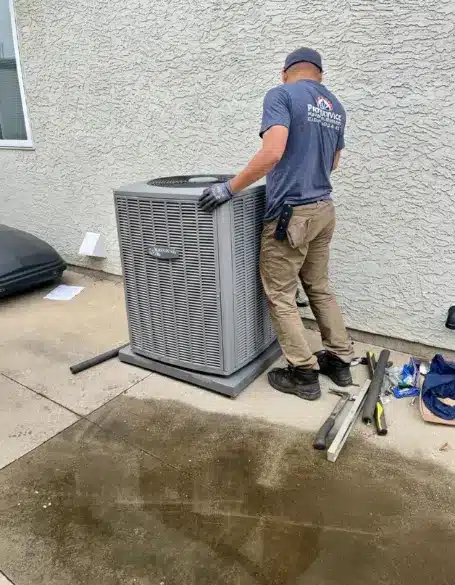
Saskatoon’s summer heat waves arrive quickly and peak hard. When daytime temperatures hold above 30°C for several consecutive days, AC service demand across the city spikes simultaneously, and wait times for non-emergency contractors can stretch to several days. Pro Service Mechanical maintains a same-day and emergency response capacity specifically because a home without cooling during a Saskatoon heat wave is not just uncomfortable, it is a genuine health risk for elderly residents, young children, and anyone with respiratory or cardiovascular conditions. Call 306-230-2442 for same-day emergency AC repair in Holiday Park and the surrounding area. During heat waves, we prioritize calls where indoor temperatures are unsafe, and we staff accordingly to handle the volume that a multi-day heat event generates.
Under normal summer conditions, a repair call placed in the morning can typically be scheduled for the same afternoon. During a declared heat warning or an extended hot spell, response times may stretch to the following morning for non-emergency calls. If your situation is urgent, be direct about it when you call: describe the household’s vulnerability, the indoor temperature, and how long the system has been down. That information helps dispatchers prioritize correctly. You can also submit a Request for Service online if calling is not convenient. For a broader overview of what our emergency AC repair service covers in Saskatoon, including after-hours response, visit that page for current availability information.
Holiday Park neighbours in nearby areas of Saskatoon have access to the same fast-response service. Homeowners in Exhibition and King George can reach Pro Service Mechanical at 306-230-2442 for repair calls as well. Our service area covers the south-central and southwest parts of the city, and we are familiar with the range of system ages and configurations found across these established, mid-century Saskatoon neighbourhoods.
Frequently Asked Questions About AC Repair in Holiday Park
How much does an AC repair typically cost for an older home in Holiday Park?
The range is wide depending on what has failed. At the low end, a capacitor or contactor replacement typically costs between $150 and $350 all-in. A fan motor replacement runs $300 to $750 depending on whether it is the outdoor condenser fan or the indoor blower. Refrigerant leak repairs and recharges vary significantly based on refrigerant type: R-410A systems are much less expensive to recharge than legacy R-22 systems, where refrigerant alone can cost $100 to $200 per pound. Compressor replacements are the most expensive common repair, typically ranging from $1,200 to $2,500 plus labour. The diagnostic fee of $75 to $200 is applied toward the repair cost when work is approved on the same visit, so you are not paying for the assessment separately from the fix.
What is the deal with R-22 refrigerant, and does it affect homes in Holiday Park?
R-22 was the standard refrigerant in residential central air conditioners installed before roughly 2003, and Canada completed its phase-out of new R-22 production in 2020. Any Holiday Park home where the AC system was installed or last replaced before 2003 almost certainly has an R-22 system. The practical implication is that recharging an R-22 system is expensive because the only available refrigerant is recovered stock, and that supply is diminishing. If your older system develops a refrigerant leak, the combined cost of leak detection, repair, and R-22 recharge can be substantial. A technician will identify which refrigerant your system uses during the diagnostic and can give you an accurate cost estimate before any work proceeds.
Is it worth repairing a 25 or 30-year-old air conditioner in a Holiday Park home?
It depends entirely on what has failed and what the compressor condition looks like. A 30-year-old system with a bad capacitor and a healthy compressor can often run reliably for several more seasons after a simple repair. The same system with a failing compressor and an R-22 refrigerant leak is a much more difficult repair argument to make financially. The 50% rule provides a useful guideline: multiply the system’s age by the repair cost, and if that number exceeds $5,000, replacement is usually the better long-term value. But a technician’s assessment of the compressor and overall system condition carries more weight than any formula, and an honest diagnostic will give you the information you need to decide without pressure.
How quickly can Pro Service Mechanical respond to an emergency AC repair call in Holiday Park?
Under normal summer conditions, a morning call can typically be scheduled for the same afternoon. During a Saskatoon heat wave, when demand spikes across the city simultaneously, response for emergency situations involving health vulnerability is prioritized, with other calls scheduled for the following morning. Call 306-230-2442 and describe the urgency of your situation clearly so dispatchers can prioritize appropriately. Pro Service Mechanical maintains emergency response capacity through the summer season specifically because AC failures during heat waves carry real health risk, particularly in Holiday Park’s older homes where a significant share of residents are seniors.
What is the most common AC failure in Holiday Park’s pre-1980 homes?
Capacitor failure is consistently the most frequent repair in older systems across Holiday Park. The dual-run capacitor degrades with every start cycle, and systems that have been running for 30 to 40 years have accumulated an enormous number of those cycles. Saskatchewan’s summer heat accelerates the degradation further, since heat is the primary factor in capacitor lifespan. The good news is that a capacitor replacement is one of the least expensive and fastest AC repairs a technician can perform, typically completed in well under an hour using parts carried on the service vehicle. Contactor failures are the second most common issue in the same age group, and both components are often inspected and replaced together when one shows wear.