
When the temperature climbs past +30°C and your air conditioner stops cooling, the situation moves from uncomfortable to urgent within hours. Exhibition’s tightly built 1920s and 1930s homes hold heat stubbornly, and once the cool air stops moving through those older ducts, a family afternoon near Gabriel Dumont Park can turn into a long, sleepless night. The calls that come into Pro Service Mechanical during Saskatoon heat waves are never abstract, they are real families on Lorne Avenue or Taylor Street, sweating in living rooms that were not designed with today’s summer peaks in mind.
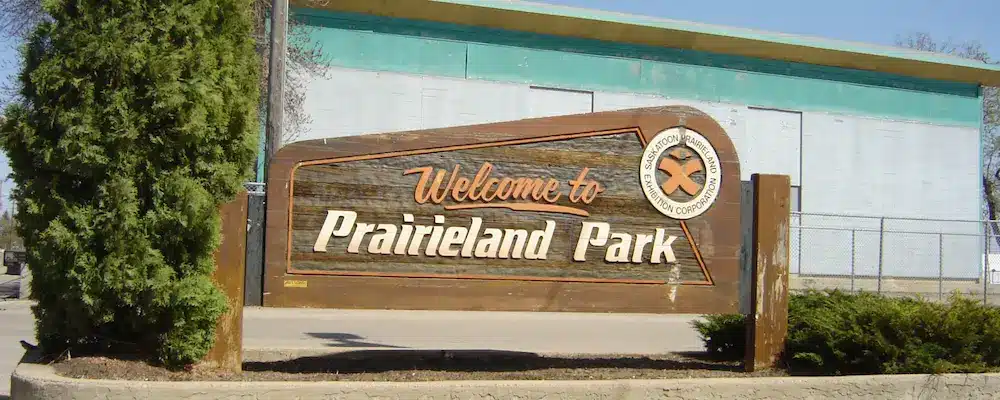
Exhibition is one of Saskatoon’s most characterful older neighbourhoods, developed primarily between 1921 and 1945, with roughly 43% of its homes predating 1960. The Western Development Museum and Prairieland Park anchor the south end of the neighbourhood, and the South Saskatchewan River runs along the western edge near Gabriel Dumont Park, bringing with it a microclimate that adds humidity and wind exposure rarely accounted for in a standard AC setup. Those factors matter when your system is already under strain. This page focuses entirely on AC repair for Exhibition’s existing homes, diagnosing what has failed, fixing it correctly, and helping you decide when repair still makes sense.
Retrofit AC Systems Dominate the Exhibition Neighbourhood — Most Are Past Their Prime
The first sign is almost always the same: you notice the house is warmer than it should be, but the unit is still running. Warm or lukewarm air coming from the vents despite the system cycling normally points toward a compressor problem, a failed contactor, or a refrigerant issue, all common in the retrofit central AC systems that Exhibition’s pre-1960 homes typically carry. These systems were added to existing forced-air furnaces, often during the 1990s or early 2000s, which means many are already pushing or exceeding the 12-to-15-year average lifespan for Saskatoon’s climate.
Ice forming on the evaporator coil or on the refrigerant lines is a sign that something has gone wrong internally, typically low refrigerant from a leak or restricted airflow from a dirty coil or blocked filter. In Exhibition homes, where ductwork in older attics is frequently undersized or partially sealed from decades of patching, restricted airflow is a recurring problem that compounds coil icing. Strange noises tell their own story: grinding or humming usually means a fan motor bearing is failing; banging or rattling suggests a loose component inside the cabinet or a compressor struggling against an electrical fault.
High electricity bills during July and August without a corresponding change in usage habits are a softer warning sign, but a meaningful one. An AC unit that is losing refrigerant, running with a weakened capacitor, or cycling excessively short will draw more power to deliver less cooling. In Exhibition’s pre-1960 homes with limited wall insulation, typically R-10 to R-20 rather than today’s R-40 standard, the system already works harder than average. Any mechanical inefficiency compounds that load fast. If your unit is running almost continuously on a +28°C afternoon and the house is still at 26°C, a diagnostic call is overdue.
Frequent short-cycling, where the unit turns on, runs briefly, and shuts off before the house cools, signals compressor strain or an electrical fault at the contactor. Left unaddressed, short-cycling accelerates wear on every other component in the system. Exhibition homeowners with retrofit systems installed before 2010 should treat short-cycling as an urgent warning, not a minor annoyance. Booking an AC repair service at the first sign of short-cycling almost always costs less than waiting until the compressor fails entirely.
Component Failures Common to Exhibition’s 1920s-to-1980s Retrofit AC Systems
Capacitors are the most frequent failure point in Exhibition’s AC systems, accounting for roughly 30 to 40 percent of all repair calls. The capacitor stores and releases the electrical charge that starts and runs the compressor and fan motors. Saskatoon’s climate is particularly hard on capacitors: dry, hot summers degrade the internal dielectric fluid faster than in humid markets, and the extreme temperature swing from winter storage at -40°C to summer operation at +35°C creates thermal fatigue that shortens service life significantly compared to milder Canadian cities. A capacitor replacement typically costs $150 to $300, one of the most affordable fixes in AC repair and nearly always worth doing on a system that is otherwise in reasonable condition.
Fan motor failures account for another 20 to 25 percent of repair calls. Exhibition’s river proximity means higher ambient dust and debris loads reaching the outdoor condenser unit during spring and summer. Bearing wear in fan motors accelerates when dust accumulates around the motor housing, and motors in retrofit systems from the 1990s or early 2000s are already at or past their expected service life. A fan motor replacement runs $400 to $800 depending on the unit. Contactors, the electrical switching components that engage the compressor, fail due to corrosion and electrical pitting, representing around 10 percent of calls, typically costing $200 to $400 to address.
Refrigerant leaks and evaporator coil failures together account for 10 to 15 percent of service calls, but they carry the highest repair cost variability. For R-410A systems, a leak repair and recharge runs $200 to $500. For older R-22 systems, and this is a critical point for Exhibition, the situation is far more expensive. R-22 refrigerant was phased out in Canada in 2020 and is now scarce. Recharging an R-22 system costs $500 to $1,500 or more, roughly two to three times the cost of an equivalent R-410A repair. Given that Exhibition’s pre-1980 retrofit systems frequently still run on R-22, refrigerant leaks on these systems often tip the repair-versus-replace calculation toward replacement rather than repair.
Compressor failures are the most expensive single-component repair, representing 15 to 20 percent of calls and costing $1,500 to $3,000. A compressor failure on an R-22 system is almost never economically justifiable to repair. On a newer R-410A system under 10 years old, a compressor replacement may still make sense depending on the overall condition of the unit and the remaining lifespan estimate. Compressor failures in Exhibition homes are frequently linked to the thermal shock of Saskatoon’s climate: lubricant thickens during cold storage, and a system that did not receive a spring tune-up is more likely to suffer a compressor overload during the first hot week of the season.
Evaporator coil corrosion and pinhole leaks are a slower-developing problem that Exhibition homeowners sometimes notice only when the system gradually loses cooling capacity over multiple seasons. The river proximity microclimate adds humidity to an otherwise dry prairie environment, which can accelerate coil surface oxidation in systems installed in tight, older attic spaces without adequate airflow. Evaporator coil replacement or repair runs $800 to $2,000 depending on the system. If you have noticed a slow, year-over-year decline in cooling performance rather than a sudden failure, a coil inspection is the right starting point. Our AC repair services include a full coil and refrigerant circuit check as part of every diagnostic visit.
How Pro Service Mechanical Diagnoses an AC Repair Call in Exhibition
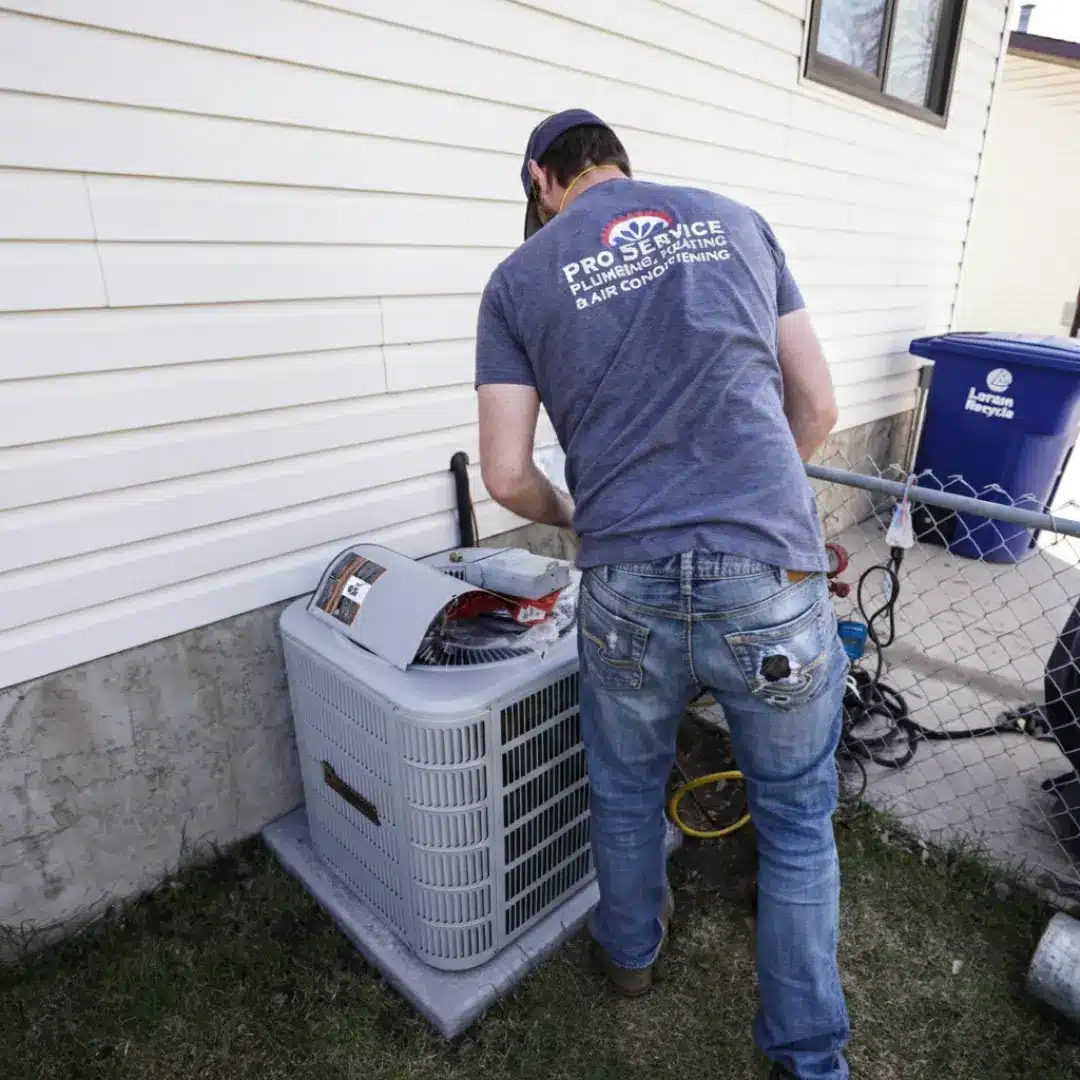
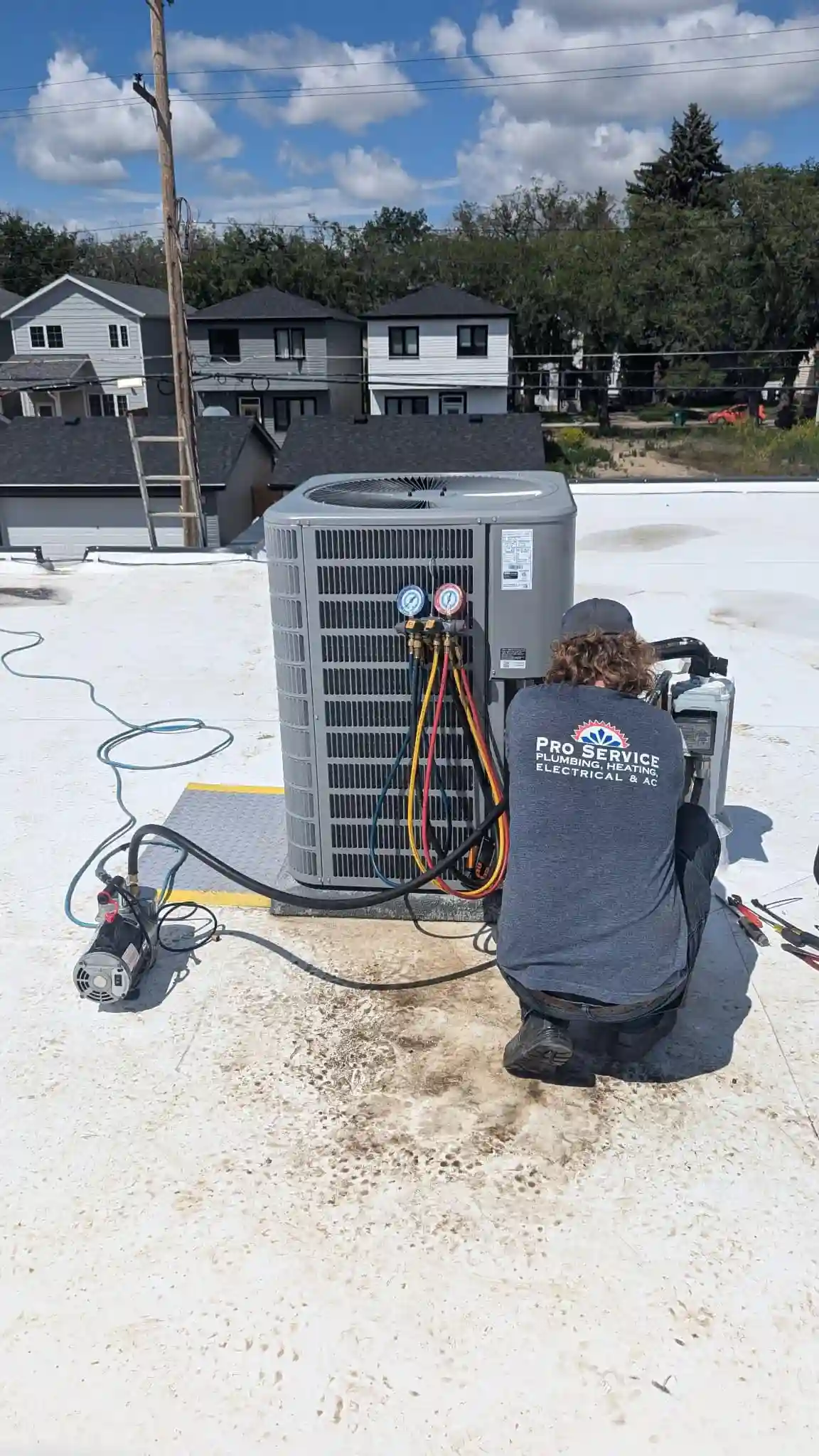
Every diagnostic visit follows a consistent order. The technician starts outside at the condenser: visual inspection for damage, debris, and signs of refrigerant oil, followed by electrical measurements at the capacitor and contactor. This catches the two most common failures first and often resolves the call in under an hour. From there, the technician checks refrigerant pressure against the system’s rated operating specifications, which reveals leak status and compressor performance in a single step. Moving indoors, the evaporator coil and air handler are inspected for ice, corrosion, restricted airflow, and drain blockages, the last of these being a common issue in Exhibition homes where older ductwork creates condensation management challenges. The diagnostic fee for a Pro Service Mechanical visit runs $75 to $200, and that fee is applied toward any repair completed the same day. You will know exactly what failed, what it costs to fix, and what condition the rest of the system is in before any work begins.
Our technicians carry a broad inventory of common repair parts on the service vehicle, including capacitors, contactors, fan motors, and refrigerant for both R-410A and legacy systems. For the majority of Exhibition repair calls, this means same-day resolution rather than a follow-up visit waiting on a parts order. Technicians hold TSASK gas fitter certification and Transport Canada refrigerant handling authorisation, which are the licensing requirements for any AC refrigerant work in Saskatchewan. Unlicensed refrigerant handling is both illegal and a genuine risk to your system. We take the best time to service your AC seriously, and that means having the right parts and credentials on every call.
An AC Repair Call on Taylor Street That Saved a Compressor
Earlier this summer, Karen B. called from her home near Taylor Street and Lorne Avenue. Her 2009 retrofit central AC had stopped cooling overnight, and by mid-morning the house was already at 27°C. She had assumed the compressor was gone and was bracing for a replacement quote. The Pro Service Mechanical technician diagnosed a failed run capacitor within fifteen minutes of arriving, the capacitor had degraded to the point where the compressor could not start under load, making it appear as though the compressor had seized. A capacitor swap costing $225 had the system running cold air within the hour. The compressor itself was in acceptable condition with several years of service remaining. Karen’s words after the visit: “I was convinced I needed a new unit. Turns out it was a $225 part. I’m glad I called for a proper diagnosis first.”
This scenario, a capacitor failure mimicking a compressor failure, is one of the most common misdiagnoses in older AC repair, and it is exactly why a proper diagnostic sequence matters. Skipping straight to a compressor quote without checking the capacitor first is a disservice to the homeowner. Pro Service Mechanical’s diagnostic process is built to rule out inexpensive failures before assessing expensive ones.
Why Exhibition Homeowners Choose Pro Service Mechanical for Cooling Repairs
Exhibition’s older homes require technicians who understand the specific failure patterns of retrofit AC systems added to 1920s-to-1940s forced-air infrastructure. That means recognising when an aging duct system is contributing to coil icing, knowing which R-22 systems are candidates for refrigerant top-up versus full replacement consultation, and understanding why a system near the river may show different corrosion patterns than one in a newer inland neighbourhood. Pro Service Mechanical has serviced Saskatoon’s mature inner-city neighbourhoods long enough to know the difference.
Licensing matters in refrigerant work. Every Pro Service Mechanical technician holds TSASK gas fitter certification and is certified for refrigerant handling under Transport Canada requirements. This is non-negotiable for any AC repair involving refrigerant, whether that is R-22 recovery and replacement or R-410A recharge. Some lower-cost operators in Saskatoon vent refrigerant illegally or handle it without proper recovery equipment. Beyond the environmental and legal issues, this practice leaves your system undercharged and prone to repeat failures.
Transparent pricing is part of every visit. The diagnostic fee is disclosed upfront ($75 to $200), applied to same-day repairs. There are no hidden call-out fees layered on top of the labour rate. Before any repair begins, you receive a written quote with the component cost and labour separated. For Exhibition homeowners who are weighing whether a repair makes sense on an older system, this transparency is essential, you need accurate numbers to make a sound decision, not a vague estimate given over the phone before anyone has looked at the unit.
Parts availability is a real differentiator during Saskatoon’s peak cooling season. When outdoor temperatures stay above +30°C for multiple consecutive days, every HVAC company in the city is busy. Pro Service Mechanical stocks common capacitors, contactors, fan motors, and refrigerant on the vehicle, which means a same-day repair is the norm rather than the exception. For Exhibition’s older retrofit systems, this matters because the parts that fail most often, capacitors and contactors, are standard components that should never require a special order. Connect with us through our Request for Service page to book a diagnostic visit. You can also call 306-230-2442 directly.
The 50% Rule and When It Applies to Exhibition’s Aging Air Conditioners
The standard industry guideline for repair-versus-replace decisions is the 50% rule: if the cost of a repair exceeds 50% of the system’s current replacement value, replacement generally makes more financial sense than repair. A practical version of this threshold for Saskatoon systems is the age-times-repair-cost formula. If your system’s age in years multiplied by the repair cost exceeds $5,000, the case for replacement becomes stronger than the case for repair. A 14-year-old system facing a $400 repair sits well below that threshold. The same 14-year-old system facing a $1,500 refrigerant leak repair on an R-22 circuit sits above it.
For Exhibition specifically, the relevant cohort is the retrofit systems installed in the 1990s and early 2000s on pre-existing furnaces. By 2026, these systems are 15 to 30 years old, well past the 12-to-15-year average lifespan in Saskatoon’s climate. If one of these systems has had multiple component repairs in recent seasons, the 50% rule is almost certainly pointing toward replacement. However, if the system is failing for the first time with a single inexpensive component, a repair still makes sense and buys additional time to plan a replacement without doing it as an emergency decision in July.
R-22 status is the sharpest line in Exhibition’s repair-versus-replace decisions. Any pre-2000 retrofit system that develops a refrigerant leak is facing a minimum $500 to $1,500 recharge cost using increasingly scarce R-22, plus the underlying leak repair. In most cases, that cost combined with the system’s age makes replacement the better choice. The honest advice from a good technician is not to push toward replacement for commission, it is to run the numbers transparently and let the homeowner decide with accurate information. Our AC installation services page covers that path for homeowners who reach that decision point.
Even when the numbers favour replacement, a proper diagnostic comes first. You should not commit to replacing a system based on a symptom alone, because that symptom might be a $200 contactor fix rather than a compressor failure. Pro Service Mechanical will always complete the diagnostic before recommending a path forward. The air conditioning section of our website covers both the repair and the replacement conversation in full, and our heating systems work in Exhibition follows the same diagnostic-first approach. You pay for a diagnosis, not for a predetermined outcome.
Same-Day AC Emergency Repair When Exhibition Loses Its Cooling
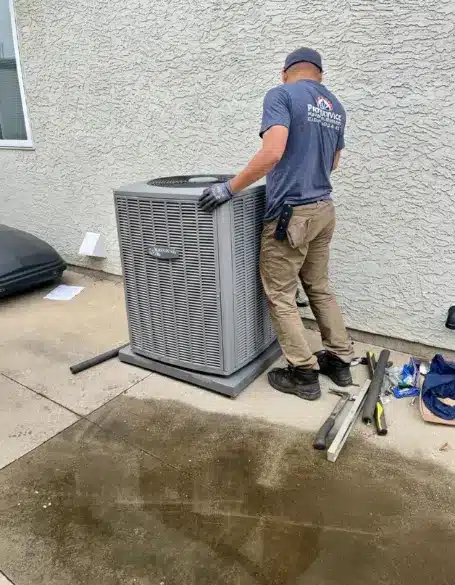
Saskatoon’s summer cooling season is compressed, it runs hard from late June through August, and during that window, demand for AC repair across the city spikes sharply. When a heat wave pushes temperatures to +33°C or +35°C, every technician at every HVAC company in Saskatoon is moving. Under normal summer conditions, Pro Service Mechanical typically responds to Exhibition repair calls within one to two hours of booking. During a declared heat event, response times extend, but the emergency AC repair line is staffed 24 hours a day, seven days a week, a real person answers, not a voicemail. Call 306-230-2442 for emergency service day or night.
Exhibition’s location, close to the river, near Prairieland Park, with narrow residential streets, means technicians familiar with the neighbourhood’s layout get to calls faster than unfamiliar crews working from a map. Pro Service Mechanical has serviced Exhibition and its surrounding neighbourhoods long enough to know the roads and the houses. During heat wave conditions, that local familiarity is worth something real in terms of response time. We also serve the nearby neighbourhoods of Queen Elizabeth and Adelaide Churchill, so if you have family or neighbours in those areas dealing with an AC failure, a single call to 306-230-2442 covers the whole area.
Do not wait out an AC failure in an older Exhibition home during a Saskatoon heat wave. Pre-1960 homes with limited insulation become dangerously hot within hours of cooling loss, particularly for elderly residents and young children. The emergency AC repair service exists precisely for those situations. A same-day capacitor swap or contactor replacement is one of the most cost-effective emergency calls a homeowner can make. Waiting until the following day to save on after-hours rates often results in a longer exposure to heat and, in some cases, secondary damage to the compressor from running unprotected without proper electrical components.
Frequently Asked Questions About AC Repair in Exhibition
What does an AC repair typically cost for an older Exhibition home?
Repair costs in Exhibition vary considerably depending on which component has failed. The most common repair, a capacitor replacement, runs $150 to $300 and is resolved in a single visit. Fan motor replacements typically cost $400 to $800. Contactor replacements come in at $200 to $400. Refrigerant leak repairs on R-410A systems run $200 to $500 for the recharge component alone, while the same repair on an R-22 system can reach $500 to $1,500 due to refrigerant scarcity. Compressor replacements are the most expensive single repair at $1,500 to $3,000, and on aging systems they often tip the calculation toward replacement rather than repair. The Pro Service Mechanical diagnostic fee of $75 to $200 is applied toward the repair cost if work is completed the same day.
My Exhibition home has an AC system from the late 1990s. Is it worth repairing at this age?
A late-1990s system installed in an Exhibition home is now 25 to 28 years old, which significantly exceeds the 12-to-15-year average lifespan for AC systems in Saskatoon’s climate. Whether repair makes sense depends entirely on what has failed. A $200 contactor replacement on a system that has otherwise run reliably is still reasonable, it buys time for a planned replacement rather than a forced one. However, if the system is on R-22 refrigerant and has developed a refrigerant leak, or if the compressor is failing, the repair cost versus remaining lifespan equation almost always points toward replacement. A thorough diagnostic will clarify which situation you are in before any money is spent on parts.
What does R-22 refrigerant phaseout mean for my Exhibition AC repair bill?
R-22 was phased out of production and import in Canada at the end of 2020. Any system still operating on R-22, which includes many pre-2000 retrofit systems common in Exhibition’s older homes, can only be serviced using recovered and reclaimed R-22 from existing stockpiles. That scarcity has pushed R-22 recharge costs to $500 to $1,500 per repair visit, compared to $200 to $500 for equivalent R-410A work. If your Exhibition system develops a refrigerant leak and it is on R-22, the repair cost often exceeds the 50% rule threshold for a system of that age. This is the single most common scenario where the honest recommendation is to discuss replacement rather than continue recharging a refrigerant circuit that will likely leak again.
How quickly can Pro Service Mechanical respond to an AC emergency in Exhibition?
Under normal summer service conditions, Pro Service Mechanical typically reaches Exhibition repair calls within one to two hours of booking. During Saskatoon heat waves, when outdoor temperatures exceed +30°C and AC failures spike across the city, response times can extend, but the emergency line at 306-230-2442 is staffed 24 hours a day, seven days a week. A real person answers that line, not an automated system. Exhibition’s proximity to the service area and its relatively compact residential footprint around Lorne Avenue and Taylor Street means technicians familiar with the neighbourhood can reach calls efficiently. Same-day resolution is the goal on every call, and our on-vehicle parts inventory makes that achievable for the majority of Exhibition repair scenarios.
What is the most common AC failure in Exhibition’s 1990s-era retrofit systems?
Capacitor failure is the single most frequent AC repair across Exhibition’s retrofit systems, accounting for 30 to 40 percent of service calls. These systems were added to existing furnaces in the 1990s and early 2000s, and their capacitors have been through 20 to 25 Saskatoon winters and summers, the extreme thermal cycling from -40°C to +35°C degrades capacitor integrity faster than in any milder Canadian market. The failure is insidious because a weakened capacitor often allows the unit to start intermittently before failing completely, which some homeowners interpret as a minor glitch rather than an impending breakdown. Fan motor failures are the second most common issue, driven by the dust and debris load that Exhibition’s outdoor condensers accumulate near the river. Both repairs are straightforward, affordable, and worth addressing immediately before secondary components are damaged.