

When temperatures climb past +30°C along Rennie Drive or Champlin Crescent, the last thing any College Park East homeowner wants is an air conditioner that has stopped cooling. Saskatoon summers are short and intense, and a single failed component can turn a comfortable home into an unbearable one within hours. Unlike cities where mild summers allow for a flexible repair schedule, our climate gives you very little margin. When your system quits, it needs attention today, not next week.
College Park East is one of Saskatoon’s earlier planned communities, with 84% of homes built between 1961 and 1980 and another 11% built in the 1980s. That means the vast majority of single-family homes on streets like DeGeer Street and Harrington Street are carrying HVAC systems that are anywhere from 35 to 60 years old. Some of those systems have been updated over the decades; many have not. Understanding which components are most likely to fail in homes of this age is exactly where accurate, honest diagnostics matter most. At Pro Service Mechanical, our technicians know what to look for in College Park East’s older properties, and we come prepared with the parts most likely to be needed.
84% of College Park Houses Were Built 1961–1980: Air Conditioning is Running on Borrowed Time
The first sign homeowners typically notice is warm air blowing from the vents even when the thermostat is set low. This often points to a refrigerant issue, a failed capacitor, or a compressor that is struggling to start under load. In College Park East’s older homes, where original or early-replacement central air systems have been running for decades, these symptoms tend to appear suddenly during the hottest days of the year because thermal stress pushes weakened components past their breaking point. A system that chugged along fine in June may stop cooling entirely the first week temperatures stay above 32°C.
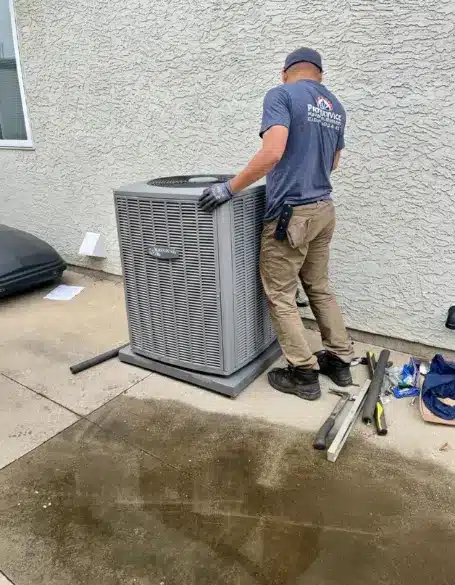
Weak or uneven airflow is another symptom that demands attention. When a fan motor is drawing too much current or a capacitor is failing, the blower cannot move conditioned air effectively through the ductwork. In homes built in the 1960s and 1970s, ductwork is often older galvanized steel that has developed small gaps or sags over the decades, which compounds the problem. If certain rooms feel significantly warmer than others, start by having the air handler and blower assembly inspected before assuming a refrigerant problem.
Ice forming on the refrigerant lines or evaporator coil is a sign that airflow is restricted or refrigerant charge is off. Homeowners sometimes see frost on the copper line running from the outdoor unit and assume the system is working hard, but it is actually an indication that something is wrong. Running a frozen system continuously can permanently damage the compressor, turning a relatively affordable fix into a very expensive one. If you see ice, shut the system off and call for AC repair services right away.
Unusual noises, particularly grinding, banging, or high-pitched squealing from the outdoor condenser unit, usually indicate mechanical failures in the fan motor or compressor. In homes approaching 50 years old, bearings wear out and motor windings degrade. A banging or rattling sound from inside the air handler often means a loose blower wheel. None of these sounds should be ignored, and none of them resolve on their own. The best time to service any AC system is before a failure happens, but when warning sounds appear, a same-day diagnostic is the next best option.
Component-by-Component Failure Patterns in College Park East’s 1960s-1980s Homes
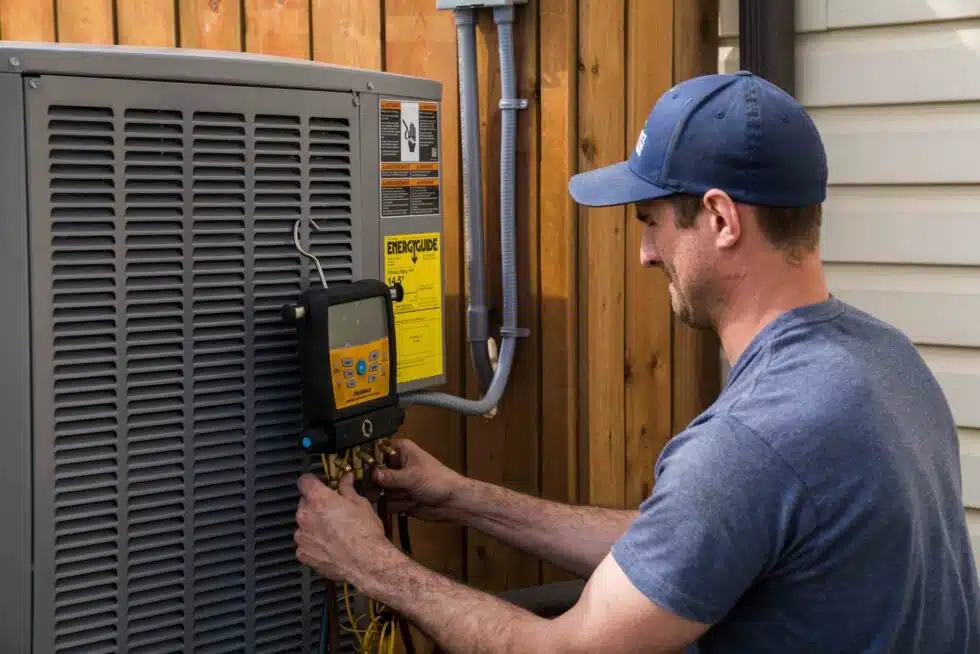
Capacitors are the single most common point of failure in aging AC systems and account for roughly 30% of all service calls during hot weather. A dual-run capacitor stores the electrical charge that starts both the compressor and condenser fan motor. In systems that are 20 or more years old, the capacitor’s capacitance degrades with each heat cycle. College Park East’s extreme seasonal temperature swings, from -40°C in winter to +35°C in summer, accelerate this degradation significantly compared to moderate climates. Capacitor replacement typically costs between $150 and $350 including parts and labour, making it one of the most economical repairs possible on an aging system.
Refrigerant leaks are the second most common issue, particularly in older systems where copper evaporator coils have developed pinhole corrosion over time. A slow leak causes the system to lose cooling capacity gradually, and homeowners often chalk up the change to aging equipment rather than a fixable problem. Leak detection, repair, and recharge typically runs $300 to $700 depending on access and the size of the refrigerant charge. However, the refrigerant type matters enormously in this neighbourhood. Systems installed or last replaced before approximately 2000 to 2004 are very likely to use R-22 refrigerant, which was phased out of production in Canada in 2020. R-22 is no longer manufactured and existing supplies are limited and expensive. If your older College Park East system has a leak and uses R-22, the cost of recharging with reclaimed refrigerant can run $600 to $1,200 or more. That cost calculation often tips the repair-versus-replace decision, which we address in detail below.
Contactors, the small electrical switches that control power to the compressor and condenser fan, fail frequently in systems exposed to Saskatoon’s thunderstorm activity. Voltage spikes during storms pit and burn the contactor points, causing intermittent operation or complete failure. A contactor replacement is a straightforward repair costing $150 to $300 and is often performed the same day as diagnosis. Fan motors on both the condenser and air handler side fail due to bearing wear and heat exposure. An outdoor condenser fan motor replacement typically costs $250 to $450, while a blower motor inside the air handler can run $300 to $600 depending on the motor type.
Compressor failures are the most serious and expensive repair scenario, typically costing $1,200 to $2,500 or more for parts and labour. In systems installed before 1990, compressor failures are often a signal that the full system has reached the end of its practical life, particularly when combined with an R-22 refrigerant type. For College Park East homes where the original or second-generation central air conditioner is still in place, a compressor quote is the point at which a genuine repair-versus-replace conversation should happen.
Evaporator coil failures, including corrosion and physical damage, are less common but more disruptive. A failing evaporator coil causes the system to ice over repeatedly, damages the compressor over time through refrigerant flooding, and eventually requires coil replacement at a cost of $600 to $1,500 depending on coil size and access. Cottonwood fluff and agricultural dust that drifts through Saskatoon summers also accumulates on condenser coils outdoors, restricting airflow and causing the compressor to work at higher pressures than it was designed for. Annual coil cleaning during spring, before the cooling season begins, is the most effective prevention, but even without it, a coil clean during a repair call restores a significant portion of lost efficiency. For complete information on our air conditioning services, including seasonal maintenance, visit our main service page.
How We Diagnose AC Problems in College Park East: The Technician’s Checklist
Our technicians approach every repair call in a consistent, logical sequence. The diagnostic process begins at the thermostat and control wiring, confirming that the correct signal is being sent to the air handler and outdoor condenser. From there, we check the electrical supply, verifying that both the indoor and outdoor disconnect boxes have full voltage and that no breakers have tripped or fuses have blown. This alone resolves a meaningful percentage of no-cooling calls at no repair cost beyond the diagnostic fee. Our diagnostic fee is transparent and disclosed upfront, typically ranging from $75 to $200 depending on complexity, and it is applied toward the repair if you choose to proceed with us.
After confirming power, we test the capacitor with a capacitance meter, check the contactor for pitting or failure, and inspect the compressor’s amperage draw against its rated specifications. At the outdoor unit, we check refrigerant pressure against ambient temperature to identify low charge. If low refrigerant is confirmed, we perform a leak search with electronic detection equipment before adding refrigerant, because adding refrigerant to an unrepaired leak is a temporary and costly solution. We also inspect both the condenser and evaporator coils for fouling, ice formation, or physical damage. By the end of the diagnostic visit, we provide a written summary of findings and a firm repair quote so you can make an informed decision without pressure. Our full range of AC repair services follows this same diagnostic-first approach every time.
A Repair Call on Harrington Street That Saved a Homeowner $2,800
Earlier this summer, a homeowner on Harrington Street called Pro Service Mechanical because their central air conditioner had stopped cooling overnight. The system was running, the thermostat was calling for cooling, but only warm air was coming through the vents. The homeowner had been quoted a compressor replacement by another service company and was preparing to spend close to $3,000. When our technician arrived and ran through the full diagnostic sequence, the real culprit turned out to be a failed dual-run capacitor combined with a moderately dirty condenser coil. The capacitor failure had prevented the compressor from starting properly, which looked like a compressor problem on the surface but was not. The repair, including a new capacitor, a full coil clean, and refrigerant pressure verification, came to $285. The system has been running reliably since. As Sandra T. from that address told us: “I was ready to spend thousands. Your technician actually fixed the real problem instead of just replacing the most expensive part.”
Why College Park East Homeowners Rely on Pro Service Mechanical for AC Repairs
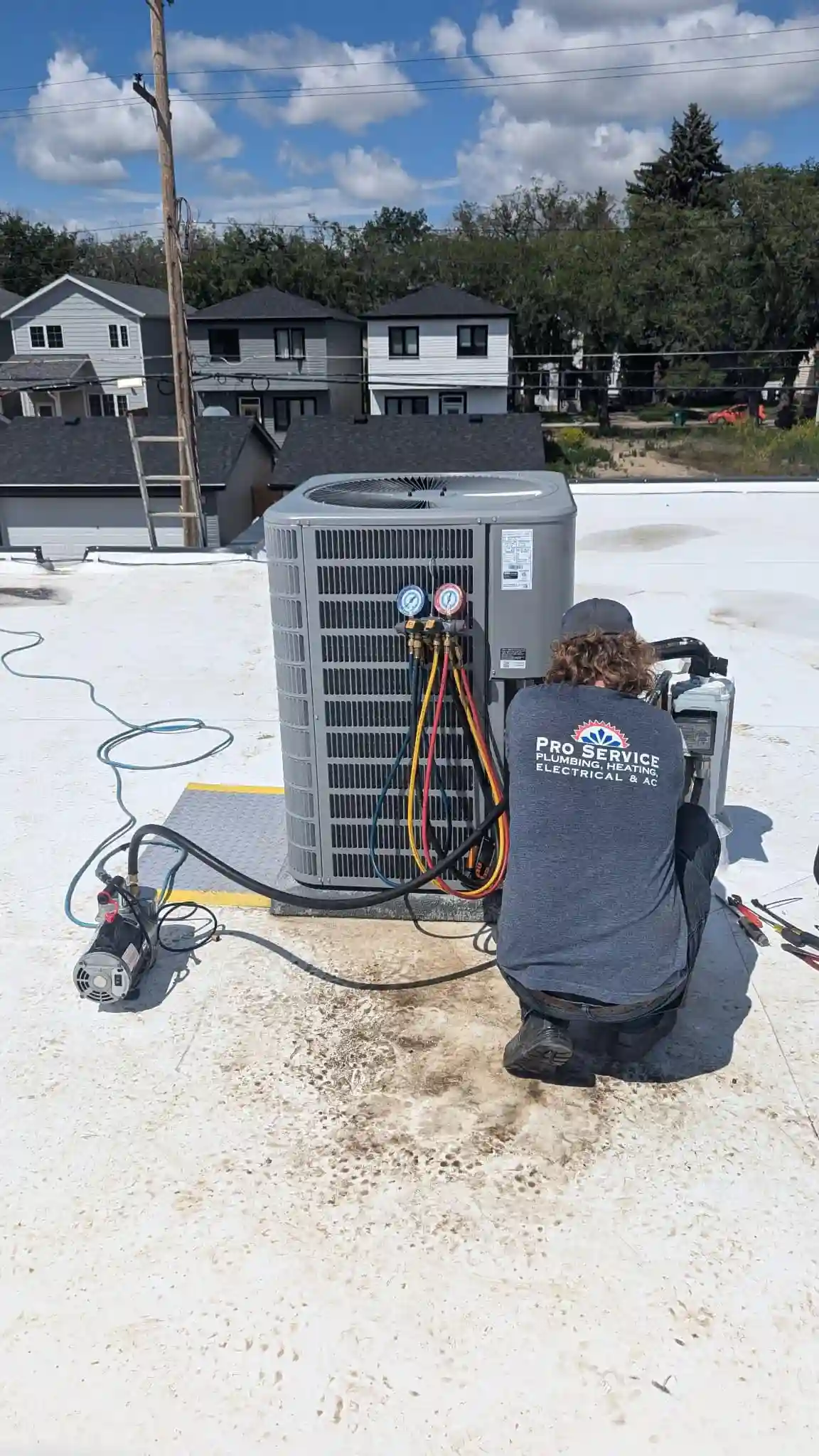
Licensing matters in refrigerant work. All Pro Service Mechanical technicians hold TSASK gas fitter certification and are certified for refrigerant handling under federal regulations. This is not a bureaucratic detail. It means that when refrigerant work is done on your system, it is done legally, safely, and with properly recovered and handled materials. Unlicensed refrigerant handling is both illegal and a risk to your equipment’s warranty, if any warranty coverage remains on an older College Park East system.
We stock the most commonly needed repair components on our service vehicles, including capacitors in the full range of ratings used by 1970s through 1990s equipment, standard contactor sizes, and common fan motor specifications. For College Park East homes, where 84% of the properties were built in a relatively narrow 20-year construction window, equipment specifications are fairly consistent. That means we are rarely waiting on a parts order to complete a standard repair. Same-day completion on the most common failures, capacitors, contactors, and fan motors, is typical rather than exceptional.
Transparency about diagnostic fees is something we treat as non-negotiable. Before any disassembly or testing begins, your technician will explain the diagnostic process and confirm the fee. Once we have identified the problem, we provide a written quote before performing any repair work. You are never presented with a bill for work you did not authorize. That approach has made Pro Service Mechanical a trusted name for emergency AC repair across Saskatoon’s east side for many years.
College Park East’s high homeownership rate, around 77%, means most people calling us are invested in their homes long-term. We respect that by giving honest assessments rather than defaulting to the most expensive recommendation. If a capacitor swap fixes your system, that is what we recommend. If your system is genuinely at the end of its life, we will tell you that clearly too. Either way, you leave the conversation with accurate information. You can also reach our team anytime at 306-230-2442 for repair questions or to schedule a diagnostic visit.
The 50% Rule Applied to College Park East’s 1960s-1980s AC Systems
The repair-versus-replace decision is one of the most important conversations in HVAC service, and it should always be based on math rather than pressure. The industry standard guideline is straightforward: if the cost of a repair exceeds 50% of the replacement cost of a comparable new system, replacement is usually the better financial choice. A more precise version of this calculation multiplies the system’s age in years by the repair cost. If that number exceeds $5,000, replacement is generally recommended. For a 40-year-old system facing a $200 repair, the calculation is 40 x $200 = $8,000, which clearly favours replacement. For a 15-year-old system with the same $200 repair, the result is $3,000, which clearly favours repair.
For College Park East homes built in the 1961 to 1980 range, many of the AC systems in place today are either original to the home or were installed as first-generation replacements in the 1990s. Systems from the early 1990s are now 30 or more years old. A central air conditioner’s typical service life in Saskatoon’s climate, with its extreme seasonal cycling, is approximately 15 to 20 years under normal conditions. A 30-year-old system is well past that threshold and should be evaluated honestly. That said, a system in its final years that needs a $200 capacitor to get through the current summer is often worth repairing on a budget basis, even if replacement planning makes sense for next spring.
R-22 refrigerant is a critical factor in this calculation for older College Park East properties. If your system uses R-22 and has a refrigerant leak, the cost of sourcing reclaimed R-22 to recharge it may run $600 to $1,200 or more. When that figure is added to labour and leak repair, the total repair cost may easily cross the 50% threshold for a system that is already 25 to 35 years old. In those cases, the honest recommendation is replacement, and we will say so directly. Our AC installation services page has more detail for homeowners at that decision point.
Equally important: the 50% rule should only be applied after a proper diagnostic confirms what the actual repair cost is. We have seen homeowners replace perfectly repairable systems because a surface-level assessment assumed a compressor failure when the real problem was a $200 capacitor. A fair diagnostic always comes before a replacement recommendation at Pro Service Mechanical. We encourage you to request a Request for Service online if you would like to schedule that diagnostic visit at a convenient time.
Same-Day AC Repair When College Park East Homes Can’t Wait
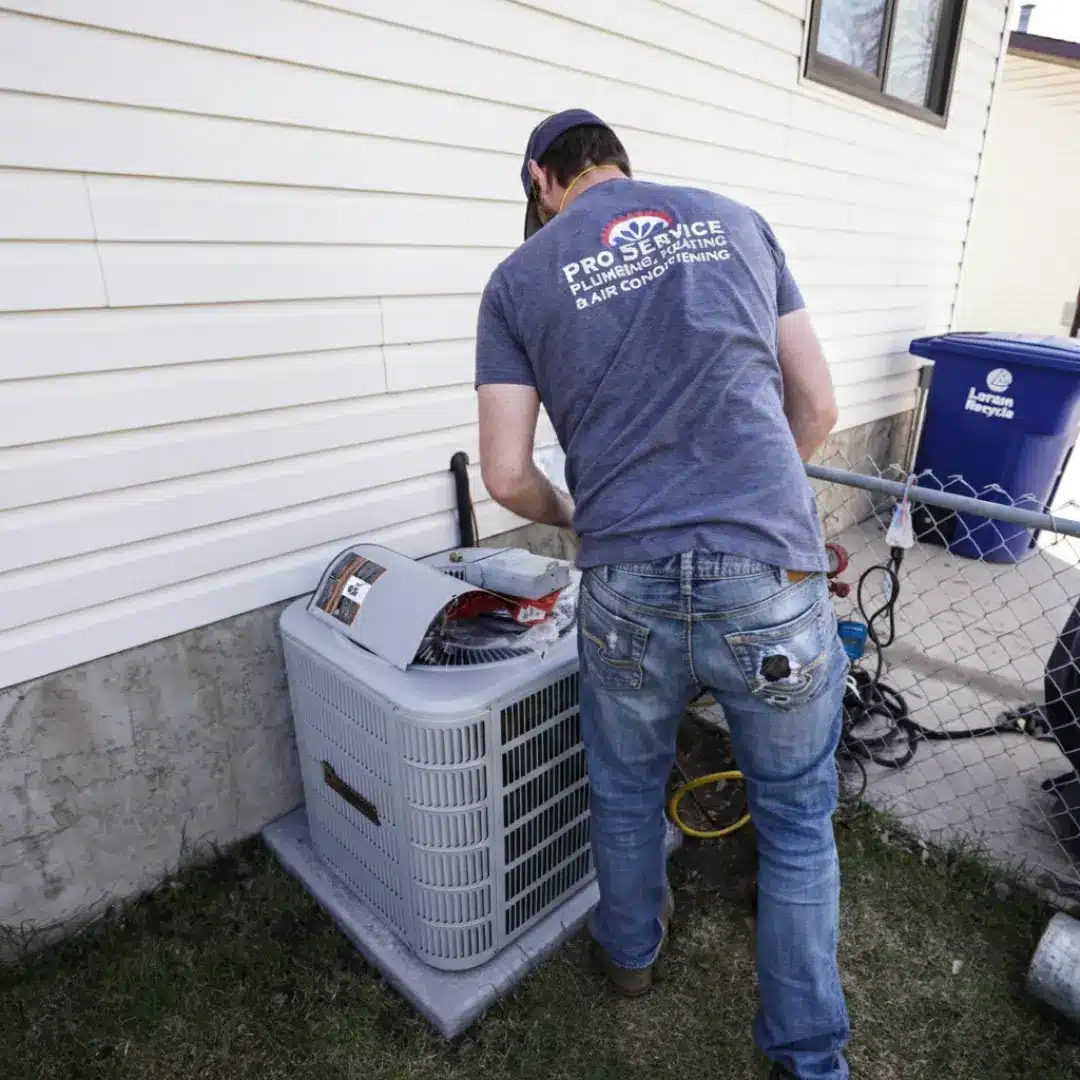
Saskatoon’s summer cooling season is compressed into roughly eight to ten weeks, and demand for AC repair spikes dramatically when temperatures stay above 30°C for multiple days in a row. During a heat wave, response times across the city can stretch to several days with some service providers. Pro Service Mechanical maintains same-day scheduling capacity for urgent repair calls, and our emergency line at 306-230-2442 is answered by a real person, not an automated system, during extended hours throughout summer. For households with young children, elderly family members, or residents with heat-sensitive health conditions, a same-day response is not a convenience. It is a necessity.
During normal summer conditions, our typical response time for a College Park East repair call is one to two hours from the time you call. During multi-day heat events, we prioritize the most urgent situations, including homes with vulnerable occupants, and we are transparent about our scheduling when demand is high. We also carry the parts for the most common failures on every truck, which means a same-day diagnosis is usually a same-day repair for capacitor, contactor, and fan motor calls. If a part needs to be ordered, we will tell you exactly when to expect it. For information on heating systems and winter service, our heating page covers furnace repair and maintenance as well.
If you are in College Park East and your air conditioner has stopped working, do not wait to see if it resolves on its own. It will not. Call Pro Service Mechanical at 306-230-2442 or submit a Request for Service online. Homeowners in nearby areas including Grosvenor Park, Greystone Heights, and Haultain are also served under the same same-day priority model during summer peak demand.
Frequently Asked Questions About AC Repair in College Park East
How much does an AC repair typically cost in College Park East?
Most AC repairs in College Park East fall between $150 and $700, depending on which component has failed. Capacitor and contactor replacements sit at the lower end of that range, typically $150 to $350, and are the most common repairs on systems from the 1970s through 1990s. Fan motor replacements run $250 to $600. Refrigerant leak repairs, including detection, leak sealing, and recharge, typically cost $300 to $700 for systems using R-410A. For systems still using R-22 refrigerant, recharge costs alone can push a refrigerant repair to $800 to $1,500 or more due to the scarcity of reclaimed R-22 since the 2020 production phaseout. Compressor replacements are the highest-cost repair at $1,200 to $2,500, and in older College Park East systems, that cost often triggers a replacement conversation instead. A diagnostic fee of $75 to $200 applies to every service call and is credited toward the repair if you proceed.
Is it worth repairing a 30-to-40-year-old AC system in a 1970s College Park East home?
It depends on what has failed and what the repair costs relative to the system’s age. The standard guideline is to multiply the system’s age by the repair cost. If the result exceeds $5,000, replacement is generally the better financial choice. For a 35-year-old system, any repair over roughly $145 starts to approach that threshold, which means most meaningful repairs on very old systems lean toward replacement. However, a $200 capacitor swap on a 35-year-old system that otherwise runs well might still make sense as a short-term measure while you plan a replacement for next spring. The most important step is getting an accurate diagnostic first, because surface-level symptoms like no cooling can come from a $200 capacitor rather than a $2,000 compressor, and no honest replacement recommendation should be made without confirming which component has actually failed.
What is the R-22 refrigerant situation for older College Park East systems, and what does it mean for my repair?
R-22, also known as Freon, was the standard refrigerant used in central air conditioners installed before approximately 2003 to 2006. Canada phased out R-22 production and import in 2020, meaning the only supply available is from recovered and reclaimed existing stocks. Those stocks are limited and increasingly expensive, with costs often running $50 to $80 per pound or more. A standard residential AC system holds three to five pounds of refrigerant, so a full recharge on an R-22 system can cost $600 to $1,200 for the refrigerant alone before labour or leak repair. For the majority of College Park East homes built in the 1961 to 1980 era, there is a real possibility that the existing AC system, especially if it has never been replaced, is still using R-22. Our technician will identify the refrigerant type during the diagnostic visit so you have full information before making any repair decision. This is one of the most important factors in the repair-versus-replace calculation for older properties in this neighbourhood.
What is the most common AC failure in 1970s-built College Park East homes?
Failed dual-run capacitors account for the highest percentage of service calls on aging AC systems and are particularly prevalent during Saskatoon’s summer heat waves. A capacitor is responsible for starting both the compressor and condenser fan motor, and its electrical capacity degrades with each thermal cycle over years of seasonal use. Saskatoon’s extreme temperature range, from deep winter cold to summer highs above 30°C, accelerates that degradation compared to milder climates. The failure pattern is typically that a system runs fine in cooler weather but fails to start or shuts off quickly once outdoor temperatures are consistently high. Contactors are the second most common failure, driven partly by Saskatoon’s summer thunderstorm activity, which causes voltage spikes that pit and burn the electrical contacts. Both capacitors and contactors are carried on our service vehicles and can usually be replaced the same day as diagnosis.
How fast can Pro Service Mechanical respond to an emergency AC breakdown in College Park East?
Under normal summer conditions, our typical response time for College Park East is one to two hours from your call. We answer our emergency line at 306-230-2442 with a real person during extended summer hours, so you are not navigating an automated system when your home is heating up. During multi-day heat events when demand spikes across Saskatoon, same-day service is maintained as a priority, though we are transparent about scheduling when wait times are longer than usual. Households with elderly residents, young children, or heat-sensitive medical conditions are given scheduling priority on high-demand days. Most of the common repairs, capacitor and contactor failures, fan motor replacements, coil cleaning, are completed in a single visit because we stock those parts on every truck. For urgent situations, calling 306-230-2442 directly will get you to a person who can give you an honest time estimate for your specific situation rather than a generic booking window.