24/7 emergency AC repair. Same-day diagnostics, transparent pricing, first-visit repair on most calls across all Saskatoon neighbourhoods.
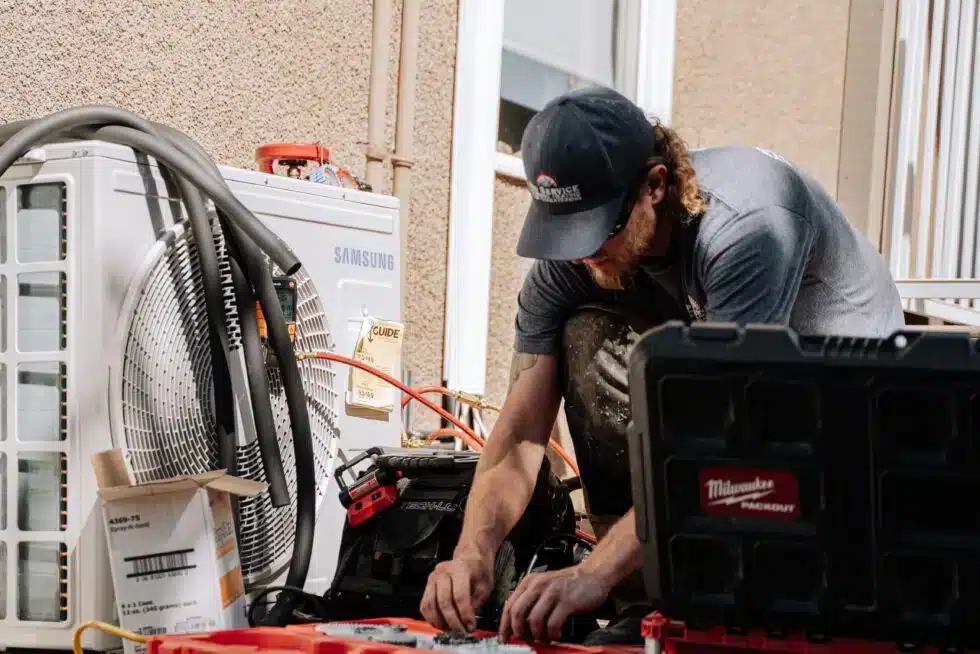
When your air conditioning quits during a Saskatchewan heat wave, you need a real technician at your door within hours, not days. At Pro Service Mechanical, we answer the phone 24/7, dispatch TSASK-certified technicians with fully stocked trucks, and repair most AC issues on the first visit. Transparent diagnostic fees ($75-$200, applied to approved work), written estimates before any parts go in, and zero high-pressure upsells. Call 306-230-2442 for same-day service.
Real dispatch, real technicians, real answers. Most AC repairs diagnosed and quoted on the first visit.
Written estimates before work begins. Diagnostic fee applied to approved repairs. No surprise charges.
When your AC fails in Saskatoon summer, every hour matters. Our TSASK-certified team delivers fast, honest repair with transparent pricing, stocked service vehicles, and a 24/7 emergency line answered by real people.
Our licensed professionals have years of experience in HVAC, plumbing, and electrical services, ensuring top-tier workmanship every time.
We’re here when you need us most. Our emergency response team is ready around the clock to handle urgent repairs and restore comfort fast.
We stand behind our work with industry-leading warranties and a commitment to customer satisfaction. Your comfort is our priority.
When your air conditioning quits during a Saskatchewan July heat wave, every minute without cool air feels like an hour. Pro Service Mechanical delivers same-day AC repair across all of Saskatoon, with real technicians answering our emergency line 24/7 and diagnostic dispatch typically within 1–2 hours under normal conditions (4–8 hours during extreme heat events when demand surges citywide). We've repaired central air conditioning systems in every corner of this city: established West Side neighbourhoods like Confederation Park, Massey Place, and Dundonald; newer West communities including Hampton Village, Blairmore, and Kensington; Central and East Saskatoon areas such as Nutana, Varsity View, and Queen Elizabeth; and the rapidly expanding South and North subdivisions like Stonebridge, Brighton, Silverspring, Evergreen, and Willowgrove.
Our TSASK-certified, background-checked technicians arrive with diagnostic tools, refrigerant manifolds, and trucks stocked with the most common repair parts: dual-run capacitors, contactors, blower motor modules, condensate pumps, and refrigerant for both R-410A and legacy R-22 systems. Diagnostic fees run $75–$200 depending on system complexity and are applied in full toward any approved repair work. We provide transparent, written estimates before installing a single part, and we'll tell you honestly when a repair makes financial sense and when replacement is the smarter long-term investment. A failed capacitor on a 7-year-old system? Absolutely worth the $180–$280 repair. A seized compressor on a 16-year-old builder-grade condenser that's already lost 15% efficiency to Saskatchewan's brutal 70°C annual temperature swing? We'll walk you through the replacement math and let you decide.
Saskatchewan's climate punishes air conditioning equipment harder than almost anywhere else in Canada. Summer peaks hit 30–35°C, winters plunge to -30°C or colder, and that massive temperature range wreaks havoc on refrigerant seals, capacitor dielectrics, contactor points, and circuit boards. What might last 18 years in Vancouver often fails by year 12 here. When your system stops cooling, call 306-230-2442 for same-day diagnostic dispatch and get your comfort back before the next heat wave rolls through.
Recognizing the early symptoms of air conditioner failure can mean the difference between a $250 capacitor replacement and a $4,000 emergency system replacement during the hottest week of summer. Saskatchewan homeowners should watch for these warning signs and understand which require immediate action versus scheduled service.
Certain symptoms signal either a safety risk or a failure that will cascade into more expensive damage within hours. If you notice an electrical burning smell coming from your indoor air handler or outdoor condenser unit, shut the system off at the thermostat and breaker, then call for emergency service. That acrid odour usually indicates overheating wiring, a failing blower motor drawing excessive current, or a shorted control board, and continuing to run the system risks a house fire.
A sweet, chemical odour near your supply vents or outdoor unit, sometimes described as chloroform-like or vaguely ether-scented, indicates a refrigerant leak. Modern R-410A and older R-22 refrigerant are not highly toxic in small quantities, but a significant leak means your system is losing cooling capacity rapidly and the compressor may be running without adequate lubrication (which circulates with the refrigerant). Shut the system down and call for repair to prevent compressor damage.
Ice buildup on the copper refrigerant lines running to your outdoor condenser during a 30°C afternoon is not normal and signals either critically low refrigerant (from a leak) or severely restricted airflow across the evaporator coil. Both conditions force the remaining refrigerant to over-expand and freeze, and both will eventually destroy the compressor if left unaddressed. Loud grinding, screeching, or banging sounds from the outdoor condenser indicate bearing failure in the compressor or condenser fan motor; these components can seize completely within hours once the noises start. Visible smoke from any HVAC component or a breaker that trips every time the air conditioner tries to start requires immediate shutdown and emergency service.
These symptoms won't burn your house down, but they will leave you sweating through a Saskatchewan heat wave and often cause secondary damage if ignored for more than a day or two. An air conditioner that runs continuously without cooling your home below 24°C on a 28°C day has lost significant capacity, whether from low refrigerant, a failing compressor, blocked airflow, or a stuck expansion valve. Warm air blowing from your supply vents when the thermostat is calling for cooling points to a compressor that won't engage, a reversing valve issue (rare in cooling-only systems), or a complete refrigerant loss.
Short-cycling, where the compressor kicks on, runs for 30–90 seconds, shuts off, and repeats the cycle every few minutes, destroys compressors and capacitors rapidly while spiking your electrical bill. This typically indicates a failing capacitor, refrigerant overcharge or severe undercharge, or a malfunctioning pressure switch. Weak airflow from your registers despite a clean furnace filter suggests a failing blower motor, blocked ductwork, a frozen evaporator coil, or a failed blower capacitor.
Water pooling around your indoor air handler or furnace almost always indicates a clogged condensate drain line, a failed condensate pump, or a cracked drain pan. In humid Saskatoon summers (especially after heavy rain when outdoor humidity climbs), a properly functioning AC can generate 20–40 litres of condensate per day. If that water backs up instead of draining outdoors, it will eventually overflow onto your furnace, damaging the control board and gas valve. A thermostat that's unresponsive, displays error codes, or shows a temperature 3–5°C off from actual room temperature may need recalibration, battery replacement, or a new low-voltage transformer, but the underlying cause often traces back to electrical issues at the air handler.
Some AC problems develop gradually and allow time for scheduled maintenance rather than emergency calls, but they still deserve attention before they cascade into urgent failures. An energy bill that jumps 20–40% compared to the same summer month last year, with no change in your usage patterns or utility rates, usually means your HVAC system has lost significant efficiency. Worn capacitors, refrigerant leaks that dropped charge by 10–15%, dirty coils, or a compressor nearing end-of-life all force the system to run longer to achieve the same cooling, burning extra electricity every cycle.
An audible hum from the outdoor condenser unit even when the system is off indicates a stuck contactor; those points are supposed to open and cut power to the compressor and fan motor when the thermostat is satisfied, but when they weld shut from electrical arcing, the contactor stays energized. This drains a small amount of power continuously and will eventually cause the contactor coil to overheat and fail. A mild musty or earthy smell from your supply vents, especially noticeable when the system first kicks on, points to mould or mildew growth on the evaporator coil. Saskatchewan's wet springs create perfect conditions for this; the coil stays damp for weeks, and without proper drainage or UV treatment, organic growth takes hold.
An air conditioner older than 12 years that still cools but struggles on the hottest days is sending a clear message: its time is limited. Saskatchewan's 70°C annual temperature swing, from -35°C winter lows to +35°C summer highs, accelerates wear on every seal, capacitor, and circuit board in the system. Refrigerant slowly migrates through microscopic imperfections in brazed joints, capacitor dielectrics degrade from temperature cycling, and compressor windings develop higher resistance. By year 10, most central air conditioning systems have lost 10–15% of their original SEER rating even without a catastrophic failure, meaning they cost more to run and cool less effectively.
When in doubt, call 306-230-2442. A phone diagnostic is free; an on-site diagnostic runs $75–$200 depending on complexity and applies in full toward any approved repair work.
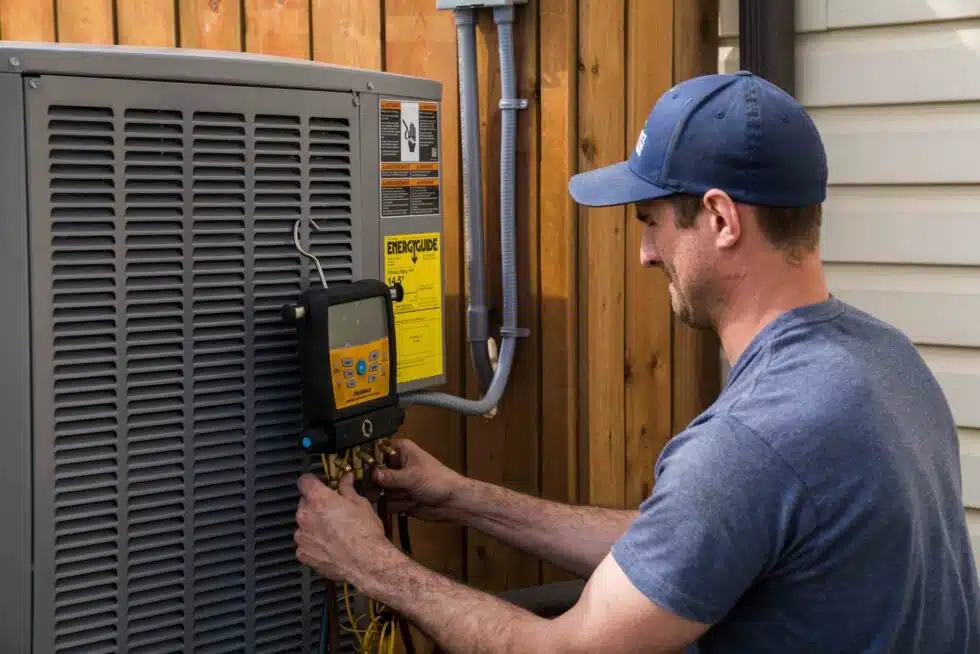
Pro Service Mechanical follows an 8-step diagnostic and repair protocol designed to identify the root cause of your AC failure, present transparent pricing before any work begins, and restore reliable cooling with documented proof of performance before our technician leaves your property.
1. Phone intake and pre-diagnostic – When you call our 24/7 emergency line, a real person answers, not a voicemail system or out-of-province call centre. Our dispatcher asks targeted diagnostic questions: How old is the system? When did the problem start? Is the outdoor unit running? Is the indoor blower moving air? Are there any error codes on the thermostat? Do you hear unusual noises? This intake allows us to dispatch the right technician with the right parts and helps us triage true emergencies (electrical burning smell, refrigerant leak) from urgent-but-safe issues (warm air, weak airflow). During normal demand, we dispatch same-day service within 1–2 hours; during extreme heat waves when half of Saskatoon is calling for AC repair, expect 4–8 hours but know that you’re on the schedule.
2. Pre-arrival call – Our technician phones 30 minutes before arrival with his name, estimated arrival time, and a quick confirmation of the symptoms you reported. This courtesy call ensures someone is home and gives you time to clear access to the furnace and outdoor condenser.
3. On-site safety check – Before any diagnostic work begins, the technician performs a visual safety inspection: electrical panel for proper breaker sizing and any signs of overheating, refrigerant lines for visible damage or oil staining (indicates a leak), thermostat for power and proper wiring, furnace filter condition (a $4 clogged filter causes half the “broken AC” calls we receive), and outdoor condenser coil inspection. Hail damage from Saskatchewan’s severe summer thunderstorms is common; even dime-sized hail can flatten condenser fins and restrict airflow by 30–40%, forcing the compressor to overheat.
4. Systematic diagnostic – Armed with manifold gauges, clamp meters, multimeters, and infrared thermometers, the technician measures actual system performance against manufacturer specifications. Refrigerant pressures on both the high side (liquid line) and low side (suction line) reveal whether the charge is correct, whether there’s a restriction in the metering device, or whether the compressor has lost pumping capacity. A clamp meter measures amp draw on the compressor, condenser fan motor, and indoor blower motor; readings significantly above or below nameplate values indicate failing motors or electrical faults. A multimeter tests capacitor microfarad ratings (a 40 μF capacitor reading 28 μF is functionally dead and will cause hard starting and motor damage). Delta-T measurement across the evaporator coil, the temperature difference between return air and supply air, should fall between 16–22°F (9–12°C); lower splits indicate restricted airflow or low refrigerant, higher splits suggest oversized equipment or ductwork issues.
5. Written estimate before repair – Once the diagnostic is complete, you receive an itemized written estimate covering parts, labour, applicable taxes, and warranty terms. No work begins without your explicit approval. If the repair cost approaches 50% of replacement value on a system older than 12 years, we’ll present both options with honest guidance. A $750 repair on a 14-year-old builder-grade 13 SEER condenser might keep you cool for two more summers, or it might fail again next July; a $3,200 replacement with a 16 SEER model will cool more efficiently and carry a 10-year parts warranty. We present the math and let you decide.
6. First-visit repair when possible – Our service vehicles stock the most common AC repair parts for Saskatoon’s typical residential systems: dual-run capacitors in 35/5, 40/5, and 45/5 microfarad configurations, which handle roughly 70% of service calls; 24-volt single-pole and double-pole contactors; universal condensate pumps and float switches; ECM (electronically commutated motor) blower modules for variable-speed furnaces; universal control boards; and refrigerant in both R-410A (standard since 2010) and R-22 (for older systems, though supply is limited and expensive). Pricing for common repairs: capacitor replacement runs $180–$280 installed, contactor replacement $190–$310, condensate pump $225–$350, blower motor ECM module $450–$850 depending on horsepower and compatibility, and refrigerant leak search plus a 2-pound top-up $280–$550 (with leak repair priced separately depending on location and brazing complexity). Compressor replacement on a residential condenser typically costs $1,800–$3,200 installed, which is rarely economical on any system older than 8 years given that you’re installing a $1,200 part into aging infrastructure with an old evaporator coil, aging wiring, and deteriorating ductwork.
7. Post-repair commissioning – After parts are installed, the technician doesn’t just flip the breaker and walk away. Refrigerant subcooling and superheat are measured and adjusted to manufacturer specifications (typically 10–15°F subcooling and 8–12°F superheat for fixed-orifice systems, though this varies by brand and ambient temperature). Airflow is measured at the supply plenum, targeting 400 CFM per ton of cooling capacity. Delta-T is re-measured and confirmed within the 16–22°F range. The thermostat is calibrated if needed. The system runs through a complete 20-minute cooling cycle while the technician monitors amp draw, refrigerant pressures, and supply air temperature to ensure stable operation before he packs up.
8. Documentation and follow-up – You receive a complete service ticket documenting the original complaint, diagnostic findings, parts installed with serial numbers, refrigerant added (if any), measured performance data, and warranty terms. Labour is guaranteed for 90 days; parts carry the manufacturer’s warranty, typically 1–5 years depending on the component. The technician photographs anything concerning that wasn’t part of the immediate repair: a rusted outdoor disconnect box, frayed low-voltage wiring, an undersized breaker, a sagging refrigerant line, or condenser coils choked with cottonwood seeds. You also receive a recommended maintenance schedule; a system that just had a major repair often benefits from a return visit in 30 days to verify performance once the repair has cycled through several heat waves.
When the temperature hits 32°C and your air conditioner stops working, you need a repair company that answers the phone, shows up when promised, fixes the problem correctly the first time, and charges a fair price with no surprise fees or high-pressure sales tactics. Here’s why Saskatoon homeowners call Pro Service Mechanical first.
Local expertise across every Saskatoon neighbourhood – We’ve repaired air conditioning systems in homes along Spadina Crescent, 8th Street, 33rd Street West, Taylor Street, and Attridge Drive. We know which Saskatoon subdivisions were built with 100-amp electrical panels (most homes from the 1960s through mid-1980s), which limits your options for adding central air without a panel upgrade. We know which neighbourhoods suffered severe hail damage in recent summers and how that affects condenser coil performance. We know that many north-end subdivisions still have original builder-grade 10 SEER condensers from the early 2000s, and we know those units are approaching end-of-life not because they were poorly made but because Saskatchewan’s extreme temperature swings age equipment faster than the manufacturer’s laboratory testing anticipated.
TSASK-certified, background-checked, and fully bonded technicians – Every technician we send into your home carries current TSASK certification for refrigerant handling and gas work. Refrigerant work requires Environment Canada ODP (Ozone Depletion Potential) certification; any repair involving refrigerant lines, coil replacement, or system charging must be performed by a certified technician to comply with federal environmental regulations. Gas work certification matters because many AC repairs involve the indoor air handler or evaporator coil, which sit directly above or integrated with your natural gas furnace. All our technicians pass criminal background checks, carry liability insurance, and are bonded against theft or property damage.
Transparent pricing with no hidden fees – Our diagnostic fee ranges from $75 for a simple visual inspection and capacitor test to $200 for a complex refrigerant leak search with nitrogen pressure testing and electronic leak detection. That diagnostic fee applies in full toward any approved repair work, meaning if the diagnosis costs $150 and the capacitor replacement is quoted at $240, you pay $240 total, not $390. Our written estimates itemize parts and labour separately, include all applicable taxes, and specify warranty terms. We don’t bundle mandatory “system cleaning packages” or “annual inspection agreements” into a repair quote to inflate the price. If your AC needs a $220 contactor, we quote $220 plus tax for the contactor installation, not $575 for a “contactor and coil cleaning package” when your coils are already clean.
First-visit repair rate and parts availability – Roughly 80% of our AC service calls are resolved on the first visit because our trucks stock the parts that fail most often in Saskatoon’s climate. Capacitors fail frequently here due to voltage spikes during summer thunderstorms and temperature cycling; we carry a dozen of the most common ratings. Contactors stick or burn out from electrical arcing; we stock single-pole and double-pole versions in 20, 30, and 40-amp configurations. Blower motors and condensate pumps fail predictably as systems age, and we stock universal replacements for the most common furnace brands installed in Saskatoon homes (Lennox, Carrier, Bryant, Goodman, Rheem, Amana). For specialty parts like brand-specific control boards, OEM compressors, or TXV (thermostatic expansion valve) assemblies, we order next-day delivery from our local suppliers and return to complete the installation within 24–48 hours.
24/7 emergency line answered by real people in Saskatoon – When you call 306-230-2442 at 11 p.m. on a Saturday because your AC quit and your house is climbing past 28°C, a real dispatcher answers, not a voicemail system asking you to leave a message, and not a call centre in another province reading from a script. Our dispatcher can see the real-time schedule, knows which technician is on call, and can give you an honest ETA. During extreme heat events when the entire city is calling for service, we triage by urgency (safety issues and medically vulnerable households first) and communicate realistic timelines so you can decide whether to wait for our arrival or make alternative arrangements.
Real results from real customers – Mark B. on Taylor Street called us on a Saturday morning in late July when his outdoor condenser was humming but not cooling. The temperature was already 32°C and climbing. Our technician arrived within 90 minutes, diagnosed a failed dual-run capacitor (the compressor was trying to start but couldn’t overcome the initial torque without capacitor boost), installed a new 40/5 μF capacitor from the truck, and had the system running cold within 20 minutes of arrival. Total invoice including diagnostic and part: under $300. Mark’s air conditioner ran flawlessly through the rest of that summer and the next, proving that not every AC problem requires a four-figure repair or a new system.
Air conditioning repair challenges vary significantly depending on when your neighbourhood was built, what kind of electrical service your home has, and how your property has been maintained over the decades. Pro Service Mechanical provides expert AC repair in every corner of Saskatoon, and we understand the unique issues each area presents.
West Saskatoon’s established neighbourhoods were built primarily between the 1950s and 1970s, an era when central air conditioning was a luxury upgrade rather than standard equipment. Many of these beautiful mature properties feature 100-amp electrical panels, knob-and-tube or early Romex wiring, and add-on AC systems installed decades after the home was built. Common AC issues here include aging 13 SEER or older condensers that have outlived their economic service life, undersized electrical panels that trip breakers when the AC and electric range run simultaneously, and refrigerant line corrosion from decades of temperature cycling and exposure to lawn chemicals. We’ve repaired and replaced systems in:
Confederation Park | Massey Place | Dundonald | Montgomery Place | Meadowgreen | Pacific Heights | Parkridge
West Saskatoon’s newer communities, developed from the 1990s through the 2020s, feature modern 200-amp electrical service, central air conditioning as standard equipment, and open-concept floor plans that challenge airflow balancing. Common issues include builder-grade 13 SEER condensers failing right at the 8–10 year mark as warranties expire, open-concept great rooms that stay warm while bedrooms overcool, and condenser coil hail damage from severe summer storms (these properties often lack the mature tree canopy that protects older neighbourhoods). We service:
Hampton Village | Kensington | Blairmore | Fairhaven | Westview
Central and East Saskatoon encompasses some of the city’s most desirable character homes, mixed-era bungalows, and heritage properties alongside mid-century developments. AC repair here often involves working around older ductwork with restricted dimensions that limit airflow, finding heritage-compatible locations for outdoor condensers (many heritage districts have placement restrictions), and dealing with split electrical systems where the furnace and AC are on separate circuits or panels. We regularly serve:
Buena Vista | Nutana | Bevoort Park | Varsity View | Queen Elizabeth | Exhibition | Adelaide Churchill | Holliston
South Saskatoon’s newer subdivisions represent the city’s most recent expansion, with homes built primarily since 2000 featuring modern HVAC infrastructure, high-efficiency variable-speed furnaces, and 16 SEER or higher air conditioners. These systems are more complex than older single-stage equipment, using ECM blower motors, multi-stage compressors, and electronic controls that require advanced diagnostic tools and manufacturer-specific training. We provide expert service in:
Stonebridge | Briarwood | Rosewood | Lakeridge | Lakeview | Eastview | Brighton
North and East expansion areas include both new developments and established communities near Saskatoon’s industrial sectors and the university. These neighbourhoods feature a wide range of housing ages and styles, from 1960s bungalows to brand-new two-storey homes, which means our technicians encounter everything from legacy R-22 systems to the latest inverter-driven variable-capacity equipment. We repair AC systems throughout:
Silverspring | Forest Grove | Sutherland | University Heights | Arbor Creek | Willowgrove | Evergreen
Central and University area neighbourhoods surround the University of Saskatchewan campus and include a mix of student rentals, long-term family homes, and properties transitioning between the two. AC systems here often suffer from deferred maintenance when properties change hands frequently, and we commonly find clogged filters, neglected condensate drains, and outdoor condensers buried in overgrown landscaping. Our service area includes:
Grosvenor Park | Greystone Heights | College Park | College Park East | Wildwood | Haultain
No matter where you live in Saskatoon, when your air conditioner stops working, call 306-230-2442 for same-day diagnostic service and transparent repair pricing from TSASK-certified technicians who know this city, this climate, and the systems that keep Saskatchewan homes comfortable through our extreme seasons.

Understanding what you'll pay for air conditioning repair before the technician arrives helps you budget appropriately and evaluate quotes from competing contractors. Pro Service Mechanical believes in transparent pricing with no hidden fees, no mandatory service agreements bundled into repair quotes, and honest guidance about when a repair makes financial sense versus when replacement delivers better long-term value.
See the full breakdown below.

Understanding what you’ll pay for air conditioning repair before the technician arrives helps you budget appropriately and evaluate quotes from competing contractors. Pro Service Mechanical believes in transparent pricing with no hidden fees, no mandatory service agreements bundled into repair quotes, and honest guidance about when a repair makes financial sense versus when replacement delivers better long-term value.
Every AC service call begins with a diagnostic fee ranging from $75 to $200 depending on system complexity and the depth of testing required. A simple visual inspection and capacitor test on a straightforward single-stage condenser costs $75–$95. A comprehensive refrigerant leak search involving nitrogen pressure testing, electronic leak detection, and UV dye injection runs $150–$200. That diagnostic fee applies in full toward any approved repair work, meaning if the diagnosis costs $150 and the approved repair is quoted at $280, you pay $280 total, not $430.
| Repair | Typical Range (parts + labour) | Notes |
|---|---|---|
| Capacitor replacement | $180–$280 | Most common failure on 5–10 year units |
| Contactor replacement | $190–$310 | Outdoor unit won’t engage |
| Condensate pump / drain clearing | $225–$350 | Water pooling at air handler |
| Blower motor (PSC) | $550–$900 | Older furnaces |
| Blower motor (ECM module) | $450–$850 | Newer high-efficiency systems |
| Refrigerant leak diagnostic + 2lb R-410A top-up | $280–$550 | Leak repair quoted separately |
| TXV / metering device replacement | $650–$1,100 | Controls refrigerant flow to evaporator |
| Evaporator coil replacement | $1,400–$2,600 | Labour-intensive, often triggers replace-vs-repair conversation |
| Compressor replacement | $1,800–$3,200 | Rarely economical on 12+ year system |
| Control board / circuit board | $480–$820 | Depends on OEM availability |
The 50% Rule for Saskatchewan climate conditions. Multiply your HVAC system age by the estimated repair cost. If that product exceeds $5,000, replacement typically delivers better lifetime value than repair, especially given how Saskatchewan’s 70°C annual temperature swing accelerates equipment aging. Example: a 14-year-old central air conditioner with a $400 blower motor repair equals $5,600, which falls into borderline territory where you should request both repair and replacement quotes. A 9-year-old unit with the same $400 repair equals $3,600, making repair the clear choice.
This framework accounts for Saskatchewan-specific aging patterns. A compressor or evaporator coil that might last 18 years in Vancouver often fails by year 12–14 here because temperature cycling from -35°C winter storage to 35°C summer operation degrades refrigerant seals, capacitor dielectrics, and circuit board solder joints faster than manufacturer laboratory testing anticipates. When your air conditioner reaches the 12-year mark, even a moderate repair cost justifies the replacement conversation.
After-hours and holiday surcharges: Emergency service outside regular business hours (Monday–Friday 8:00 AM to 5:00 PM) carries an additional $95–$180 surcharge on top of standard diagnostic and repair rates. Weekend calls during heat waves, statutory holiday failures, and overnight emergencies when your house is climbing past 28°C at midnight all trigger this premium. The surcharge compensates the on-call technician who maintains availability 24/7 and covers the logistical costs of maintaining emergency parts inventory and dispatch capability when most Saskatoon HVAC contractors send calls to voicemail.
What’s included in every repair visit: Beyond the specific component repair you’re paying for, every service call includes a complimentary safety inspection covering electrical disconnect condition, proper breaker sizing, visible refrigerant line integrity for oil staining or physical damage, and thermostat calibration. After the repair work is complete, the technician rinses the outdoor condenser coil to remove cottonwood fluff, grass clippings, and dust accumulation that restricts airflow and reduces efficiency. The system then runs through a full 20-minute commissioning cycle while the technician monitors refrigerant pressures, amp draw, and supply air temperature to verify stable operation. You receive a written invoice documenting the original complaint, diagnostic findings, parts installed with manufacturer and serial numbers, refrigerant added if applicable, measured performance data, and warranty terms covering both labour and parts.
Financing options: For repairs exceeding $1,500, we offer financing through our partner lender with approved credit. Monthly payment plans help spread the cost of major repairs like evaporator coil replacement or compressor installation across 12–36 months rather than requiring full payment at the time of service. Ask our dispatcher about financing availability when booking your appointment.
Saskatchewan’s extreme climate creates predictable air conditioning failure patterns that differ significantly from what HVAC technicians encounter in milder regions. These seven issues account for roughly 85% of the AC repair calls we receive between May and September.
1. Failed dual-run capacitor, This represents our single most common service call during July and August heat waves. The dual-run capacitor provides the electrical boost needed to start both the compressor and condenser fan motor on your outdoor unit, and it stores that energy in a dielectric film that degrades rapidly under temperature cycling. Saskatchewan’s daily temperature swings, especially in spring and fall when we see 30°C afternoons and 12°C overnight lows, cycle the capacitor hundreds of times per season until the dielectric bulges, ruptures, or loses capacitance below functional thresholds. Symptoms include an outdoor unit that hums loudly but won’t start, or a compressor that struggles to engage and draws excessive amperage. This is not a DIY repair; capacitors store lethal voltage even when system power is off, and incorrect replacement can destroy the compressor. Professional replacement costs $180–$280 and typically takes 15–20 minutes once diagnosed.
2. Dirty condenser coil, Saskatoon’s cottonwood trees release massive quantities of airborne fluff in late May and early June that blankets outdoor condenser coils like felt insulation. Add grass clippings from weekly mowing, dust from grain farming operations upwind of the city, and general airborne debris, and the aluminum fins on your condenser coil become choked with material that blocks airflow and forces the compressor to work harder and run hotter to achieve the same cooling output. Symptoms include longer run times, higher electrical bills, and eventually high-pressure faults or compressor overheating. This is one repair homeowners can address themselves: shut off power at the outdoor disconnect, gently rinse the coil from inside-out using a garden hose at moderate pressure (avoid pressure washers that will bend the delicate aluminum fins), and let the unit dry for 30 minutes before restoring power. Professional coil cleaning as part of annual maintenance costs $150–$220 and includes fin straightening, coil-specific cleaning solution, and inspection for hail damage or refrigerant leaks.
3. Low refrigerant from a slow leak, Refrigerant doesn’t “burn off” or get consumed; if your air conditioner is low on refrigerant, you have a leak somewhere in the sealed system. Common leak points include brazed joints on the copper refrigerant line set where temperature cycling causes microscopic cracks, pinhole corrosion on the evaporator coil from condensate acidity, and service port valve cores that seep over time. A system running 15–20% low on refrigerant can’t extract enough heat from your home, runs continuously without satisfying the thermostat, and eventually develops ice on the suction line or evaporator coil as the reduced refrigerant over-expands. Leak search and diagnosis costs $280–$550 and involves nitrogen pressure testing, electronic leak detection, and often UV dye injection followed by a return visit after the system has cycled for 24–48 hours. Actual leak repair cost varies dramatically by location: an accessible brazed joint on the outdoor line set might cost $220–$350 to repair, while an evaporator coil leak requires coil replacement at $1,400–$2,600.
4. Frozen evaporator coil, Walking into your furnace room and finding the copper refrigerant lines covered in frost during a 28°C afternoon signals either critically low refrigerant or severely restricted airflow across the evaporator coil. Both conditions cause the remaining refrigerant to over-expand and drop below freezing temperatures, collecting ice until the coil becomes a solid block that stops all airflow. Restricted airflow typically stems from a severely clogged furnace filter (check this first), closed or blocked supply registers in multiple rooms, collapsed or disconnected ductwork, or a failed blower motor that’s moving air weakly. Immediate action: shut the air conditioning off at the thermostat but leave the fan setting on “ON” rather than “AUTO” to run the blower continuously. This circulates room-temperature air across the frozen coil and typically thaws it completely within 2–3 hours. Once thawed, call for professional diagnostic service to identify whether you’re dealing with low refrigerant, airflow restriction, a failed blower capacitor, or a stuck TXV metering device.
5. Failed contactor, The contactor is an electrical relay that closes when your thermostat calls for cooling, sending 240-volt power to the compressor and condenser fan motor. The contactor consists of a 24-volt electromagnetic coil and a set of heavy-duty contact points that carry the full electrical load. Saskatchewan’s frequent summer thunderstorms cause voltage spikes that pit and burn the contact points until they no longer make solid electrical connection, or the contact points weld shut from electrical arcing and won’t release when the thermostat is satisfied. A failed contactor produces a loud electrical hum from the outdoor unit as the electromagnetic coil energizes but the damaged contact points can’t close to deliver power to the compressor. The outdoor fan may run while the compressor stays silent, or nothing happens at all. Replacement costs $190–$310 and takes roughly 20 minutes once the failed contactor is confirmed.
6. Clogged condensate drain or failed pump, A properly functioning air conditioner in Saskatoon’s humid summer conditions generates 20–40 litres of condensate water per day as it removes moisture from indoor air. That water collects in a drain pan beneath the evaporator coil and flows through a PVC drain line to a floor drain, sump pit, or outdoors. Over months and years, the drain line accumulates algae, mould, dust, and biological slime until it clogs completely. Water backs up into the drain pan, triggers the safety float switch that shuts down the air conditioning system to prevent overflow, and eventually spills onto the furnace if the float switch fails. Homes without gravity drainage use a condensate pump to lift water from the drain pan up and out; when that pump fails, water pools around the indoor air handler. Symptoms include water stains on the furnace cabinet, water pooling on the floor, or a system that runs for 15 minutes then shuts down with no cooling. Professional drain clearing and pump replacement costs $225–$350.
7. Thermostat failure or low-voltage wiring fault, Not every “broken air conditioner” involves the air conditioner itself. Dead thermostat batteries, a wire chewed by mice or squirrels in the attic, a tripped condensate float switch, a blown 3-amp fuse on the furnace control board, or a failed 24-volt transformer can all prevent the outdoor condenser from receiving the signal to run even though every component is functional. The diagnostic fee often resolves these issues: new thermostat batteries cost pennies, a replacement transformer runs $45–$85 installed, and repairing a chewed wire takes minutes once located. Full thermostat replacement, necessary when the unit itself has failed or when upgrading from a basic mechanical model to a programmable or smart thermostat, costs $225–$650 depending on model and complexity.
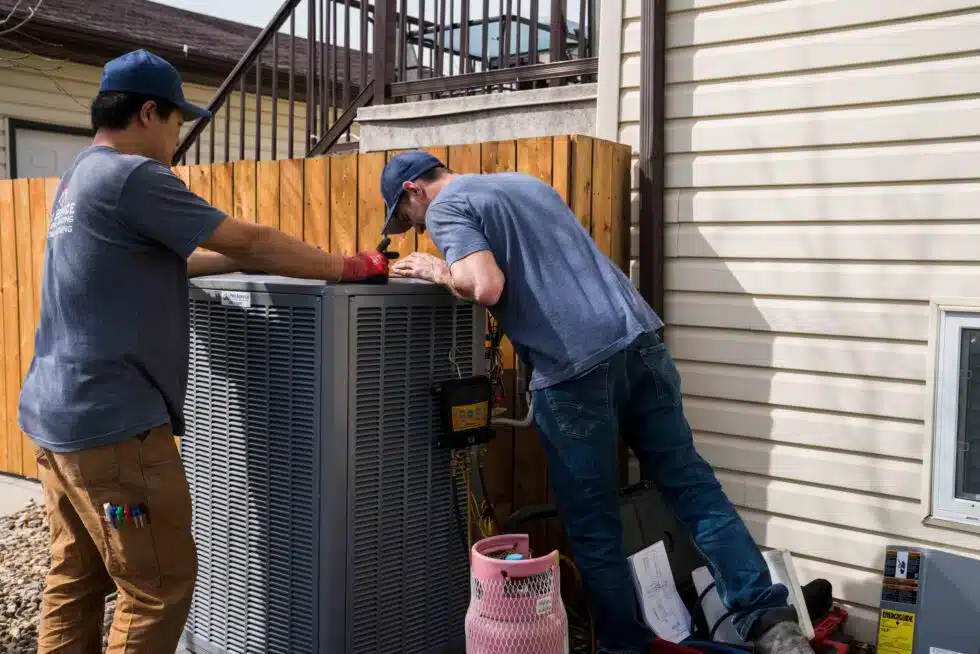
When your air conditioning system fails, you face a decision: invest in repairs to extend its service life, or replace the entire system and start fresh with modern efficiency and a full warranty. Pro Service Mechanical provides both options with transparent pricing and honest guidance, because we’d rather earn your trust for future business than pressure you into an unnecessary replacement.
Age-based decision framework: Systems under 10 years old should almost always be repaired unless they’ve suffered catastrophic damage from electrical surge, hail, or flooding. The initial purchase price is still being amortized, manufacturer parts are readily available, and the technology isn’t outdated enough to justify replacement for efficiency gains alone. Systems between 10 and 14 years fall into the evaluation zone where you apply the 50% Rule described earlier: multiply system age by repair cost, and if the product exceeds $5,000, request replacement quotes alongside repair estimates. Systems 15 years or older trigger the replacement conversation even for moderate repairs, because you’re investing significant money into aging infrastructure that will require additional repairs soon and operates at obsolete efficiency levels compared to modern equipment.
Refrigerant type considerations: Air conditioners installed before 2010 used R-22 refrigerant, which was phased out of production in 2020 under international environmental agreements. Remaining R-22 inventory now costs $180–$300 per pound and becomes scarcer every year, making any significant refrigerant leak on an R-22 system economically unviable to repair. If your 15-year-old air conditioner using R-22 has a leak requiring 4 pounds of refrigerant at $250 per pound plus leak repair costs, you’re looking at $1,200–$1,800 to restore a system that might develop another leak next summer and has no long-term refrigerant availability. Replacement makes clear financial sense.
Compressor failure analysis: Compressor replacement represents the most expensive single-component repair on any air conditioning system, typically costing $1,800–$3,200 installed. You’re placing a $1,200 compressor into a 10–15 year old condenser cabinet with an aging fan motor, deteriorating wiring, a condenser coil that’s lost efficiency from years of minor fin damage, and an evaporator coil inside that’s the same age as the failed compressor. Unless the system is under 8 years old, compressor failure almost always tips the economics toward full replacement.
Efficiency gap calculation: A 13 SEER air conditioner from 2008 consumes roughly 40% more electricity than a modern 16 SEER model to deliver the same cooling output. For a typical Saskatoon home running 800–1,200 hours of air conditioning between late May and mid-September, that efficiency gap translates to $120–$220 in excess SaskPower costs every single summer. Over the 12–15 year expected service life of a new system, you’ll spend $1,400–$3,300 in unnecessary electrical costs by keeping the old inefficient unit running. When repair costs on an old system approach $800–$1,200, replacement with a high-efficiency model pays for itself through operating cost savings within 5–7 years.
Matched heating system timing: If your natural gas furnace is the same vintage as your failing air conditioner and approaching the 18–22 year replacement window, installing a matched HVAC system (furnace plus air conditioner) as a single project saves 15–20% compared to two separate installations. The labour overlap is significant: refrigerant line installation, condensate drain routing, electrical work, thermostat upgrades, and ductwork modifications happen once instead of twice.
Saskatchewan’s shorter cooling season context: Our 3.5-month air conditioning season from late May through mid-September means payback calculations on efficiency upgrades work out slower than in longer-season climates like southern Ontario or British Columbia’s interior. A homeowner in Ottawa runs their air conditioner 1,800 hours per season; the same efficiency upgrade delivers faster financial return. This doesn’t change the repair-versus-replace decision framework significantly, but it does mean we prioritize repair on mid-life systems (8–12 years) more readily than contractors in longer-season markets might recommend.
We’ll give you the honest answer. If repair makes sense for your situation and budget, we repair it correctly with quality parts and proper commissioning. If replacement delivers better long-term value given your system’s age, condition, and repair history, we’ll quote both options with transparent pricing, explain the tradeoffs, and let you decide without pressure or manipulation.
Every HVAC contractor in Saskatoon advertises “24/7 emergency service,” but the reality of what that means varies dramatically. Pro Service Mechanical answers our emergency line 306-230-2442 with real people located in Saskatoon, not voicemail systems or out-of-province call centres, and we dispatch TSASK-certified technicians around the clock. Here’s what same-day and emergency service actually looks like in practice.
Normal operating conditions: During typical weather when outdoor temperatures range between 20–28°C and system failures occur at manageable rates, we dispatch emergency AC repair service within 1–2 hours to addresses anywhere within Saskatoon city limits. Our on-call technician receives the service ticket, phones you 30 minutes before arrival, and arrives with diagnostic equipment and the most common repair parts already stocked in the truck.
Peak demand during heat waves: When Saskatoon hits 32°C or higher, typically 3–6 days each summer during late June, July, or early August, air conditioning failures surge citywide as aging systems struggle under maximum load. Capacitors fail from heat stress, compressors overheat and trip on high-pressure faults, and electrical components pushed to their amperage limits burn out. During these extreme heat events, response times extend to 4–8 hours as we work through the service queue. We prioritize calls involving vulnerable households: homes with infants, elderly residents, anyone with medical equipment that requires climate control, or occupants with respiratory conditions aggravated by heat. A healthy family tolerating 28°C while waiting for service ranks lower than a senior with COPD struggling in a house approaching 32°C.
After-hours surcharge structure: Emergency service outside regular business hours (Monday through Friday, 8:00 AM to 5:00 PM) carries an additional surcharge of $95–$180 on top of standard diagnostic fees and repair pricing. This premium applies to weekend service calls, statutory holiday failures, and overnight emergencies. The surcharge compensates the on-call technician who maintains availability 24/7, covers the additional administrative costs of emergency dispatch, and funds the parts inventory and truck preparation necessary to resolve most failures on the first visit even at 2:00 AM on a Sunday.
What qualifies as genuine emergency service: No cooling capacity in a home with vulnerable residents, indoor temperature climbing above 28°C during an Environment Canada heat warning, electrical burning smell from any HVAC component, sweet chemical odour indicating refrigerant leak, visible smoke from the air handler or condenser, water damage occurring in real-time from condensate system failure, or a breaker that trips repeatedly when the system attempts to start. These situations justify the after-hours premium and immediate dispatch.
What does not require emergency rates: Slightly warm air if the home is still maintaining 25–26°C, weak airflow that’s annoying but not causing heat buildup, elevated energy bills noticed when reviewing your SaskPower statement, minor water staining discovered around the furnace but not actively leaking, or unusual noises that aren’t accompanied by smoke, burning smell, or complete failure. All these situations warrant professional service, but they can wait for next-day standard-rate appointments and save you $95–$180 in unnecessary after-hours premiums.
When you call 306-230-2442 after business hours, a dispatcher answers the phone (not a voicemail system asking you to leave a message). They’ll ask diagnostic questions to assess urgency, provide a realistic arrival timeframe based on current call volume, and in many cases walk you through a 2-minute troubleshooting sequence that might resolve the issue without requiring a truck roll. Checking thermostat batteries, verifying the furnace filter isn’t completely clogged, resetting a tripped condensate float switch, and confirming the outdoor disconnect hasn’t been accidentally switched off resolve roughly 15% of after-hours calls without any service charge.
Related services: We also handle AC installation services for homeowners whose systems are beyond economical repair, full air conditioning service across Saskatoon, urgent emergency AC repair when your system fails on the hottest day of the year, and matched heating systems for year-round comfort. Pro Service Mechanical has been serving Saskatoon for decades, submit a Request for Service or read about the best time to service your AC to avoid emergency calls.
When your air conditioning stops working during a Saskatchewan heat wave, you need a repair company that answers the phone with real people, dispatches TSASK-certified technicians who arrive when promised, stocks the parts that fail most often in our extreme climate, and provides transparent written estimates before installing a single component. Pro Service Mechanical has repaired air conditioning systems in every corner of Saskatoon, from established West Side neighbourhoods and newer West communities to Central and East heritage areas, rapidly expanding South subdivisions, and North and East developments. We serve more than 40 Saskatoon neighbourhoods with the same commitment: same-day diagnostic dispatch under normal conditions (1–2 hours typical, 4–8 hours during citywide heat events), first-visit repair on roughly 80% of service calls because our trucks stock capacitors, contactors, blower motors, condensate pumps, and refrigerant for both modern R-410A and legacy R-22 systems, and honest guidance about when a repair makes financial sense versus when replacement delivers better long-term value.
Our diagnostic fees run $75–$200 depending on system complexity and apply in full toward any approved repair work, meaning you’re never paying twice for the same visit. Common repairs like capacitor replacement cost $180–$280, contactor replacement runs $190–$310, and condensate system service ranges $225–$350. Major component replacements like evaporator coils ($1,400–$2,600) or compressors ($1,800–$3,200) trigger the repair-versus-replacement conversation where we present both options with transparent pricing, explain efficiency gaps and expected service life, and let you decide without pressure. Every repair includes post-work commissioning with measured refrigerant pressures, verified airflow, confirmed delta-T across the evaporator coil, and a full 20-minute test cycle before our technician leaves your property.
Call 306-230-2442 right now for same-day AC repair dispatch, or submit a service request online and we’ll contact you within two hours during business days to schedule your diagnostic appointment. Our emergency line is answered 24/7 by real people in Saskatoon who understand this climate, know this city, and will get your cooling system running again before the next heat wave arrives.
Pro Service Mechanical offers 24/7 emergency AC repair services in Saskatoon, ensuring residents stay cool even during extreme temperatures.
Any situation where the AC stops working during extreme heat, makes unusual noises, or leaks water can be considered an emergency requiring prompt repair.
During normal operating conditions, we dispatch TSASK-certified technicians within 1–2 hours of your call to any address within Saskatoon city limits. During extreme heat events when outdoor temperatures exceed 32°C and citywide demand surges, response times extend to 4–8 hours as we prioritize vulnerable households with medical needs, infants, elderly residents, or health conditions aggravated by heat. Our emergency line 306-230-2442 is answered 24/7 by real people in Saskatoon who can see the live dispatch schedule and provide honest arrival estimates, not voicemail systems or out-of-province call centres reading scripts. Weekend, holiday, and overnight emergency calls carry a surcharge of $95–$180 on top of standard diagnostic and repair rates to compensate the on-call technician maintaining availability around the clock.
In most cases, Pro Service Mechanical dispatches a technician within hours to address emergency AC issues in Saskatoon homes.
Yes, our technicians are skilled with all major brands, so Saskatoon residents can rely on Pro Service Mechanical regardless of the make or model.
No, operating a faulty AC can worsen damage or cause safety hazards. Turn it off and call a professional like Pro Service Mechanical immediately.
Homeowners should turn off the system to prevent further damage and clear access to the unit. Pro Service Mechanical technicians in Saskatoon will arrive promptly and assess the situation.
Yes, common issues include frozen coils, compressor failures, and refrigerant leaks. Pro Service Mechanical’s Saskatoon team handles all these efficiently.
Our team is trained for quick diagnostics, has fully stocked service vehicles, and responds 24/7. Pro Service Mechanical prioritizes emergency AC needs for Saskatoon homes.
Every technician we dispatch to your home carries current TSASK (Technical Safety Authority of Saskatchewan) certification for both refrigerant handling and gas work, along with Environment Canada ODP (Ozone Depletion Potential) certification required by federal law for anyone adding, removing, or handling refrigerant in sealed air conditioning and refrigeration systems. Refrigerant work without proper certification violates both provincial TSASK regulations and federal environmental law under the Canadian Environmental Protection Act, carrying penalties including fines up to $1 million and potential criminal charges for significant violations. TSASK gas certification matters because most AC repairs involve the indoor air handler or evaporator coil, which sit directly above or integrated with your natural gas furnace, and any work in that area requires knowledge of gas codes, combustion safety, and carbon monoxide risks.
All our technicians also pass criminal background checks, carry $5 million liability insurance covering property damage and injury, and are bonded against theft or damage to your property. You can request to see certification credentials when the technician arrives; legitimate HVAC professionals carry their tickets and are proud to show them.
Diagnostic fees range from $75 for a straightforward visual inspection and capacitor test to $200 for comprehensive refrigerant leak searches with nitrogen pressure testing and electronic detection, and that fee applies in full toward any approved repair work.
The most common repairs include capacitor replacement at $180–$280, contactor replacement at $190–$310, condensate pump or drain clearing at $225–$350, blower motor replacement at $450–$900 depending on type, and refrigerant leak diagnosis plus a 2-pound R-410A top-up at $280–$550 with leak repair quoted separately. Major component replacements like evaporator coils run $1,400–$2,600 and compressor replacement costs $1,800–$3,200, both of which typically trigger the repair-versus-replacement conversation on systems older than 10 years. Every estimate is provided in writing with parts and labour itemized separately, all applicable taxes included, and warranty terms clearly stated before any work begins.
The diagnostic fee of $75–$200 depending on system complexity covers a comprehensive evaluation of your entire cooling system and applies in full toward any approved repair work. Every diagnostic includes a visual safety inspection of the electrical panel for proper breaker sizing and overheating signs, refrigerant line inspection for visible damage or oil staining that indicates leaks, thermostat verification for power and proper wiring, furnace filter assessment, and outdoor condenser coil inspection for hail damage or debris blockage.
The technician then performs systematic testing with manifold gauges measuring refrigerant pressures on both high and low sides, clamp meters measuring amp draw on the compressor, condenser fan motor, and blower motor compared to nameplate specifications, multimeter testing of capacitor microfarad ratings and electrical voltages, and infrared temperature measurement of supply air delta-T across the evaporator coil. You receive a written diagnostic report documenting all findings, itemized repair estimates with parts and labour separated, warranty terms, and honest guidance about whether repair makes financial sense versus replacement given your system’s age and condition.
The only scenario where the diagnostic fee doesn’t apply toward repair is if you decline all recommended work, at which point you pay only the diagnostic fee and receive the written findings to use for second opinions or future reference.
For approved repairs exceeding $1,500, we offer financing through our partner lender with approved credit, allowing you to spread major repair costs like evaporator coil replacement, compressor installation, or combined electrical and refrigerant system work across 12–36 month payment plans rather than requiring full payment at the time of service. Financing availability, interest rates, and term lengths depend on credit approval and the total financed amount.
Ask our dispatcher about financing options when you call 306-230-2442 to schedule your diagnostic appointment, or inquire when the technician presents your written repair estimate on-site. For repairs under $1,500, we accept cash, cheque, Interac debit, and all major credit cards, with payment due upon completion of work and verification that your system is cooling properly. The diagnostic fee of $75–$200 is due at the time of service and applies in full toward any approved repair work completed the same day.
While emergency services have standard rates, we provide upfront pricing and no hidden fees, ensuring Saskatoon homeowners know what to expect before we start.
Regular maintenance, filter changes, and early inspections can prevent many breakdowns. Pro Service Mechanical offers routine checkups to avoid costly emergencies.
Homeowners can and should perform basic maintenance like replacing furnace filters monthly during cooling season, rinsing debris off the outdoor condenser coil with a garden hose at moderate pressure, clearing vegetation and obstructions from around the outdoor unit, and ensuring supply registers throughout the home remain open and unblocked. Beyond that, air conditioning repair requires specialized tools, refrigerant handling certification, and electrical knowledge that make DIY work dangerous and often illegal. Capacitors store lethal voltage even when system power is off and can cause fatal electrical shock if discharged improperly. Any repair involving refrigerant requires Environment Canada ODP (Ozone Depletion Potential) certification; adding, removing, or handling refrigerant without certification violates federal environmental regulations and carries significant fines.
Misdiagnosed repairs waste money on incorrect parts, and improper installation can destroy expensive components like compressors or create safety hazards including refrigerant leaks, electrical fires, and carbon monoxide risks when working near gas furnaces. Our diagnostic fee of $75–$200 applies in full toward approved repair work, meaning you’re paying for expert diagnosis that identifies the actual problem the first time, not guesswork that might require multiple service calls.
Our TSASK-certified technicians repair all major residential air conditioning brands commonly installed in Saskatoon homes, including Lennox, Carrier, Bryant, Trane, Goodman, Rheem, Amana, York, Coleman, and Payne, as well as builder-grade systems and discontinued brands no longer in production. We stock universal replacement parts that work across multiple manufacturers for the most common failure points: dual-run capacitors in all standard microfarad ratings, universal contactors in 20–40 amp configurations, ECM blower motor modules compatible with most high-efficiency furnaces, universal condensate pumps, and refrigerant in both R-410A (standard since 2010) and limited R-22 inventory for older systems.
For brand-specific components like proprietary control boards, OEM compressors with unique mounting configurations, or specialized TXV metering devices, we order next-day delivery from our local HVAC suppliers and return within 24–48 hours to complete the installation. Age matters more than brand; we can repair a 25-year-old discontinued system if parts are available through aftermarket suppliers, but we’ll also tell you honestly when parts scarcity, obsolete efficiency, or cumulative repair costs make replacement the smarter financial decision.
Ice buildup on the copper refrigerant lines or evaporator coil during warm weather signals either critically low refrigerant from a leak or severely restricted airflow across the indoor coil, both of which cause the remaining refrigerant to over-expand and drop below freezing temperatures. Restricted airflow typically stems from a severely clogged furnace filter (check this first before calling for service), closed or blocked supply registers in multiple rooms, collapsed ductwork, or a failed blower motor moving air weakly. Low refrigerant indicates a leak somewhere in the sealed system, most commonly at brazed joints on the outdoor line set, pinhole corrosion on the evaporator coil, or leaking service port valve cores.
Immediate action: shut the air conditioning off at the thermostat but leave the fan setting on “ON” to run the blower continuously, which circulates room-temperature air across the frozen coil and typically thaws it completely within 2–3 hours. Once thawed, call 306-230-2442 for professional diagnostic service to identify the root cause and prevent recurrence.
It depends on the specific repair cost and the system’s overall condition, but Saskatchewan’s extreme 70°C annual temperature swing from -35°C winters to +35°C summers accelerates equipment aging faster than manufacturer laboratory testing anticipates. Apply the 50% Rule: multiply your system’s age by the repair cost, and if that product exceeds $5,000, replacement typically delivers better lifetime value than repair.
A 13-year-old air conditioner needing a $400 blower motor equals $5,200, placing it in borderline territory where you should request both repair and replacement quotes; that same $400 repair on an 8-year-old system equals $3,200, making repair the clear choice. Systems using legacy R-22 refrigerant, phased out of production in 2020, face additional challenges because remaining R-22 inventory now costs $180–$300 per pound and becomes scarcer every year, making any significant refrigerant leak economically unviable to repair. We’ll provide transparent pricing for both options, explain the tradeoffs including efficiency gaps and expected service life remaining, and let you decide without pressure or manipulation.
A mild musty, earthy, or mildew-like odour from supply vents, especially noticeable when the system first kicks on after sitting idle, indicates mould or mildew growth on the evaporator coil or in the condensate drain pan.
Saskatchewan’s wet springs create perfect conditions for this: the evaporator coil stays damp from condensation for weeks during shoulder seasons when cooling demand is intermittent, humidity remains elevated, and without proper drainage or UV treatment, organic growth takes hold on the wet aluminum fins. A clogged condensate drain line that allows water to pool in the drain pan rather than flowing away provides a stagnant breeding ground for bacteria and mould. Less commonly, musty odours trace to ductwork contamination, especially in older homes with decades of accumulated dust and organic material in sheet metal runs, or to dead rodents or birds in ductwork or the outdoor condenser cabinet.
Professional evaporator coil cleaning with antimicrobial treatment costs $280–$450 and involves accessing the coil, applying coil-specific cleaning solution, rinsing thoroughly, treating with EPA-registered mould inhibitor, and verifying proper condensate drainage. If odours persist after coil cleaning, duct inspection and possible cleaning or sealing may be necessary, which falls under indoor air quality services rather than standard AC repair.