
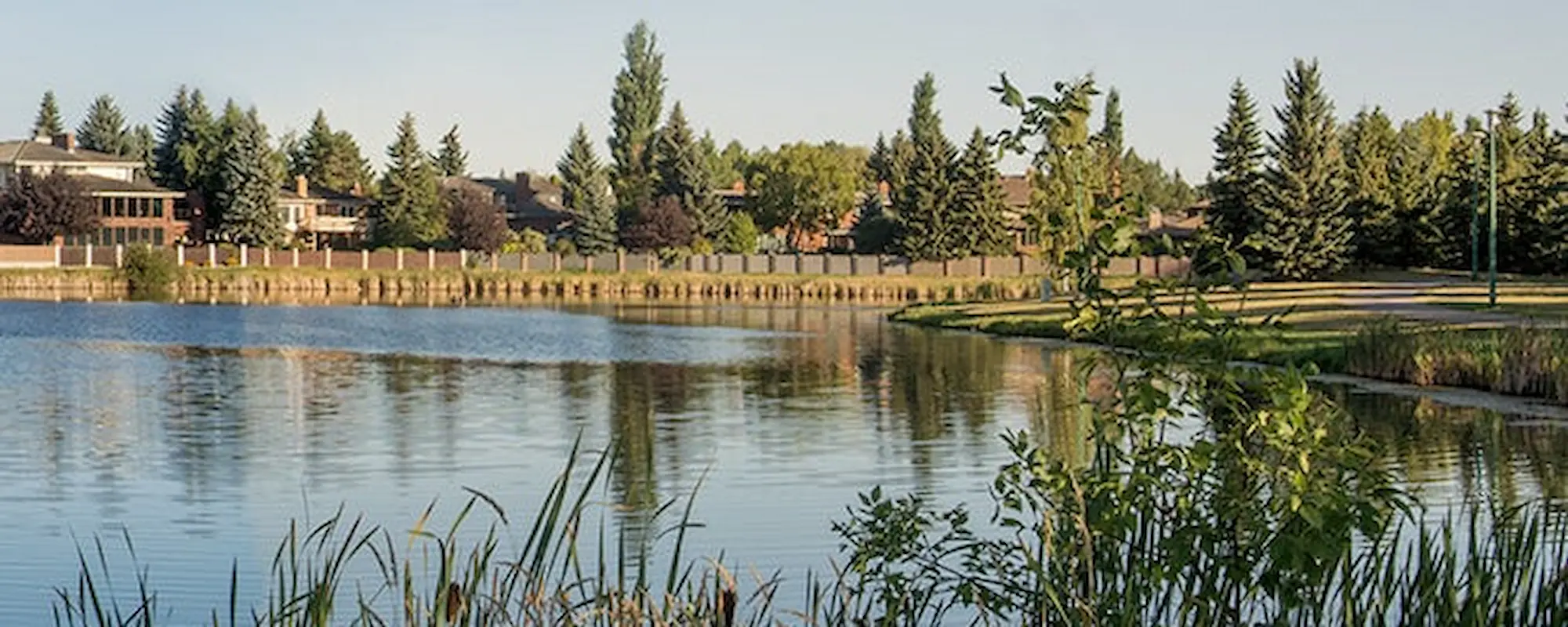
When the temperature climbs past +30°C along Wanuskewin Road and your central air conditioner stops cooling, the difference between a comfortable afternoon and a miserable one comes down to how fast you can get a licensed technician to your door. Silverwood Heights homeowners know this feeling well. Developed primarily between 1981 and 1985, the neighbourhood’s single-family homes are now home to AC systems that are pushing 40 years old, well past the standard 10-to-15-year service lifespan for central cooling equipment. That age gap matters enormously when summer heat waves hit the South Saskatchewan River corridor.
Near Silverwood Road, where Sister O’Brien School sits and families gather at WJL Harvey Park on warm evenings, the last thing anyone wants is a dead air conditioner. The river-edge location that makes Silverwood Heights so appealing in spring and fall also brings its own humidity fluctuations in summer, which puts extra strain on ageing evaporator coils and refrigerant lines. Whether your system is producing warm air, cycling on and off every few minutes, or making a grinding noise from the outdoor unit, the repair call you make today will determine whether you sleep comfortably tonight. Pro Service Mechanical provides dedicated AC repair services across Silverwood Heights, with same-day diagnostics available throughout the summer season.
What Your Silverwood Heights Air Conditioner Is Telling You Before It Quits
The warning signs of AC failure in a 1980s-era Saskatoon home tend to be gradual at first, then sudden. The most common early indicator is warm or lukewarm air coming through supply registers even when the thermostat is set well below room temperature. In Silverwood Heights homes of this era, that symptom almost always points to either a failing capacitor, low refrigerant from a slow leak, or a compressor beginning to struggle under load. Catching it early, before the compressor fails completely, is the difference between a $300 repair and a $2,500 one.
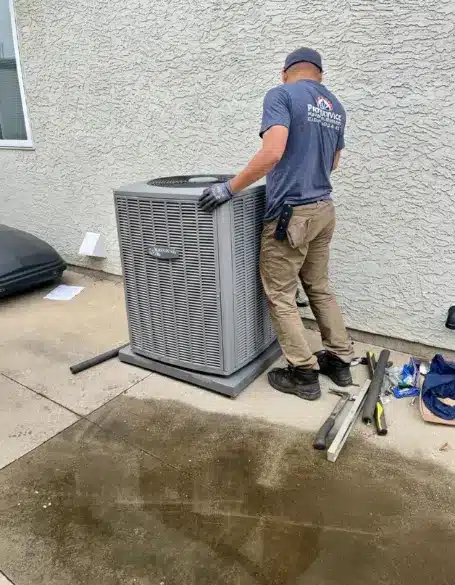
Weak airflow through the vents is another signal that deserves immediate attention. In homes built in the early 1980s, blower motors and fan assemblies have been running for four decades, often without a full inspection. Bearings wear out, capacitors weaken, and airflow drops gradually enough that many homeowners assume it is normal. It is not. Reduced airflow forces the entire system to work harder, overheating the compressor and accelerating wear on components that are already near the end of their designed lifespan.
Ice forming on the evaporator coil or on refrigerant lines near the indoor air handler is a clear distress signal. It typically indicates that refrigerant has leaked to the point where coil temperature drops below freezing. On a system originally charged with R-22, this scenario carries a higher repair cost today than it would have five years ago, because R-22 was phased out in Canada in 2020. If you see ice on your lines, shut the system off and call for service. Running a frozen system can damage the compressor within hours.
Unusual sounds from the outdoor condenser unit, including rattling, grinding, or a high-pitched squealing, are classic signs that a fan motor or contactor is failing. In Silverwood Heights homes where the outdoor unit has been through 35 to 40 Saskatoon winters, the freeze-thaw stress on electrical contacts and motor windings is cumulative. A system that buzzes when it tries to start but does not run has almost certainly lost its run or start capacitor, which is one of the most affordable repairs in the industry if caught before the motor burns out trying to compensate.
When 1980s Compressors Fail: AC Repair Patterns in Silverwood Heights Homes
Silverwood Heights sits in a well-defined repair cohort. Seventy-one percent of homes here were built between 1981 and 1990, with another 24 percent dating from 1961 to 1980, and only three percent constructed in the 1991-to-2000 window. That means the overwhelming majority of AC systems in this neighbourhood are operating far beyond their engineered lifespan. Understanding which components fail first in this era of equipment helps homeowners make smarter, faster repair decisions when something goes wrong.
Capacitors are the most frequently replaced component in older AC systems across Silverwood Heights. These small cylindrical devices provide the electrical boost that starts and runs the compressor and fan motors. They degrade with age and heat cycling, and in a 40-year-old system they have endured thousands of start-stop cycles through Saskatoon’s extreme seasonal swings. A failed capacitor typically costs between $150 and $350 to diagnose and replace, including labour, and the repair takes less than an hour. This is the classic scenario where a fast repair call saves a homeowner from a much larger bill, because a motor that struggles to start against a dead capacitor will eventually burn itself out.
Refrigerant leaks are the second most common issue in this era’s systems. On the 1981-to-1990 cohort in Silverwood Heights, the original refrigerant is almost certainly R-22, which was phased out of production and import in Canada as of January 1, 2020. Repair technicians can still legally use reclaimed R-22 to top up an existing system, but supply is limited and expensive. Whereas recharging an R-410A system might run $300 to $800, an R-22 recharge for the same leak can cost $500 to $1,500 or more depending on how much refrigerant was lost and whether the leak source can be sealed. If your system requires its second or third R-22 recharge, a frank repair-versus-replace conversation is warranted.
Fan motors and compressors represent the higher-cost end of the repair spectrum. Fan motor replacement in an outdoor condenser unit typically runs $400 to $700 parts and labour. Compressor replacement on a system of this age is considerably more involved, often ranging from $1,200 to $2,500, and at that price point the 50% rule (discussed in a later section) becomes relevant. Contactors, which are the electrical switches that open and close power to the compressor and fan, are a frequent failure point due to decades of corrosion in Saskatoon’s climate. Contactor replacement is a relatively affordable repair, generally $150 to $300, and a failed contactor can cause symptoms that mimic a compressor failure, which is exactly why accurate diagnostics matter before any parts are ordered.
Evaporator coils in 1980s Saskatoon homes are subject to a different kind of wear. Silverwood Heights homes sit near the South Saskatchewan River, and the seasonal humidity fluctuations along this corridor accelerate corrosion on copper coil surfaces. A pinhole leak in an evaporator coil is repairable in some cases, but coil replacement is a larger job, typically $600 to $1,200 for the part and labour, and a corroded coil may simply be a symptom of a system that is approaching the end of viable service life. A thorough diagnostic will distinguish a patchable coil leak from one that signals broader system deterioration.
How Pro Service Mechanical Diagnoses Your AC Repair in Silverwood Heights
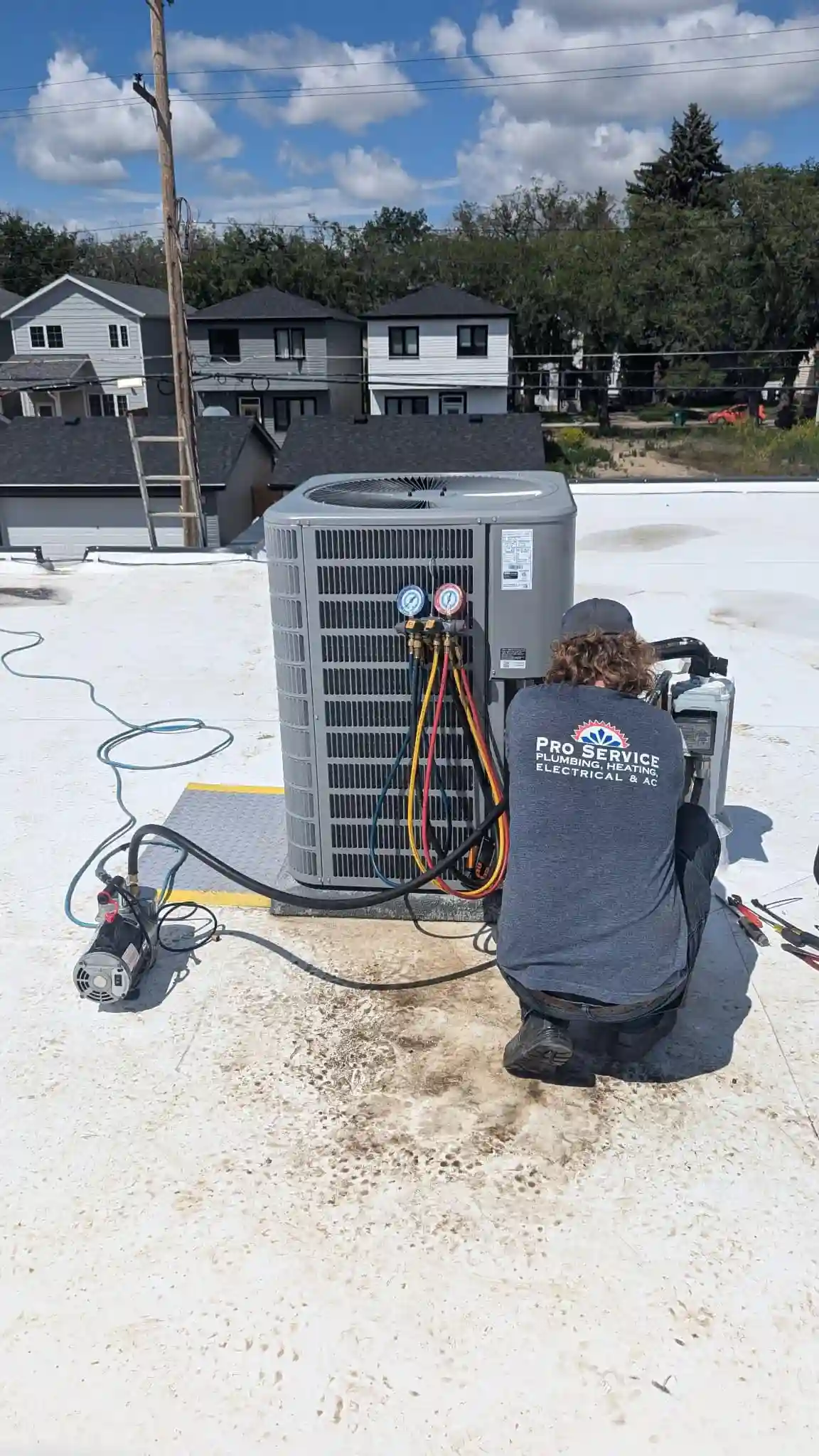
When a Pro Service Mechanical technician arrives at a Silverwood Heights home, the diagnostic process follows a structured sequence designed to identify the root cause before any parts are recommended. The first step is always a thermostat and electrical panel check, confirming that the system is actually receiving the call to cool and that no breakers have tripped. From there, the technician moves to the outdoor condenser unit to check capacitor readings with a multimeter, inspect the contactor for pitting or burn marks, verify refrigerant pressure on both the high and low sides, and listen to compressor operation under load. The indoor air handler is checked for airflow restriction, coil icing, and blower motor function. This full diagnostic typically takes 45 to 75 minutes and is priced transparently between $75 and $200, which is applied toward the repair cost if work proceeds the same day.
The value of this ordered process is that it catches cascading failures before they compound. In a 40-year-old Silverwood Heights system, a bad capacitor may have been stressing the compressor for weeks. A technician who skips straight to refrigerant pressure checks without testing the capacitor first can miss the real problem entirely. Pro Service Mechanical technicians carry the most commonly replaced components for 1980s-era systems on every service vehicle, including capacitors, contactors, and motor run capacitors, so that when a straightforward repair is identified, the fix happens the same day rather than waiting for a parts order. For guidance on keeping your system in shape between repair calls, the best time to service your air conditioner is early spring, before the first heat wave of the season.
A Silverwood Heights Repair Call That Saved a Working Compressor
Earlier this summer, Sandra K. on Silverwood Road called Pro Service Mechanical when her central air conditioner stopped producing cold air despite the thermostat showing a call for cooling. The outdoor condenser was running, the indoor fan was blowing, but the air coming through the registers was room temperature. A technician arrived the same afternoon and confirmed within 20 minutes that both the run capacitor and the contactor had failed simultaneously, a common combination in systems of this vintage. The compressor itself tested within normal operating parameters. Total repair cost was under $400. Sandra noted afterward that a competitor had quoted her a compressor replacement over the phone without even looking at the unit. The capacitor-and-contactor swap restored full cooling function and, based on the compressor’s current condition, should give the system several more serviceable summers before a replacement conversation becomes necessary.
This scenario plays out regularly in Silverwood Heights. Because the neighbourhood’s homes are so tightly clustered in a single construction era, the same failure patterns repeat across the same model years of equipment. A technician who diagnoses these systems regularly knows that capacitor failure is the first thing to rule out, not the last, and that an expensive repair quote delivered over the phone without a site visit tells you nothing useful about your actual system condition.
Why Silverwood Heights Homeowners Trust Pro Service Mechanical for Air Conditioner Repairs
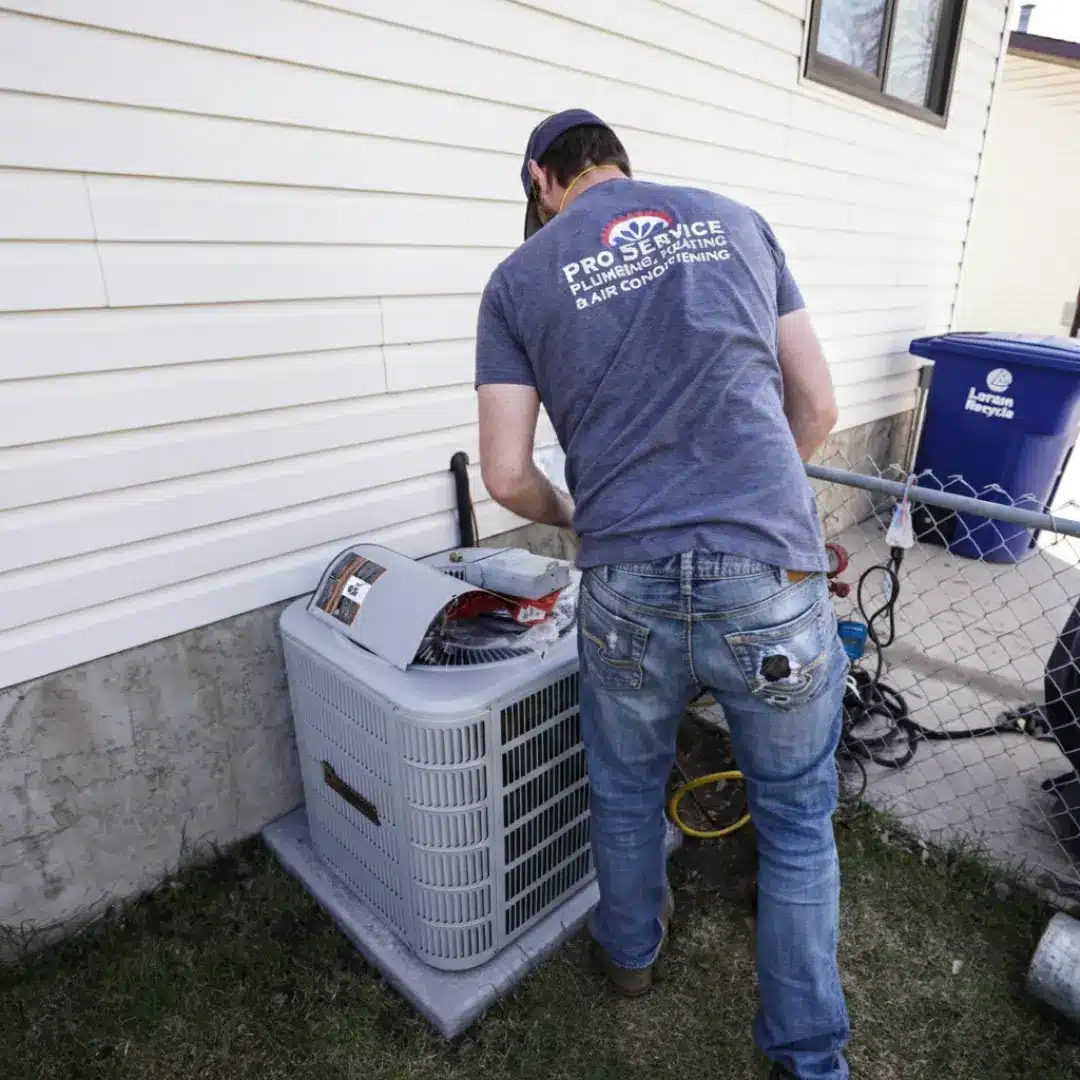
Licensing matters in refrigerant handling, and it matters more than most homeowners realise. Refrigerant work in Saskatchewan requires a certified refrigeration mechanic operating under TSASK oversight. Pro Service Mechanical technicians hold the required certifications for both R-22 reclaimed refrigerant handling and R-410A work, meaning your repair is done legally, safely, and with the documentation that protects your warranty and your liability as a homeowner. This is not a universal standard among the companies advertising HVAC service in Saskatoon.
Transparent diagnostic fees are a core part of how Pro Service Mechanical operates. The $75-to-$200 diagnostic range is disclosed before a technician arrives, and that fee is credited toward repair costs when work is approved the same visit. There are no hidden “trip fees” piled on top, and no parts are recommended without showing the homeowner the test results that justify them. For a Silverwood Heights homeowner sitting with a 40-year-old system on a 32-degree afternoon, knowing exactly what is wrong and what it costs to fix it is worth a great deal.
Parts availability is a practical differentiator in emergency summer repair. Pro Service Mechanical service vehicles are stocked with the components most commonly needed in 1980s-era Saskatoon systems. Capacitors, contactors, and common fan motor assemblies are on hand, which means the diagnostic appointment and the repair often happen in a single visit. Waiting three days for a parts order on a heat wave weekend is not a comfortable scenario for any Silverwood Heights family, and stocking for this era’s systems is a deliberate operational choice.
Response times during normal summer conditions run one to two hours from your call to a technician at your door. During heat waves, when demand across Saskatoon spikes simultaneously, Pro Service Mechanical prioritises households with vulnerable residents and manages the schedule transparently. For urgent situations, emergency AC repair is available around the clock, with a real person answering the line rather than a voicemail system. The phone number for same-day and after-hours calls is 306-230-2442.
The 50% Rule Applied to Silverwood Heights AC Systems
The 50% rule is the most practical framework for repair-versus-replace decisions, and it is directly relevant to the equipment age found across Silverwood Heights. The principle is simple: if the estimated repair cost exceeds 50% of the cost of a replacement system, replacement is generally the smarter investment. A related formula puts it in concrete terms: multiply the system’s age in years by the proposed repair cost. If the result exceeds $5,000, the economics favour replacement. A 40-year-old system facing a $150 compressor repair passes easily. The same 40-year-old system facing a $1,500 R-22 recharge with an unknown leak source does not.
For Silverwood Heights homes built in the 1981-to-1985 peak construction window, the honest reality is that most original AC systems are operating on borrowed time. This does not mean every repair call should end in a replacement recommendation. A capacitor swap on a system with a healthy compressor is a legitimate and cost-effective repair that may deliver two to five more years of reliable service. A compressor replacement on a system that also has a leaking evaporator coil and an R-22 charge is a different calculation entirely.
The 24-percent of Silverwood Heights homes built between 1961 and 1980 face a starker situation. These are systems approaching or past 45 to 65 years of age. The probability of additional failures within 12 to 24 months of any repair is high, and repeated R-22 recharges on a system with recurring leaks can add up to more than a replacement costs over two or three seasons. For homes in this cohort, the diagnostic appointment is still the correct starting point, but the conversation should include a realistic lifespan assessment alongside the repair quote.
Pro Service Mechanical will always present both options clearly. If a repair is viable and cost-effective, the recommendation will be to repair. If the math points clearly toward replacement, homeowners will hear that honestly before they spend money on a system that will not last another summer. For full information on AC installation services when replacement is the right call, that guidance is available separately. For everything about keeping your existing system running, explore our complete air conditioning resources. The goal of every diagnostic visit in Silverwood Heights is to give homeowners accurate, actionable information, not to upsell a system they do not yet need.
Same-Day Cooling Repair When Silverwood Heights Homes Go Hot
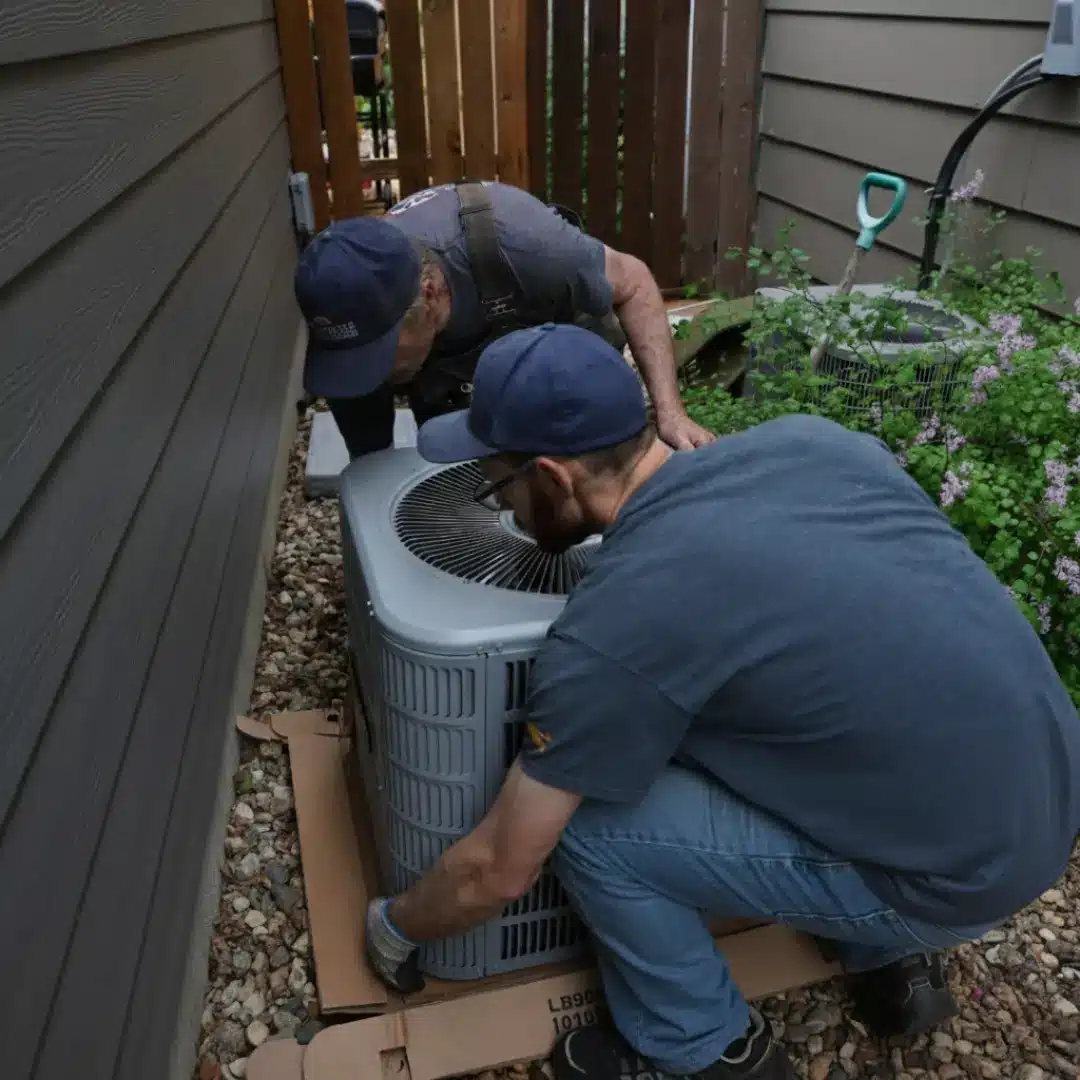
Saskatoon summer heat waves can push temperatures above +35°C, and when that happens, the entire city’s repair demand spikes within hours. Silverwood Heights, with its concentration of identically aged equipment all installed around the same period, tends to see clusters of failures during these events because the same thermal stress hits the same model-year components at the same time. Calling early in the day during a heat wave, rather than waiting to see if the system recovers on its own, dramatically improves the likelihood of same-day service. A system that is short-cycling at 10 AM is not going to fix itself by 4 PM; it is going to stop cooling entirely by noon.
For after-hours failures, the emergency line at Pro Service Mechanical is answered by a real person, not an automated system. Call 306-230-2442 to reach the dispatch team directly. Emergency response times during extreme heat events may extend beyond the standard one-to-two-hour window due to volume, but prioritisation is applied to households with elderly residents, infants, and individuals with medical vulnerabilities. If that describes your household, say so when you call. Our heating systems team is part of the same dispatch network, so the line you call for AC emergencies reaches the full service team.
Silverwood Heights sits close to several other established west-side and north Saskatoon neighbourhoods that Pro Service Mechanical also serves. If you are searching for repair service and want to compare response areas, neighbours in Erindale are covered under the same dispatch network. Wherever you are in the Silverwood Heights area, a Request for Service through our online form or a direct call to 306-230-2442 starts the repair process immediately. Pro Service Mechanical is committed to getting Silverwood Heights families back to comfortable as quickly as possible when the Saskatoon summer demands it.
Frequently Asked Questions About AC Repair in Silverwood Heights
How much does a typical AC repair cost for a 1980s-era system in Silverwood Heights?
Repair costs vary significantly by component. A capacitor replacement, the most common repair on Silverwood Heights systems of this vintage, typically runs $150 to $350 parts and labour. Contactor replacement falls in a similar range at $150 to $300. Fan motor repairs come in at $400 to $700, while refrigerant leak diagnosis and recharge on an R-22 system can run $500 to $1,500 depending on refrigerant quantity and whether the leak source is sealable. Compressor replacement is the highest-cost single repair, generally $1,200 to $2,500, at which point the 50% rule becomes an important part of the conversation. The diagnostic fee of $75 to $200 is credited toward the repair when work proceeds the same day, so you are not paying twice.
Is it worth repairing a 40-year-old AC system, or should I just replace it?
The answer depends entirely on which component has failed and the overall condition of the remaining system. A capacitor or contactor failure on a unit with a healthy compressor is almost always worth repairing; the fix is inexpensive and buys legitimate additional service life. A compressor failure or a recurring R-22 refrigerant leak on a 40-year-old system is a different calculation. Apply the formula: multiply the system’s age by the repair cost. If the result exceeds $5,000, replacement economics are typically more favourable. A 40-year-old system with a $1,500 refrigerant repair exceeds that threshold. Pro Service Mechanical will walk through the numbers with you after the diagnostic, so you can make an informed decision without pressure.
My Silverwood Heights home was built in 1983. Is my AC system definitely on R-22?
If the central AC system in your 1983 home has never been replaced, it almost certainly contains R-22 refrigerant, also known as Freon. R-22 was the standard refrigerant for residential central air conditioning through the 1990s and was phased out of production and import in Canada on January 1, 2020. Technicians can still legally use reclaimed R-22 inventory to service existing systems, but the supply is shrinking and the cost has risen substantially, anywhere from 50% to 100% higher than R-410A recharges. If your system needs more than one R-22 recharge in a two-to-three-year window, the leak is recurring and the cumulative cost of repeated recharges will likely exceed the cost of a replacement system. A certified technician can confirm your refrigerant type on the first service visit.
How quickly can Pro Service Mechanical respond to an AC emergency in Silverwood Heights during a heat wave?
Under normal summer conditions, response time from call to technician on-site runs one to two hours for most Silverwood Heights addresses. During an active Saskatoon heat wave, when demand across the city spikes simultaneously, that window can extend. Calling early in the day gives you the best chance at same-day service; a system showing warning signs at 9 AM should be called in immediately rather than monitored through the afternoon heat. The emergency line at 306-230-2442 is answered by a real person around the clock, not a voicemail system. Households with elderly residents, infants, or medically vulnerable individuals are prioritised in dispatch during extreme heat events, so mention that context when you call.
What is the most common AC failure in early-1980s Silverwood Heights homes, and what does it sound like?
Capacitor failure is the single most common repair on the equipment vintage found throughout Silverwood Heights. The most characteristic symptom is a system that hums or buzzes from the outdoor condenser unit but does not start, or one that starts and then shuts down after a few seconds. You may also notice the fan blades turning very slowly before stopping, a sign that the motor is not receiving the startup boost it needs. Capacitors degrade with age and repeated thermal cycling, and on a system that has been through 35 to 40 Saskatoon winters and summers, it is not unusual for both the run capacitor and the start capacitor to fail within the same season. The repair is quick and affordable when caught early, but a motor that has been struggling against a dead capacitor for weeks can sustain winding damage that turns a $300 repair into a $600 one.